Author

admin

Browsing

Silver price remained on edge on Thursday morning as investors reacted to the latest Federal Reserve interest rate decision. XAG was trading at $53.97, where it has been stuck at in the past few days. This price was about 24% below its highest level in September this year. It has formed a bearish flag pattern, pointing to more downside in the near term. 

Silver, a top industrial and precious metal, moved sideways after the Federal Reserve delivered its interest rate decision. It left interest rates unchanged between 3.75% and 4%, with two officials voting to hike them by 0.25%.

In his press conference, Kevin Warsh said that inflation rate remained too high, citing the recent data showing that the headline and core consumer price index (CPI) rose 3.7% and 2.6% in September, moving further away from the bank’s target of 2.0%.

Most analysts, including those from Goldman Sachs, now believe that the Fed will hike interest rates in the December meeting. The view is that inflation will continue rising in the foreseeable future, with gasoline and diesel prices continuing their upward trend. 

Silver often underperforms the market when the Fed has embraced a highly hawkish tone because of its impact on the bond market. US bond yields rose, with the ten-year rising to 5% and the five-year moving to 4.8%. Investors tend to rotate from silver to yielding bonds. 

Higher interest rates also affect the economy by raising the cost of borrowing. In some cases, this usually impacts the industrial sector, where silver is widely used in the manufacturing of chips, solar panels, and kitchen appliances. 

The next important catalyst for silver will be the upcoming macro data from the United States. For example, the Bureau of Economic Analysis (BEA) will release the latest personal consumption expenditure (PCE) data later today. This is an important number since it is the Federal Reserve’s favorite inflation gauge. 

The US will also publish the latest GDP numbers. Economists expect the report to show that the economy expanded by 3.2% in the third quarter after growing by 2% in Q2. This growth rate is being driven by the data center buildup. 

On the positive side, the iShares Silver ETF SLV has continued to add assets this year, a sign that investors expect it to bounce back. Its three-month inflows rose to over $960 million.

Silver chart | Source: TradingView

Technicals suggest that silver is on the cusp of a strong bearish breakout. It has formed an inverted cup-and-handle pattern, which is a common continuation sign. In this, it has already moved below the cup’s lower side of $54. 

Silver has also formed a bearish flag pattern, which is made up of a vertical line and a horizontal channel. It remains below the 50-day and 100-day moving averages and the Supertrend indicator. 

Therefore, the most likely scenario is where it breaks lower as investors target the key support level of $50. On the other hand, a move above the resistance level of $54 will invalidate the bearish outlook.

A plan to produce more natural gas means more than drilling a few extra wells. Producers need equipment to build sites, move materials, and keep operations running. They also need people who can repair that equipment when an expensive piece of machinery stops working.

That creates an interesting way to invest in an energy expansion. You can own the supplier serving several projects, instead of choosing a single producer and depending entirely on the price it gets for gas.

B.C. premier-elect Lorne Doerkson pledged to double the province’s natural gas production by 2032. It’s a political ambition that still needs investment and execution, but brings renewed attention to businesses capable of supplying the work. One Vancouver-headquartered equipment dealer already has plenty to do.

Source: Getty Images

More than machinery

Finning International (TSX: FTT) sells Caterpillar equipment and supports it with parts, maintenance, and related services. Its customers work across industries including construction, mining, and energy. That mix gives it several possible sources of demand, with operations beyond Western Canada as well.

Selling a new machine is valuable. Helping the customer keep using it can be valuable for much longer. As more equipment enters service, there are more machines needing replacement parts and repairs. The customer has an incentive to keep an essential asset working instead of losing production while shopping around.

That’s the part of Finning I find particularly appealing. A larger equipment fleet can create future business after the original order has been delivered. It gives the company a continuing relationship with the people buying the machinery.

Think of a contractor with a full schedule and a broken machine. Getting it working again helps keep the whole job moving, so knowledgeable service has real value. Finning doesn’t need to win another brand-new equipment sale every time that customer needs help. Years of use can bring repeat visits, parts purchases, and eventually another replacement machine.

Work is waiting

Finning reported earnings of $1.22 a share in the second quarter, up 21% year over year. Its equipment backlog was a record $3.8 billion at June 30. Backlog means equipment customers have ordered for future delivery, giving the company a useful view of business still to come.

Those results also show why the opportunity doesn’t have to depend entirely on a new government’s plans. The order book already reflects customer demand. Any additional gas investment would arrive alongside a business that has been growing through its existing markets.

Canadian product-support revenue grew 19% in the quarter. More repair and parts business can help Finning earn from machinery already working in the field, while new-equipment sales remain tied more closely to customers’ investment budgets.

A fair price

Shares recently closed at $97.50, while Finning earned $2.24 per share on an adjusted basis during the first half. Doubling that six-month amount gives a simple annual earnings pace of $4.48, putting the shares at roughly 22 times that pace.

That price already reflects a business investors like. I’d start gradually, with the intention of holding through more than one resource cycle. The appeal is a combination of equipment demand and service income, with energy expansion offering an additional path for growth.

Customers can delay purchases when commodity prices weaken, and a large order book still needs to become delivered equipment and collected cash. Currency movements also affect overseas operations. These are manageable reasons to diversify a Canadian stock portfolio, especially if you already own several resource producers.

Bottom line

I like Finning as a way to participate in more construction and energy activity while owning a business that keeps serving customers afterwards. Its place in a long-term dividend strategy comes from those earnings and relationships. If B.C.’s expansion turns into real projects, Finning has a practical way to earn from the work, one machine and one service visit at a time.

“That little synthesizer had a function that allowed you to make your own sounds, and I became completely captivated by the possibilities,” he says.

Synthesizers were taking a more prominent place in pop music during the 1980s, adding to his fascination with the technology.

As he advanced through school, Smaragdis wanted to study music made with synthesizers. But this was not an educational path offered by the more traditional European conservatories at the time.

Instead, he enrolled at Berklee College of Music in Boston, into a program where he could explore the use of computers and synthesizers to shape and manipulate sound.

“With computers and synthesizers, I could make new sounds that have never been heard before,” he says.

At the same time, Smaragdis became immersed in jazz fusion. He declared bass as his major at Berklee since it would allow him more opportunities to play with jazz ensembles.

“I found the bass to be sonically more interesting than the guitar. It was a more unexplored domain, and I’ve always gravitated toward unexplored domains,” he says.

That interest in the unexplored carried over into his coursework. He and mentor Richard Boulanger, a professor of electronic production and design, created new tools to help people use computers to write, produce, and enhance music. 

Through his studies at Berklee, Smaragdis embarked on a collaborative project with Professor Barry Vercoe (who passed away in 2025) at the MIT Media Lab to create software synthesizers for music creation. Building on that project, Smaragdis pursued graduate studies in Vercoe’s group, where he completed his master’s degree and PhD, followed by a postdoc.

“In the Media Lab, I got exposed more to the computer part of computer music. That’s where my attention shifted a bit. Now I really wanted to make computers that could understand sound,” he says.

Tuning in to unexplored domains

At that time, many students in the Media Lab were using signal processing techniques to help machines handle sound. Smaragdis chose a less explored approach — machine learning — to separate himself from the pack.

He found that training machine-learning models to understand sound offered advantages that couldn’t be attained with traditional signal processing techniques.

“Over time, it became really clear to me that we need to teach computers how to listen. We can’t just tell them how to listen. If anything, we don’t even know how we humans listen,” he says. “We don’t have a vocabulary to explain what it means to listen, or how to tell the difference between a cat’s meow and the sound of a violin.”

After finishing his postdoc, Smaragdis began a career at Mitsubishi Electric Research Labs, where he worked on artificial intelligence systems that could scan video soundtracks and understand what is happening on screen. 

“What if you record an entire soccer game, but you only want to watch the highlights? In computer vision, it is very difficult to identify what a highlight is. But on the other hand, if you only listen to the sounds, then when the crowd goes crazy you would know that something interesting is happening,” he says.

That system was eventually incorporated into electronic devices, including a personal video recording system Mitsubishi was developing at the time, and into traffic monitoring systems and cell phones.

Smaragdis later joined Adobe, where he created the audio research team that built user-friendly tools to help artists, musicians, and producers manipulate sound without needing a lot of expertise.

“As we did that work, I kept coming up with deeper technical problems that needed to be resolved. I jumped into academia to address that itch,” he says.

Smaragdis joined the faculty at the University of Illinois at Urbana-Champaign, where he and his group incorporated the latest machine-learning techniques into audio-processing systems.

One of the technologies they developed utilized neural networks for separating individual sounds from audio mixtures. That project caught the attention of the team working on the 2021 documentary mini-series “The Beatles: Get Back.”

The production team enlisted Smaragdis to help clean up some archival Beatles recordings.

“That was a very different way of audio processing than what I was doing in academia. Now, I had to do something that sounded good but didn’t necessarily have to look good on paper. We didn’t have a formula we could optimize,” he says.

Every recording involved different challenges. For instance, in one clip John Lennon was playing music while Paul McCartney was horsing around, reading headlines from newspapers and making fun of George Harrison.

“We were trying to come up with a technological solution that could help us do everything, as opposed to addressing each problem on its own,” he says.

His contributions helped the team win an Emmy Award for sound editing for a nonfiction or reality program, in 2022.

A concerted effort

After 15 years at the University of Illinois, Smaragdis decided to join the faculty at MIT to tackle the thorny, interdisciplinary problems that were emerging in the field. 

His group now focuses on two main areas. For one, they develop systems that make computers more useful tools for musicians. 

One project in this area is enabling machines to understand how to listen to music, so they can provide constructive feedback to musicians.

“We want to enhance the toolbox a musician has. We don’t want to use computers to replace musicians,” he says.

On the other side, his group focuses on the fundamental tools scientists and artists alike can use to process, analyze, and manipulate audio.

Brookfield Infrastructure Partners (TSX: BIP.UN) is a standout 5%-yielder that many Canadian investors may be overlooking. Undoubtedly, shares have been pretty much flat in the past five years, but as the artificial intelligence (AI) data centre buildout moves ahead at full steam, I do think that Brookfield Infrastructure might just have the right catalysts in place to sustain a leg higher. Indeed, in the second quarter, the firm already posted some impressive results, especially when it comes to data segment funds from operations (FFO) growth.

Of course, it’s tough to tell where that figure goes from here. Some investors betting on an inflection point might find it to be worth the while to give BIP.UN a closer look, especially as most other investors start pausing on the AI trade.

Source: Getty Images

AI is taking a breather: Should investors buy the dip?

Indeed, the great AI data centre buildout is not coming cheaply. And backlash facing some projects might just slow progress in an unexpected way. Either way, though, I do think that AI demand could continue to heat up into 2027 and beyond despite recent volatility within the AI scene.

As we get a better gauge of the ROIs to be had (perhaps a “killer app” or breakthrough could be enough to help AI infrastructure plays move ahead at full speed), perhaps a name like Brookfield Infrastructure could be in for a bit of multiples expansion, especially after a couple of volatile years. For now, AI demand is robust, and it’s probably going to stay that way as the hyperscalers look to keep increasing their CapEx into the new year.

With new strategic partnerships in place and early signs already starting to pay dividends, questions linger as to whether Brookfield Infrastructure will have such a hefty yield in a few years’ time as more investors come to appreciate the firm for its seat at the AI buildout.

Data centres might not stay out of favour for the long haul

Any way you look at it, AI infrastructure is not a cheap business to be in these days. And as rates south of the border go on the rise (rates might have room to climb in Canada as well), there’s every reason to be cautious when it comes to heavy investment in an infrastructure buildout that’s going to continue costing serious dough. In my view, Brookfield has done a fantastic job of making use of debt that isn’t going to render the firm vulnerable, even as rates head markedly higher in a hurry.

Sure, data centres aren’t exactly the hottest part of the market these days. As the semi stocks fold and neocloud plays in the U.S. lead the charge lower, I do think that Canadian investors might have a chance to snag shares of BIP.UN at a reasonable price with one of the better yields in the space.

At the time of this writing, shares are down close to 15% from their highs, a move that I think might already be overdone, especially if an AI bubble scenario doesn’t pan out and dip-buyers look to capture some of the better deals on the way down before the trade’s next big move. While it’s hard to pick winners in AI infrastructure, I do think that BIP.UN is a standout play for the fast-growing data segment and other businesses tied to the multi-year AI boom (think energy transmission and utilities), whether you’re in it for the income, the growth, or both.

Building a portfolio that pays every month can take a lot of time and tinkering, particularly when working toward a larger income target. Another alternative for investors to consider is a monthly income ETF.

That represents another, simpler way to get started. That’s especially appealing for investors who want exposure outside of the usual universe of well-known Canadian dividend stocks.

One option that’s worth a closer look right now is Hamilton Enhanced U.S. Covered Call ETF (TSX: HYLD).

Source: Getty Images

What this monthly income ETF actually owns

As of the time of writing, the fund offers a yield of 11.9%. That yield will likely be the first thing that attracts income investors.

The fund is a fund-of-funds that primarily holds U.S. equities. This spreads exposure across more companies than holding a single stock.

The funds that are part of this monthly income ETF span multiple sectors, including financial services, technology and health care.

HYLD also hedges its currency exposure to the loonie. That minimizes the influence of exchange rate shifts, but it doesn’t offer any protection from the risks in the underlying stocks.

How HYLD generates its monthly income

One of the main questions for investors looking at this monthly income ETF is how it can generate that double-digit distribution. The answer to that is that the underlying funds use options strategies to generate cash alongside dividends from their investments.

With covered calls, a fund collects a premium by selling someone else the right to buy shares at an agreed price within a specified period. The premium provides income, but it can limit gains on the shares covered by those options.

The fund also uses cash borrowing to increase its investment exposure. The fund allows nearly 25% leverage. This means that returns or losses can be amplified.

For income-seekers, a $10,000 investment in HYLD will generate about $99 each month. That can provide a boost to retirement income or fund other investments.

Investors who aren’t ready to draw on that income can also choose to reinvest it. Once reinvested, that $99 per month works out to a little over a half-dozen new shares generated without additional funding.

What investors give up for that yield

Prospective investors should remember that the yield shows how much cash an investment pays relative to its price. What it doesn’t reveal is how much investors will earn overall.

If, for example, the unit price falls, that decline can offset some or all of the income earned. That’s why the total return is important to consider. If a $1,000 position falls to $850 over a year while paying $110 in distributions, the investor still ends up with a $40 loss.

Another risk to note during rising markets is the covered call part. When stocks climb sharply, the options can restrict how much of that increase the underlying funds capture.

Leverage also needs to be mentioned. Borrowing increases exposure when markets rise, but it can also accelerate losses when markets fall. Interest costs can reduce the benefit of that exposure.

Finally, there’s the distribution itself. There’s no guarantee that a monthly income ETF with an 11% yield will maintain its current payout.

Where HYLD fits in an income portfolio

HYLD is an intriguing option to consider in a portfolio where monthly cash flow is needed.

It shouldn’t be the sole anchor for that income portfolio. It’s a supplementary income producer that can work alongside other investments.

That makes the fund an option to consider as a small position, as part of a larger, well-diversified income portfolio.

Target is making major changes to one of its biggest home brands as it works to win back shoppers.

The retailer says it’s revamping Threshold, its $3 billion private brand, with more than 800 new products, a broader range of design styles, and lower prices on many items.

The move is a part of the company’s larger plan to rebuild its homewares business, a category that it has identified as a key part of its broader turnaround strategy.

Target is making major changes to Threshold

In late October, Target announced it would be completely revamping Threshold, its largest private label homewares brand.

The move is “part of Target’s multi-year strategy to reinforce its style authority in Home with more distinctive products and shopping experiences that reflect how guests live and decorate today,” the retailer said in a statement.

Updates to the range include improved quality and materials, a wider range of design aesthetics, better in-store merchandising intended to make it easier to find what you’re looking for, and lower everyday prices.

“Homes are an extension of our guests’ personalities and sense of style, and Target’s Threshold reinvention makes it easier for everyone to create spaces they’ll love,” Mara Sirhal, senior vice president of home merchandising at Target, said. 

“As we’ve refreshed Threshold throughout the year and continue to rebuild our Home business, it’s exciting to see how guests are already responding to the merchandising authority we bring with a range of styles, elevated design, and incredible value,” she continued.

According to the retailer, reinvented products that have already hit store shelves, like throws and decorative accessories, are seeing double-digit growth, and tests of updated product presentations are seeing mid-single-digit lifts in both sales and units.

Target announced it will be reinventing its Threshold homewares brand as it works to bring back customers.

Marvin Samuel Tolentino Pineda / Getty Images

Target has a bigger problem to solve in homewares

Regular Target shoppers will know that the retailer has been slowly revamping its homewares department for months.

The push to rework the category started at the close of the 2025 fiscal year, when Cara Sylvester, Target’s chief merchandising officer, noted that the company had “lost its way” in the category.

“[Homewares] is foundational to the Target brand,” she told investors. “Having led this business before, I understand both its potential and the discipline required to win here. Home is where our design ethos first became tangible, but it’s also a space where we’ve lost our way. You see that in our recent results.”

“Transforming this category will be a multi-year journey,” she continued. “We are going category by category to reinvent key areas that have not been touched in years…. We are not adding complexity. We’re getting back to what differentiates Target, sharper curation, clearer storytelling, and a compelling presentation in stores. Own brands play a big role in how we deliver style and design, and so does the design collaboration strategy we invented more than 25 years ago.”

The revamp comes at a key time

These particular Threshold updates come at a key time for the retailer.

As the holiday season approaches, and shoppers get ready to spend, Target is hoping to nab a good portion of those sales. 

“This holiday season, guests will see and feel the changes we’ve been making across Target, bringing together the style, design and value they expect from us with an experience that makes shopping easier and more inspiring,” Target CEO Michael Fiddelke said in a recent statement. 

More Target news:

  • Target wants to win customers, but price cuts miss the mark
  • Target has a problem that sends shoppers to Amazon
  • Kohl’s and Target just gave investors something to watch

Deloitte’s 2026 Holiday Retail Survey found that the average household plans to spend $1,654 this year, but also notes that “the value hunt is very much on.”

Consumers are increasingly looking to promotions and private-label products for their holiday purchases, Deloitte found. That’s a potential opportunity for retailers like Target, which has been working to make its owned brands more appealing to shoppers.

In fact, value-focused shoppers are expected to spend 12% more this season than other shoppers, the report found.

So by pairing a broader selection of designs with more accessible prices, Target could give shoppers another reason to explore its home department and add products to baskets they might already be filling with holiday gifts.

That could help the retailer capture more seasonal spending as it works to rebuild a category its leadership has acknowledged needs improvement. 

While the Threshold revamp is part of a longer-term strategy, the holiday season gives Target an important opportunity to put those changes to the test.

Related: Bath & Body Works makes a big move for the holidays

(Anna Watson/Alamy)


8 min read3 hr

The fallout from the Green Party’s controversial ‘Zionism is racism’ motion has exposed deep internal divisions. Zoe Crowther and Matilda Martin report on the efforts to limit the damage

The full text runs to more than three pages but its title contains the key claim: Zionism is racism.

It also commits the Greens to supporting “the establishment of a single democratic Palestinian state in all of historic Palestine”, and calls for boycotts, the release of Palestinian prisoners and support for all action consistent with international law.

The motion was passed unamended at the annual Green Party Conference, which has supreme policymaking power, on 4 October by 1,002 votes – 0.4 per cent of total members – to 813. (Unlike in other parties, any Green member can vote at their Conference; they do not have to first be elected as delegates.)

Zack Polanski, its leader, was in neither column – insisting that he had instead to campaign in Holborn and St Pancras as he sought, unsuccessfully as it turned out, to replace Sir Keir Starmer in the by-election triggered by the former Labour PM’s departure.

Polanski has defended his decision to absent himself, while insisting that it binds his hands. Under the Greens’ constitution, the party’s official position is that it cannot now support a two-state solution, still less affirm Israel’s right to exist, until October 2028 at the earliest.

The damage has already been profound, exposing deep splits between an ‘old guard’ and the influx of newer members – many disaffected former Labour supporters – over the policy itself as well as Polanski’s leadership and political strategy. The party’s poll ratings are on the slide.

It is not hard to find Green figures in despair. The party is in “a very challenging place”, admits one insider in what might be termed the old guard. “It has caused a split and a significant rift.”

The controversy over ‘ZiR’ overshadowed other Conference policies, including those on the economy and nuclear power, they add. “Sadly, it’s distracting, and it’s going to distract for a long period of time.

“It’s a wake-up call to some of us who have been in the party for longer, who are progressives, we were very much pro-Palestinian but have a bit more of a realistic view and don’t want to antagonise the Jewish community… For us, we realise actually we need to organise a bit better.”

The motion has also led to significant confusion. The party has sent communications to members stating that it will “not discriminate against or exclude people holding Zionist views”, despite the wording of the motion suggesting that Zionism should be equated with other forms of racism.

Many Green councillors describe this position as “unsustainable”, with several telling The House that they have lost local members since the motion was passed. They also express concern that it will have a negative impact on their local campaigning capacity.

Martin Dimery, a Green councillor and former parliamentary by-election candidate in Somerset, says he intends to focus his campaigns on “local issues and environmental issues” in the hope of distancing his local Green group from the national party’s motion.

Senior figures say they are exploring ways to repair the damage with discussions ranging from member consultations to potential changes to party rules.

Siân Berry, the Green MP for Brighton Pavilion, tells The House the party should enter a “period of reflection, a period of working and finding out what the party thinks”, following a similar proposal from deputy leader, Mothin Ali.

Proposals could include citizens’ juries, wider consultations and preparing possible amendments ahead of Spring Conference 2027. However, under party rules, the motion cannot be officially amended until 2028.

Berry, one of four Green MPs who opposed the motion, says the party needs to establish its position and rebuild trust. Party figures are also discussing whether a binding online ballot could change the policy sooner, amid concerns about safeguarding Jewish institutions that identify as Zionist.

James McAsh, the Green leader of Southwark council, says: “When rules say something that maybe makes something difficult, it doesn’t make it impossible. And there’s always a way to find a solution, so long as everyone’s willing to work together on it.”

McAsh says the party’s pre-Conference position on Gaza and Palestinian rights had resonated with “hundreds of thousands of progressive voters across the country”.

However, Russell Warfield, a close ally and biographer of Polanski, warns against rushing reform to resolve a specific dispute.

“You want it to stand on its own merits, and it be the right thing to do anyway,” he says, adding that constitutional changes were “always quite contentious” within the party.

The row has also raised questions about whether the Greens can build the credibility needed to challenge Labour nationally while maintaining the possibility of working with it in a coalition government.

Some established Green figures fear the row has undermined years of work to build the trust of voters, as well as its relationship with the Labour Party at national and local level.

Andy Burnham has said Labour “cannot support a partnership with a party that holds the position that has recently been adopted”. Some Greens see this as leaving the door open to co-operation if the motion is amended or overturned.

Polanski’s rhetoric has shifted from setting Green ambitions as replacing Labour as the party of the left, towards simply attempting to push the government leftwards on Gaza, migration and the economy: a move that has not gone unnoticed or unlamented by some in the party.

It’s a wake-up call to some of us who have been in the party for longer

But Jamie Driscoll, a former Labour mayor and now Green councillor, says: “I reject the idea of dragging Labour to the left, because you will only get tinkering around the edges.”

Neal Lawson, founder of the cross-party pressure group Compass, says Labour and the Greens are “connected”: “Given the threat from the far right across the globe now, and including in the UK, we need at least an equal and opposite force from the progressive side. Dividing that and undermining that is not helpful to anyone other than the far right.”

Local Labour groups have been instructed to write to their Green counterparts seeking clarity on their position on the motion. Some council leaders, including McAsh in Southwark, where the Greens are in control with the Liberal Democrats as their junior partner, have already publicly condemned the motion. Green councillors in Lewes issued an open letter opposing the motion, while also expressing disappointment at Burnham’s call for coalitions to end.

In Sheffield, Green councillor Angela Argenzio stopped short of condemning the motion, instead warning the Labour group of the consequences of ending the coalition.

“Our responsibility goes beyond the direction you are receiving from London,” she writes. “If Labour chooses to destabilise Sheffield city council over this, Labour owns the consequences.”

At the time of writing, many other Green groups on coalition councils, such as Stafford borough council, have not yet met to agree a response.

Warfield argues Greens should resist the pressure. “If Labour wants to play politics and let local authorities collapse, then they should be allowed to do so, and they should own it,” he says.

“The Greens should show some unity on this question and not be pushed around and bullied by a larger or established party.

“Broadly, we’ve arrived at a culture where we have enough self-confidence, and the broad consensus of opinion on this is that we shouldn’t be dancing to the tune of Labour. I think we’ve arrived at that position before this particular situation, and it’s my hope that we can sort of sustain that general outlook.”

One policy working group officer who supports the motion says there was “always a minority that were never happy with Zack’s leadership and are using this [ZiR], combined with him not winning the by-election and changing fortune in the polls”.

“At the moment, there is a lot of discussion about what should the party’s overall strategy or position kind of be?” they add.

Senior Green figures have raised concerns that newer members are unfamiliar with the party’s processes and approach to co-operation. Others argue parts of the old guard find conflict “uncomfortable”.

One former member of the party’s executive says: “There has always been a part of the party [that] has tried to minimise press interest and try to keep everything quiet and sensible.”

Another veteran says the party was “maturing” as it moved from being a small party into local government, forcing councillors to make difficult trade-offs.

“Zack is more eco-populist… but you’ve got eco-socialists like Greens Organise, who are very proudly eco-socialist and organising. You’ve got more progressive/ecologist types, and with that distinct grouping, you’re going to now get more think pieces, policy processes which are quite distinct, and there’s going to be a real battle of ideas on what do the Greens stand for?”

Polanski’s leadership appears safe for now. But under party rules that mandate a leadership election every two years, he may well face a challenge next summer. It would be ironic if the motion that caused his downfall outlasted him. 

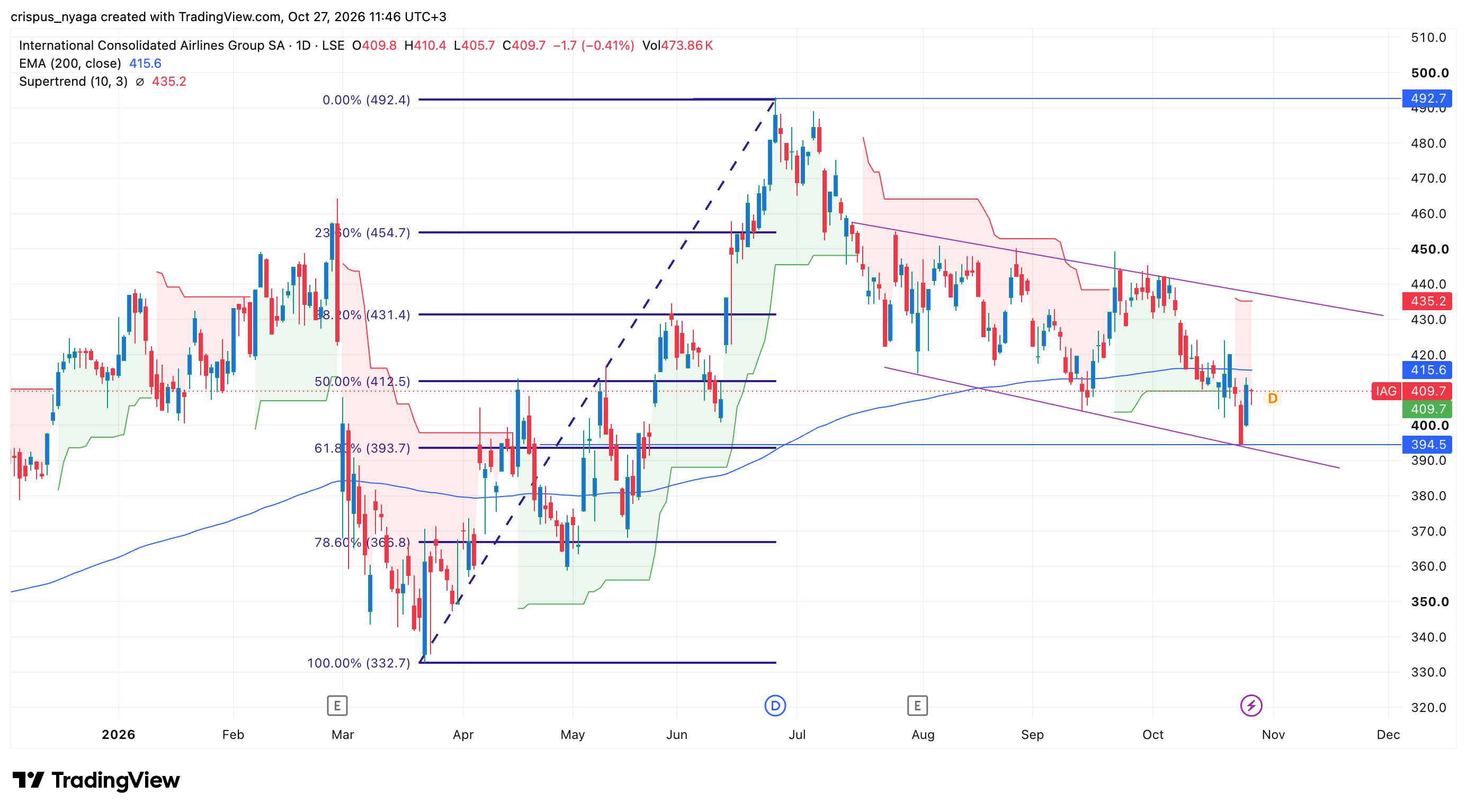
IAG’s share price has faced intense turbulence this year as the war between the US and Iran has pushed costs significantly higher. The stock dropped to a low of 394p on Friday before bouncing back to 411p today. The weakness will likely persist, as the possibility of renewed strikes in the Middle East remains.

Airlines are warning of rising jet fuel prices

Top American airlines are warning that price hikes are not enough to boost their profitability. In its recent statement, Delta Airlines lowered its full-year earnings after releasing its third-quarter results, which came short of expectations. It now expects that its adjusted earnings will be between $5.10 and $5.60, down from the previous estimate of between $6.50 and $7.50.

United Airlines also delivered a similar warning. It now estimates that a gallon of jet fuel will cost about $4.80 in the final three months of the year, higher than the expected $3.90. Also, the company said that fuel prices are rising at a faster pace than its fare hikes.

These numbers mean that IAG’s business is also facing these challenges because jet fuel prices have remained at an elevated level. IATA data shows that the average jet fuel has risen to $196.70, up by 6.6% from the previous month. It has jumped by almost 120% in the same period last year. 

IAG, like other airlines, has responded by hiking prices across its brands, which include companies like British Airways and Aer Lingus. At the same time, unlike its US competitors, IAG uses some hedging strategies, making it less exposed to rising jet fuel prices.

READ MORE: IAG share price eyes crash to 400p as jet fuel costs escalates

IAG faces some major risks ahead

IAG stock faces some major risks ahead. The most notable one is that jet fuel prices will continue rising in the near term. Oil will likely jump as the midterm elections near, a move that will push President Donald Trump to restart his attacks against Iran.

A restart of the US-Iran war will likely be more severe than the last phases. Iran has warned that it will respond by launching attacks against major targets, including airports and oil infrastructure. Such a move will push oil and jet fuel prices higher. 

The next important catalyst for the stock will be its earnings report, which will provide details about its business in the third quarter. Analysts expect the results to show that its operating profit dropped to 1.81 billion euros in the quarter from 2.08 billion euros last year.

IAG share price technical analysis

IAG share price

IAG stock chart | Source: TradingView

The daily chart shows that the IAG stock price has slumped from a high of 492.7p in June to the current 410p. It bottomed at 394p, which coincided with the 50% Fibonacci Retracement level.

The stock has formed a descending channel. Also, the stock remains below the 200-day Exponential Moving Average (EMA) and the Supertrend indicator. Therefore, the stock will likely remain under pressure in the foreseeable future, potentially to the key support level of 394p. A drop below the support level of 394p will point to more downside to 350p.

The post IAG share price is facing turbulence: will it drop or rise ahead of Q3 earnings? appeared first on Invezz

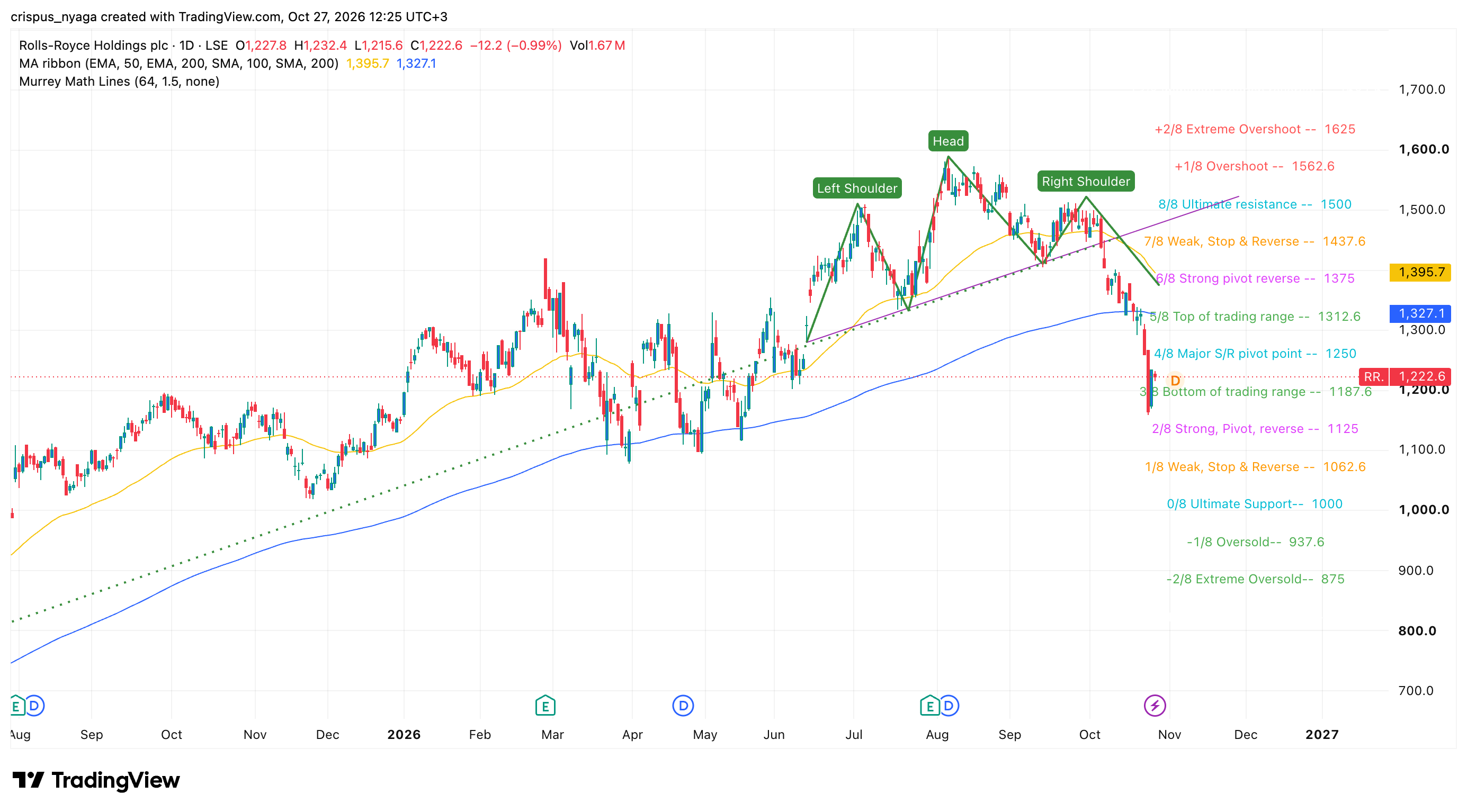
Rolls-Royce’s share price is in a bear market, a trend that accelerated after its top competitors published their earnings. The stock plunged to 1,160p on Friday before stabilizing at 1,220p today, and technicals suggest further downside over time.

Rolls-Royce share price technicals point to more downside

On the charts, we see that the RR stock price has been in a strong sell-off in the past few months. It dropped from a high of 1,585p in August to a low of 1,159p this month. This retreat happened after the stock formed a head-and-shoulders pattern, a common bearish sign in technical analysis.

The stock has dropped below the 50-day and 200-day moving averages and the Major S/R pivot point of the Murrey Math Lines tool. Moving below that level confirmed that bears have prevailed. It has also remained below the Supertrend and Ichimoku cloud indicators. 

Therefore, the stock will likely continue falling, potentially to the strong, pivot, reverse level of the Murrey Math Lines tool at 1,125p. A move below that level will point to more downside towards the support level of 1,000p. 

Rolls-Royce

RR stock chart | Source: TradingView

GE Aerospace and Safran earnings

The ongoing Rolls-Royce stock weakness has coincided with that of other companies in the industry. GE Aerospace has slumped by 26% from its highest point this year, a trend that continued after publishing the recent earnings. 

Safran stock also dropped to 271 euros, its lowest level since May 18th this year. It has slumped by 26% from the year-to-date high. RTX, a company that owns Pratt & Whitney, has also fallen by over 12% from its peak.

Safran and GE Aerospace stocks dropped because, while its earnings reports were strong, their guidance were a bit weaker. GE said that its earnings per share will be between $1.87 and $1.97, well lower than the expected $2.04. It also flagged higher costs and warned that its airline clients were cutting capacity.

Safran, on the other hand, the company flagged the challenges in the aftermarket as companies slash their trips because of the rising costs. 

These factors may also affect Rolls-Royce’s business since it is in the same business. A cut in trips would have an immediate impact on its business since it makes most of its money in the civil aviation industry. In addition to selling engines, the company also offers services to airlines through long-term contracts.

A key risk that the company faces is that the US-Iran war could resume in the coming weeks, pushing oil prices higher. Already, data compiled by IATA shows that the weekly average price jumped to $196.70, up by 6.6% from a month earlier. During this Iran war, we have seen that Rolls-Royce has always reacted to rising jet fuel prices.

Another risk is that the Iran war could push Iran to bomb airports in the Middle East, as it did earlier this year. Bombing airports like in Dubai, Saudi Arabia, and Qatar, a move that will affect the civil aviation industry. Such a move will have an immediate impact on Rolls-Royce’s business since it counts companies like Turkish, Emirates, and EgyptAir as clients. 

The next key catalyst for Rolls-Royce shares will be its earnings report that comes out on November 12. These earnings will provide more hints on how the war is impacting its business.

The post Rolls-Royce outlook as Safran and GE Aerospace earnings flag aviation risks appeared first on Invezz

Starting to save for retirement later than planned could feel overwhelming, especially when you realize how much time has already passed. But taking bigger risks isn’t necessarily the answer. If retirement is closer than you’d like, your priority should be building a roadmap you could follow consistently, with investments offering income and room to grow.

In this article, I’ll outline that roadmap and highlight two Canadian dividend stocks that could help you put it into practice.

Source: Getty Images

A realistic roadmap for late retirement savers

While it’s easy to regret not starting earlier, the good news is that you can still make meaningful progress with a disciplined investing strategy.

Even if you have only 10 or 15 years before retirement, regular contributions and reinvested dividends could help your portfolio grow over time. I would begin by making the most of available Tax-Free Savings Account (TFSA) and Registered Retirement Savings Plan (RRSP) contribution room while focusing on quality businesses with sustainable earnings and dividend growth. As those companies increase their payouts, the additional income could help accelerate your savings journey.

At the same time, you should also take advantage of portfolio diversification to avoid relying too heavily on any single stock or sector for your retirement savings. Spreading your investments across different industries can help reduce the impact of company-specific setbacks while keeping you exposed to long-term growth opportunities.

This way, you may not be able to recover every missed year, but you could still build a meaningful retirement portfolio by making the most of the years ahead.

And here are two dividend stocks that could help you put this retirement savings strategy into practice.

Manulife stock

For late starters trying to make the most of the years they still have, Manulife Financial (TSX: MFC) offers a useful mix of dividend income and long-term growth potential.

This Toronto-based firm provides insurance, retirement solutions, and wealth management services across Canada, Asia, and the United States. Its shares gained 38% over the last year to trade at $61.99 apiece. At that price, Manulife has a $102.7 billion market cap and a 3.1% annualized dividend yield.

The company’s core earnings in the second quarter climbed 12% year-over-year (YoY) at constant exchange rates to $1.9 billion, backed by growth in Asia and wealth management and a lower expected credit loss provision. Asia was a key driver, with core earnings growing 21% YoY. Its global wealth and asset management division also posted 9% higher core earnings, helped by fee income and contributions from Comvest.

Notably, Manulife also returned $2.6 billion to shareholders through dividends and buybacks in the first half of 2026. Meanwhile, the company is expanding investment offerings and using artificial intelligence (AI) to improve efficiency.

For late retirement savers, that blend of diversified earnings, growth opportunities, and shareholder returns makes Manulife stock worth considering.

Fortis stock

If Manulife brings growth and diversification to this roadmap, Fortis (TSX: FTS) could add some stability to your portfolio through regulated utilities and a long-term dividend-growth plan.

Based in St. John’s, Fortis mainly provides electricity and natural gas services across Canada, the United States, and the Caribbean. Its stock has jumped 12% over the last year to trade at $81.13 per share. At that price, it has a $41.7 billion market cap and a 3.2% annualized dividend yield.

In the June quarter, Fortis reported net earnings of $396 million, up about 3% YoY, while its earnings per share improved to $0.78 from $0.76. Growth in its regulated asset base and higher retail electricity sales backed that earnings growth, although financing and operating costs limited gains.

In the first half of the year, the company invested $2.7 billion and remains on track with its $5.6 billion annual capital plan. Its $28.8 billion five-year investment program is expected to grow its regulated asset base by around 7% annually through 2030. More importantly, Fortis expects this growth to support annual dividend increases of 4% to 6% through 2030.

For late retirement savers, Fortis offers an attractive combination of current income and potential dividend growth. Along with Manulife and other investments, it could help build wealth without depending on risky shortcuts.