Author

admin

Browsing

Block, the company led by Jack Dorsey, has released Dessa, a new voice model from its research lab that runs locally and produces strikingly human expressions such as laughter, pauses and crying. The company said the model was trained entirely on human speech using a single NVIDIA GPU rack.

Dessa is a full-duplex model, able to speak and listen simultaneously, similar to OpenAI’s GPT-Live. While most speech models rely on a paired large language model for knowledge, Block said Dessa’s knowledge comes from its conversational training data.

In a blog post, Block argued that current voice AI often feels unnatural because it converts speech to text, discarding information text cannot carry, so even the most powerful models cannot hear how users feel. The company described this as a worse and potentially dangerous experience. Unlike models such as ElevenLabs v4 and Fish Audio Drama 3, which use voice tags to steer emotion, Block claims emotion is built into Dessa, though it is unclear whether tags play any role.

Researchers shared demos showing varied voices, cadences and emotions. Dessa can run on consumer hardware such as a MacBook M4 Max, but is not yet publicly available while Block invites safety researchers to test it. An on-device model could help Block, whose Square unit already uses voice AI for ordering, power more experiences at lower cost.

Searching for a reliable monthly passive income can be quite an adventure. Finding yields high enough to matter without taking on unacceptable financial risk is the ultimate goal. While high-yield dividend stocks can sometimes trap investors with unsustainable payouts, certain real estate investment trusts (REITs) offer the perfect balance of yield, safety, and operational durability. Crombie Real Estate Investment Trust (TSX: CRR.UN) could be the top-notch monthly dividend stock one could buy to earn a 5.5% yield in retirement.

Source: Getty Images

Essential retail anchors drive high occupancy

Crombie REIT owns a portfolio of 310 high-quality, predominantly retail properties comprising roughly 19.4 million square feet of gross leasable area (GLA). The portfolio’s heavy concentration in necessity-based retail space is what makes it a particularly compelling passive income investment for Canadian retirees. Rather than relying on discretionary shopping malls or vulnerable fashion retailers, Crombie’s cash flow is anchored by grocery stores, pharmacies, and essential service providers – the kind of tenants that retain foot traffic even during economic downturns.

The retail REIT saw portfolio occupancy remain near all-time highs at 97.5% going into the third quarter. Its stability is traceable back to its close relationship with its former parent company, Empire Company Limited, the grocery giant behind national chains like Sobeys, Safeway, IGA, FreshCo, and Farm Boy. Empire remains Crombie’s majority unit holder and principal tenant, generating approximately 55% of the REIT’s annual minimum rent.

A conservative payout ratio protects the 5.5% yield

Most noteworthy for passive income seekers, Crombie’s monthly distribution of $0.08 per unit is well covered by distributable cash flow. During the first half of 2026, Crombie reported an Adjusted Funds From Operations (AFFO) payout ratio of 77.2%. This implies the REIT retained nearly 23% of its distributable cash flow to manage debt and develop the portfolio. Crombie’s low and sustainable payout rate provides a comfortable margin of safety for income investors.

That retained capital allows the REIT to fund property improvements and debt reduction internally rather than stretching its balance sheet with debt. Supported by recent steady mid-single-digit net operating income (NOI) growth and strong rental renewal rate increases exceeding 11% during the second quarter, management has rewardingly increased distributions in two consecutive years now.

Long-term growth beyond monthly rent cheques

Looking ahead, Crombie offers investors more than just a static stream of monthly rent cheques. The trust possesses a valuable growth driver in its urban mixed-use development pipeline. Crombie is creating new recurring income streams on land it already owns by converting underutilized land and parking space around existing, transit-connected grocery sites into modern residential apartments and commercial hubs. Furthermore, built-in contractual rent escalators ensure that top-line revenue rises steadily alongside inflation.

Key risks every income investor should monitor

Every income investment carries trade-offs that dividend investors must evaluate. Crombie’s primary concentration risk stems from its high revenue exposure to Empire Company. However, given Empire’s strong credit profile, market position, and essential status in Canadian society, the probability of tenant default remains low. Additionally, elevated interest rates continue to apply pressure across the broader real estate sector, making disciplined balance sheet management vital.

Should you buy Crombie REIT for monthly passive income?

Retirees looking to replace a traditional employment paycheque with dependable, monthly passive cash flow will find that Crombie REIT checks all the right boxes. Its stable 5.5% yield, a conservative payout ratio below 78%, recession-resistant grocery anchors, and a clear path toward long-term value creation qualify it for a prominent spot in any Canadian retirement investment plan.

Alberta’s referendum supplied investors with a large political headline and a strong reminder to read the wording underneath it. Early reporting put support for remaining in Canada at roughly 76%.

Reduced political uncertainty can improve sentiment, but doesn’t change the selling price of natural gas or pay for a producer’s next processing facility. For Alberta energy stocks, the enduring investment case still rests on costs, market access, and cash left after spending.

Source: Getty Images

Giving commodities attention

Natural gas has its own complications. A strong global price doesn’t guarantee a strong price at a particular Canadian delivery point. Transportation constraints, weather, storage levels, and available export routes can leave producers receiving very different amounts for apparently similar output.

That makes diversification of sales markets valuable, especially for a company large enough to plan infrastructure and contract commitments over several years. Shareholders still need to examine the economics of those commitments. Growth that consumes cash without improving returns is an expensive hobby.

Tourmaline Oil (TSX: TOU) is a Calgary-based producer with a large Western Canadian operation. Its appeal comes from producing efficiently and expanding access to attractive markets, not simply from having Alberta on the address label.

TOU

Tourmaline reported second-quarter operating costs of $4.59 per barrel of oil equivalent (boe), down 10% year over year. That measure excludes other expenses, so it shouldn’t be mistaken for the company’s total cost of producing and delivering a barrel-equivalent of output.

Management has also approved a 5% increase in the quarterly base dividend, from $0.50 to $0.525, effective in the fourth quarter. The September announcement said the payment was expected to be declared in early December. Approval of the planned increase and the eventual dividend declaration are separate steps. At a recent closing price of $66.16, the planned $2.10 annualized base payout implies a yield of about 3.2%.

Considerations

The share price needs to make sense under an ordinary gas-price outlook. A producer can have good assets and still disappoint a buyer who assumes exceptional prices or unusually large special distributions will continue. A new political headline doesn’t increase the value of every future cubic foot.

The main risks are familiar ones. Gas prices can weaken, transport costs can rise, and infrastructure spending can exceed expectations. Market-access agreements help shape the revenue mix, but don’t remove commodity exposure. Investors buying Canadian stocks should keep an energy position proportionate to the losses they could tolerate.

For a dividend portfolio, I’d budget around a conservative base payment and regard any special payout as additional cash to allocate when it is actually declared. That avoids building grocery spending around a commodity cycle.

Bottom line

The base payout also gives a buyer a useful price discipline. Paying more for the shares lowers the starting yield unless the dividend rises as well. A good operating plan doesn’t make the purchase price irrelevant. At roughly 3.2% on the planned higher rate, I see Tourmaline as an income-and-growth energy holding, not a high-yield substitute for a fixed monthly payment.

All in all, Tourmaline interests me as a disciplined producer with an operating plan that can outlast the referendum coverage. I’d watch whether lower costs and new infrastructure improve cash generation per share. If they do, shareholders will have a reason to stay invested long after the political signs come down.

Illustration by Antonello Sticca


6 min read2 hr

Kemi Badenoch is increasingly critical of Donald Trump. Ben Gartside reports on the calculations among sister parties as attention starts to shift to life after his presidency

Asked on Newsnight last month whether Donald Trump was an ally of the United Kingdom, Kemi Badenoch gave a one-word answer: “Sometimes.”

It was a far cry from her first Prime Minister’s Questions as Conservative leader, in November 2024, when she congratulated the president-elect on his “impressive victory” and asked for him to be invited to address Parliament.

The Republican Party is a natural ally of the Conservatives, but politics on both sides of the Atlantic has strained the relationship. Earlier this month, after President Trump eased sanctions on Russian diesel and said Ukraine should get a new president, Badenoch wrote that “Ukraine’s freedom is not President Trump’s to bargain away”. That criticism went further than Andy Burnham did.

Priti Patel, then shadow foreign secretary, told the Washington Examiner in March: “Our sister party is the Republican Party, 100 per cent.” But the party has struggled to stay close to every wing of the GOP. When Matt Schlapp, chairman of the Maga-aligned Conservative Political Action Conference (CPAC), came to London in July, he said the Tories did not deserve the label “conservative”.

Patel has since been replaced but was handed a new international role focused on sister parties. It came shortly after Badenoch visited the Italian Prime Minister, Giorgia Meloni – a trip that ended in bickering with Reform (like much of the party’s outreach this year) over what Meloni had told her.

Patel’s job is to smooth out differences like these. “I think it’s interesting that the Conservative Party sees the importance of creating deeper relationships with like-minded political parties around the world, and build relationships with potential future leaders,” says Sarah Elliott, director of the Prosperity Institute’s Special Relationship Unit.

In Washington, the former home secretary is well-liked. Greg Swenson, chairman of Republicans Overseas UK and a fundraiser for Trump, says the party’s links go beyond the White House. “There’s definitely people with relationships – Priti Patel’s got really good relationships [with the administration],” he says. Patel, he adds, “is friends with” Marco Rubio from the secretary of state’s years in the Senate.

Goodwill towards one MP is not the same as loyalty to her party. “Republicans naturally regard the official right-leaning party as their counterpart, so the Conservative Party,” Elliott says. “However, with Reform UK on the scene and Nigel Farage’s friendship with Donald Trump well-known in American conservative media, Reform UK is looked [on] as the more Maga-adjacent one for many in the Republican Party.”

Swenson goes further. “[There’s] the personal relationship between Trump and Nigel, but just the movement itself is clearly a Maga-type movement,” he says. “Reform definitely wins the respect of the Republican Party on their views on mass migration and illegal migration. I don’t think the Tories can ever get that back.”

Conservative MPs insist the bond holds. “It’s right that we should engage as positively as we can with President Trump and his administration and with our sister party, the Republican Party in the United States,” says Bernard Jenkin, the Conservative MP for Harwich and North Essex. He prefaces that with a warning, though: “President Trump and his regime is a very difficult thing for the UK to deal with. No previous president has ever questioned Article 5 of the Nato treaty.”

The rhetoric has shifted all the same. In February 2025 Badenoch said JD Vance had been “dropping some truth bombs” in his Munich speech, in which he accused European leaders of retreating from free speech. By April this year she was saying Trump should not be “abandoning a mess that he’s made”. This month she told The Spectator: “He’s quite erratic.”

Washington may not have noticed. “To be perfectly honest, I am not sure many Republicans would have picked up on her criticisms of the president or his foreign policy,” Elliott says.

Her allies reject the idea that she has changed course. “I think Kemi’s been completely consistent,” Jenkin says, adding: “We should avoid pissing off the Trump administration unnecessarily, but that doesn’t mean that Kemi’s wrong to speak out when the British national interest is involved.”

At the Conservative Party Conference, Tom Tugendhat, the new shadow foreign secretary, spent his speech attacking Ed Miliband, and Badenoch’s hour-long speech did not mention Trump or America once.

“President Trump and his regime is a very difficult thing for the UK to deal with”

Jack Pannell of the British Foreign Policy Group (BFPG) says the party has little choice. Trump is “a deeply toxic figure across the UK”, he explains. The BFPG’s annual survey found that 67 per cent of 2024 Conservative voters trusted the US to act responsibly in the world; this year, 36 per cent did. Reform voters, at 45 per cent, are now the outliers. “Nigel Farage is a friend of Trump, and that is a potential distinction for the Conservative Party: yes, we are more pro-US, but we are not necessarily in the pocket of Maga,” Pannell says.

The difference shows in the two parties’ trips across the Atlantic. When Farage goes to America, he follows Trump, whether to his second inauguration or to Palm Beach. The Conservatives have stuck with the Republican establishment. Tugendhat has made four trips paid for by the Hudson Institute, the think tank where he is a fellow. Badenoch’s only donor-funded trip across the Atlantic was to the Hoover Institution.

“Kemi and Conservative MPs visit Washington regularly, so it appears that their relationship with Republican leadership, especially on Capitol Hill, is solid,” Elliott says. Swenson doubts the establishment can carry the Tories far. “I don’t think it swings back to the traditional establishment,” he says. “[The Tories] would be much better off being in touch with the Maga people, which is now most of the administration.”

Last week, the White House took Farage’s side against Badenoch again. After Badenoch attacked Farage’s offer of guaranteed US use of the base at Diego Garcia, a White House official said that anyone claiming Farage meant to give away the Chagos Islands was “peddling fake news and undermining the Anglo-American relationship, including, apparently, Conservative Party leader Kemi Badenoch”.

The party’s response was muted. “The relationship has moved from active courting to managed containment,” says a Conservative with close ties to Washington. “The time where having Trump on side won you points over Farage has gone.”

In her Washington Examiner interview in March, Patel insisted Republican senators were “not engaging with those guys, the other guys”. Five months later, Vance met Reform’s Robert Jenrick in Washington. Afterwards Jenrick said Britain’s allies “know Reform is the party with the plan” on defence spending.

The price of Washington’s respect, Elliott suggests, is policy. Republicans would like the Conservatives to be “more forthright and assertive” on immigration, especially small boats crossing the Channel, she says. “President Trump will only respect the British leaders who will expand North Sea oil drilling and clamp down on illegal and legal immigration.”

Jenkin, who has sat in the Commons through nine pairings of president and Conservative prime minister, advises politicians to leave well alone when Trump or his allies intervene.

“Nobody in the UK is accountable for what Trump says or what his administration says about what’s going on in the United Kingdom,” he says. 

“I think the one thing President Trump likes is provoking a reaction. Don’t react.” 

Antimatter is not known for being easy to get ahold of. That’s part of why these particles remain so cryptic. But recently, a team of physicists at Northwestern University managed to trap a single antimatter particle for months. Cooling it to temperatures near absolute zero, they could control its quantum states with great precision without even touching it. The experiment, published in Physical Review Letters, represents a breakthrough in our understanding of one of the great mysteries of physics.

In theory, antimatter should be everywhere. Mathematics predicts that every particle of matter has an equivalent antiparticle, a fact that scientists have verified experimentally. The universe should therefore contain similar amounts of both, but almost everything we observe is made up of ordinary matter, and we still don’t know why.

It is possible to produce antimatter particles in laboratories, but studying them is still incredibly difficult. When an antiparticle comes into contact with ordinary matter, the two annihilate each other and release energy. To prevent research facilities from exploding, scientists use vacuum chambers and electromagnetic fields that suspend the antiparticles in isolation. But this only partially solves the problem. Studying these particles, especially experimenting with their behavior on a quantum scale, remains challenging.

For this experiment, researchers at Northwestern trapped a positron, the antimatter counterpart of electrons. The team, led by Gerald Gabrielse, developed a device known as a single-positron quantum cyclotron, which used electric and magnetic fields to hold the positron in a vacuum at a temperature close to absolute zero. This means the antimatter particle was at its lowest energy state, allowing the researchers to induce controlled changes in its quantum behavior. Unlike other methods in particle physics, this approach didn’t destroy the particle. The researchers were therefore able to keep the single antiparticle trapped for months, allowing them to repeat measurements.

So what can taming antimatter particles actually teach us? Scientists know that matter and antimatter have very similar properties. For example, an electron and a positron have exactly the same mass, although their electric charges are opposite. However, questions still remain about exactly how similar these two forms of matter are and whether there are small differences that have gone unnoticed in experiments conducted to date.

To this end, researchers want to compare the magnetic properties of both particles. Physicists have already made very precise measurements with electrons, but achieving the same level of precision with positrons has proven more difficult. According to the American Physical Society, the new device could enable measurements of antimatter particles about 30 times more precise than scientists were capable of before.

So far, the experiment has not revealed any unexpected differences between the two particles. What the researchers have achieved is an improvement in their ability to detect these differences in antimatter particles. If future measurements find that a positron responds to magnetic fields differently than an electron, scientists would have to revise some of the laws they use to explain the behavior of matter and antimatter.

This story originally appeared in WIRED en Español and has been translated from Spanish.

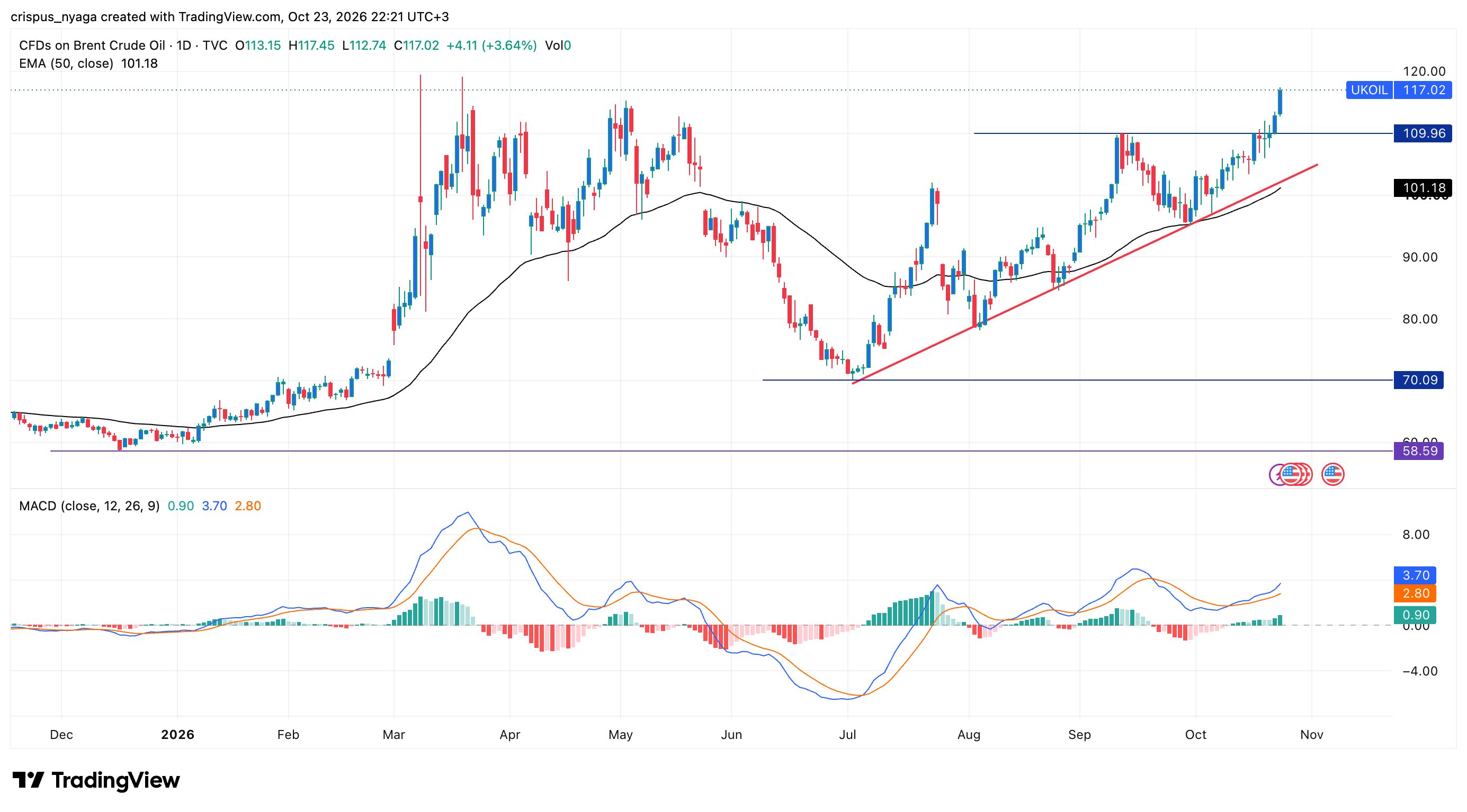
Crude oil prices continued their bull run, reaching its highest level since May as concerns about the escalation between the US and Iran grew. It jumped to $117, continuing a bull run that started in July when it bottomed at $70. This rally will likely continue rising in the coming weeks.

Brent and WTI jumps on rising US-Iran escalation fears

There are signs that the US, Iran, and Israel are planning a major escalation in the coming weeks. 

President Donald Trump has insisted that the US will not launch any attacks against Iran before the midterm election. 

Media reports suggest that the US and Israel are preparing a massive attack aimed at Iran’s civilian infrastructure. Trump and his officials believe that such a move will push Iran to capitulate and reach a deal. 

Israeli leaders have also planned to attack Iran’s oil infrastructure, a move meant to choke the country’s finances. A key target in these attacks will be Kharg Island, which handles more than 90% of Iran’s oil exports.

Iran, on the other hand, has warned that its response to any attacks will be more severe than before. It has warned that it will target energy infrastructure of its neighboring countries, including Bahrain, Kuwait, Saudi Arabia, and the United Arab Emirates. 

Most analysts believe that the next phase of the war will be more destructive than previously. For one, Houthis, a less-equipped group than Iran has demonstrated its capability in choking Saudi Arabia’s oil facilities. 

Crude oil prices also continued rising as investors reacted to the ongoing Iranian attacks on ships crossing the Strait of Hormuz. The UKMTO issued a report of a ship that was attacked by an unknown projectile today, but open-source information is that more ships were attacked. 

https://twitter.com/UK_MTO/status/2113646703303868669

Brent crude oil price technical analysis

Crude oil price chart | Source: TradingView

The daily chart shows that Brent has been in a strong rally in the past few months. This rally started after it bottomed at $70 in July. It has now crossed the important resistance level of $109.96, which coincided with the highest swing on September 11. Moving above that level was important as it invalidated the double-top pattern. 

Crude oil has remained above the ascending trendline that links the lowest swings since July. It also rose above the 50-day Exponential Moving Average (EMA), while top oscillators like the MACD and the Relative Strength Index (RSI) have continued rising. 

Therefore, the price will likely continue rising as bulls target the key resistance level of $120. It may even rally past that as the crisis in the Middle East escalates. 

The post Crude oil price forecast as Brent hits $117 amid US-Iran war fears appeared first on Invezz

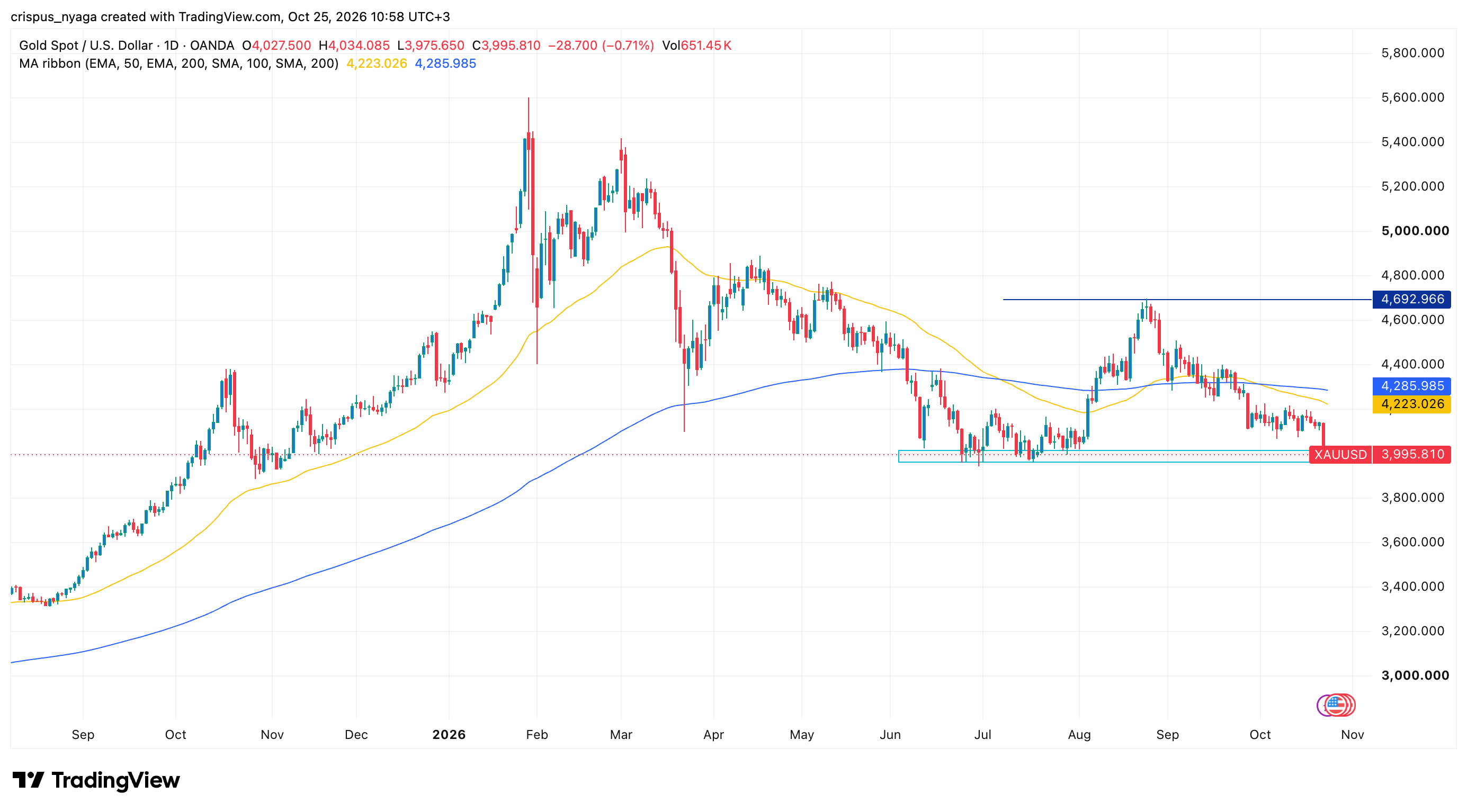
The gold price extended its sharp downward trend, falling to its lowest level since July last year as inflation concerns intensified. The precious metal dropped to $3,995, about 29% below this year’s peak, and formed a death cross pattern, which points to further downside in the near term.

Gold price sinks as crude oil soars

Gold has remained in a bear market in the past few months as inflation concerns have flared. The most recent data showed that the headline Consumer Price Index (CPI) rose 3.7% in September, while the core CPI rose 2.6% in September. Inflation has remained above 2% in the last five years. 

US inflation will likely continue rising in the foreseeable future now that oil prices are on an upward trajectory. Brent crude oil prices ended last week at $117.35, while the West Texas Intermediate (WTI) jumped to $103. The two benchmarks have soared by 67% from their lowest levels in July.

As a result, the average gasoline price has jumped to $4.29, while diesel is hovering at its all-time high. Diesel has continued soaring, even after President Donald Trump eased sanctions on Russian diesel exports.

Higher oil prices mean that inflation will remain above the Federal Reserve’s target of 2.0% in the foreseeable future. As a result, the Federal Reserve is unlikely to cut interest rates in the near term. 

Economists expect the bank to leave interest rates unchanged in this week’s meeting. Fed’s Chair, Jevin Warsh, has hinted that the bank will not hike this week, but left the door wide open for another hike. Polymarket odds that the Fed will hike rates in December have jumped to over 80%. 

On the positive side, gold may benefit if US bond yields continue falling in the coming weeks. The ten-year has dropped to 4.99%, while the two-year has moved to 4.686% from the year-to-date high of 4.95%. Gold tends to perform well when yields are in a downward trend.

Another potential catalyst is the fact that the SPDR Gold Trust (GLD) has continued adding assets. The fund has added over $430 million in assets in the last 30 days, a sign that bulls expect it to rebound.

Gold price forecast: technical analysis

Gold price

Gold price chart | Source: TradingView

The daily chart shows that gold has come under pressure in the past few months. It has dropped below the important support level of $4,000, a sign that bears are in control.

Gold formed a death cross pattern, which happens when the 50-day moving average crosses the 200-day moving average. In most cases, this pattern normally leads to more downside. 

Gold has slumped below the Supertrend indicator, which is a highly bearish sign. Therefore, the price will likely continue falling, potentially to the support level of $3,800. A move above the resistance level of $4,131 will invalidate the bearish outlook.

The post Gold price outlook: Can bulls survive the death cross and oil surge? appeared first on Invezz

Ever wondered why we always talk about an ideal TFSA stock? What is so different about a Tax-Free Savings Account (TFSA) that matching the right stock with its benefits could amplify returns?  A TFSA is not a normal savings account. It allows you to invest in stocks, bonds, and ETFs listed on public exchanges. Your investment grows tax-free, and you can even withdraw tax-free, without specifying a reason.

Suppose you take payouts from your TFSA in a particular year. You can reinvest those withdrawals in the following tax year without losing your TFSA contribution room. In a Registered Retirement Savings Plan (RRSP), your withdrawals are taxed unless they are under a specific plan, like a home purchase or higher education. You cannot reinvest the money withdrawn for any other reason, which means you will lose your RRSP contribution room forever.

Source: Getty Images

Why monthly dividend stocks are an ideal TFSA pick

Let’s take a hypothetical situation. Amy has been building a passive income portfolio for a long time. By now, that portfolio is fetching her $100 a month. A sudden house repair created an expense shortfall beyond her emergency fund. She can access TFSA investments and take dividend payouts or sell some of her profitable shares and withdraw that amount. None of this amount will be added to her taxable income. In fact, her TFSA withdrawals this year will be added back to her TFSA contribution room on January 1, 2027.

In an RRSP, the same $100 would face a 10% withholding tax, and the remaining $90 would be added to Amy’s taxable income. Moreover, she would lose her RRSP contribution room. Thus, monthly dividend stocks are ideal for a TFSA.

An ideal TFSA stock for October

Granite REIT (GRT.UN) is an ideal TFSA stock for October, as the REIT dips to its seasonal low. Granite REIT has a portfolio of warehouses and storage facilities. Around 71% of its portfolio (by value) is e-commerce distribution centres spread across six countries in North America and Europe. Considering that the holiday season sale begins in November, manufacturers’ and e-commerce companies’ inventory starts falling, leading to lease renewals.

The REIT’s unit price has dipped 13% from its July 20 high of over $99, increasing the annual dividend yield to 4.2%. What’s unique about this REIT is that it grows its dividend every January at an average annual rate of 3%. Moreover, the REIT’s unit price hovers in the range of $65–$80. In some peak years, the unit price goes up to $100.

Most REITs’ unit prices are not volatile, but Granite REIT’s is because it actively buys and sells property to meet the changing storage demand. Even now, it has assets held for sale. You can use this volatility to accumulate units when the price dips.

You could also consider booking profit on one-off gains where the unit price touches $100. Otherwise, a $65 to $80 price is ideal to accumulate units.

This stock pays 0.34% per month

Granite REIT’s dividend is safe because it maintains a conservative debt profile. Its total debt is 37.3% of its property portfolio. Moreover, it has five times operating profit to cover interest costs. This shows Granite can comfortably absorb interest rate hikes without affecting profits.

As for dividends, here again its distributions are 65% of its adjusted funds from operations (AFFO), giving it sufficient financial flexibility to tackle inflation. It has grown its dividends annually for 15 consecutive years and can continue doing so.

As the 4.2% yield is paid in 12 monthly installments, you get 0.34% every month. So if you invest $10,000 today, you can buy 115 units and get $34 on November 16, 2026. This amount will likely increase by 3–4% in January 2027.

StockPurchase priceInvestment AmountNumber of shares purchasedDividend per shareMonthly Dividend AmountAnnual Dividend AmountGRT.UN$86.55$10,000115$0.2958$34.02$408.20

The TFSA will make these withdrawals tax-free. You can either take the payout or reinvest the dividend amount to buy Freehold Royalties, which pays a 6.2% annual dividend yield.

Trick-or-treating has never seemed as popular in Florida as it was back when I lived in New England. That could be because it’s still hot in October, or perhaps it’s simply because no holiday except the 4th of July feels right when you live in tropical weather.

Despite having no trick-or-treaters most years, we always buy candy just in case. And for 2026, the candy my wife chose (because she expected I would end up eating it), gummy bears, plays into a trend.

With chocolate prices rising, shoppers have been leaning into cheaper options.

“This Halloween, trick-or-treaters may see fewer traditional colors of chocolate brown and more bright red and blue, as shoppers turn to more colorful, less expensive candy assortments to hand out,” Omnisend retail and ecommerce advisor Greg Zakowicz shared with TheStreet.

ALSO READ: Kroger cuts discounts, promises pricing changes

Amazon’s candy sales

Omnisend sent TheStreet an analysis of Amazon sales data that showed the following:

  • Chewy/gummy candy sold the most of any individual candy category at $22.1 million and 1.2 million units, with Sour Patch Kids selling the most units in the category. This beat chocolate bars, at $18.2 million and 730,000 units. 
  • As chocolate prices rise, consumers are opting for more cost-effective options: Chewy candy is the best value candy at $16 per unit (compared to chocolate’s $22 and hard candy’s $29 average per unit price). 
  • Bulk packs made up 48% of revenue and 40% of units sold as households opt for large bags of crowd pleasers over single bars.
  • Brands specializing in allergy-friendly, low-sugar, and better-for-you candy options (like Shameless Snacks and YumEarth) outsold M&Ms, selling a total of $3.73 million.
    • Methodology: Aggregate analysis of Amazon sales data scraped on Oct. 12 using Jungle Scout with the keyword “Candy.” Figures represent Jungle Scout’s 30-day rolling sales estimates, totaling $154.7 million in revenue and 7.3 million units sold.

“Chocolate prices have risen roughly 15% in 2026, making the cost of traditional Halloween handouts less affordable for families. This could lead to fewer Snickers and a plethora of Dum Dums and Sweet Tarts filling up pillowcases this Halloween,” Zakowicz said.

The analyst suggested that higher prices might lead to some families making an extreme decision.

“Due to overall price increases on everyday goods, I suspect we will see more families who venture out of the house on Halloween to either reduce the amount of self-serve candy they leave out or skip leaving it out altogether. I expect those who stay in to purchase less to avoid the dreaded candy leftovers and temptations of overindulgence,” he added.

Chocolate remains popular, despite higher prices.

Shutterstock

Candy prices have climbed, but chocolate still rules

Candy prices rose in September and are now up nearly 8% over the past year. On average, prices are 13% higher now than five years ago, according to the Bureau of Labor Statistics.

While chocolate prices have climbed, Instacart’s sales data shows that consumers have not abandoned chocolate-based candies.

“Reese’s Peanut Butter Cups took the No. 1 spot by ounces of candy sold and it wasn’t even close. The top five is a chocolate bloc: Peanut M&M’s in second, Hershey’s Milk Chocolate in third, M&M’s in fourth, and Snickers in fifth. You don’t even get to a non-chocolate candy until No. 7, where Sour Patch Kids sneaks into the mix,” the report showed.

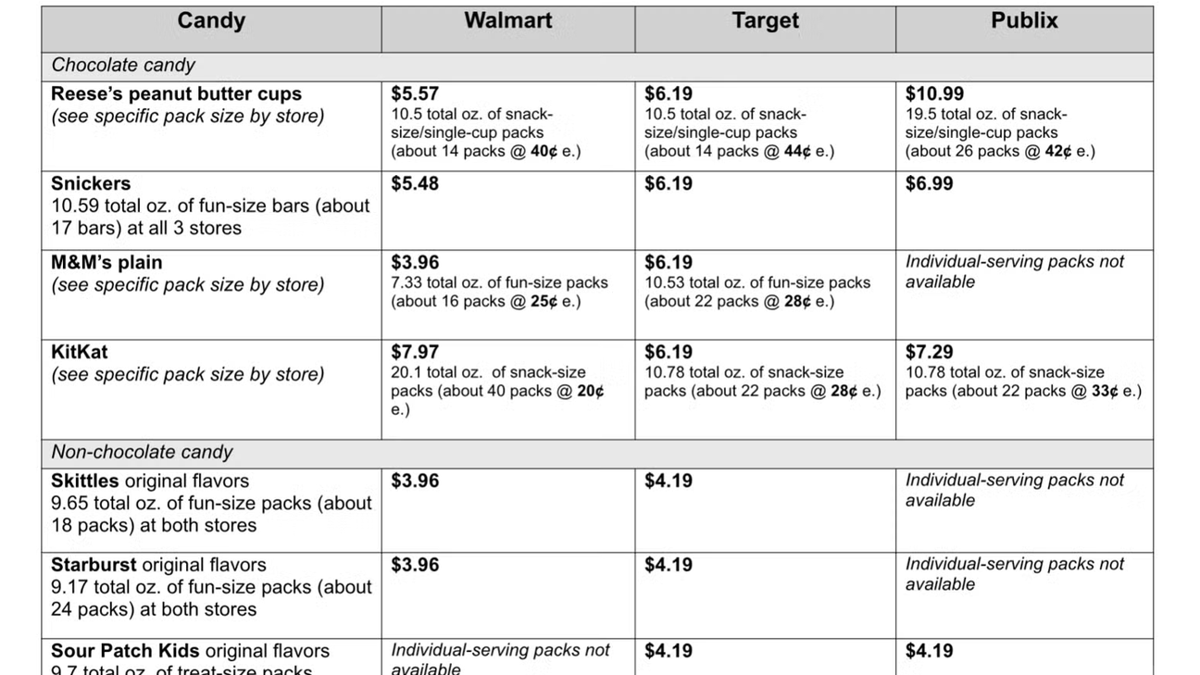
TheStreet’s own study of Halloween candy prices did show that non-chocolate treats were the cheaper option.

Despite the price difference, Americans simply prefer chocolate candies.

A majority, or about 51% of the population, say chocolate is their preferred Halloween candy of choice. In a distant second place, 9% said they love gummies and jelly candy and another 9% said they reach for sour candies, while 7% said caramel candies are their top choice, according to an Ipsos poll.

In addition, 15% of poll respondents said they don’t like Halloween candy at all.

Related: McDonald’s changes its discount strategy

Legal scholar Martha Minow delivered this fall’s Compton Lecture at MIT on Thursday, examining the civic foundations of democracy — and describing how artificial intelligence is undermining it, but could be used to help reinforce traditional U.S. governance. 

“It’s not a good time for democracy or constitutionalism,” said Minow, who is the 300th Anniversary University Professor at Harvard University, and a prominent expert in constitutional law and human rights. She noted a litany of challenges to democracy in recent years, including violations of laws and norms, the stifling of free speech, a diminution of congressional authority, disregard of legal rulings, the common vilification of others in society, and more. 

Recent Gallup polling, Minow observed, shows 77 percent of people saying that the founders of the U.S. would be disappointed in the contemporary condition of the country. 

“Many people genuinely wonder whether this nation’s system of government and rule of law, ignited 250 years ago, will survive,” Minow said.  

Her remarks assessed the state of the U.S. in terms of what she called four key “ingredients” of democracy: education, reliable and accessible information, security from violence, and fairness. Minow evaluated how AI has, among other things, influenced these areas of life — but also suggested ways people could use contemporary technology to help. 

“It’s very familiar to hear blame attributed to digital technologies and experts of all stripes, but a turnaround, I believe, is genuinely possible if people at MIT and elsewhere pour time and talent towards real and much-needed solutions,” Minow said. 

A substantial portion of her remarks focused on the pitfalls of AI in education. That issue compounds some other troubling trends: The U.S. already has large local and regional disparities in educational funding, Minow noted, while schools have actually become significantly more segregated in economic and ethnic terms over the last three decades. 

In this context, AI threatens to further weaken independent-thinking skills, Minow suggested, just when greater understanding of civic issues is absolutely vital. 

“As AI surges, I think we have to learn to be smarter about how to use it, how to regulate it, and how to actually educate people about the costs of mindless using,” Minow said. She added: “Dominant AI platforms supercharge the strategies that are deployed by social media companies, inducing passivity in people … Leading AI models and interfaces and sycophantic elements endanger the development particularly of young people’s capabilities to think, to remember, and to engage in critical thinking.” 

That trend away from cognitive effort, she suggested, can be changed — perhaps through AI tools that act more like tutors and are designed to enhance people’s deep thinking.

“Existing LLMs, model training, and interface design can offer nudges and questions and hints rather than replacing student work, but there’s so much more that could be developed, and more effectively, to be trustworthy, and to deepen human activities and curiosity, rather than replacing people,” Minow said.

To the audience, she added, “AI tools could do much more of that … And I believe that you, the people here, could develop better tools than the ones that are out there. And make better assessments, more meaningful and cheating-resistant.” 

Minow’s talk, “Constituting Democracy in the Era of AI,” was delivered to a large audience in MIT’s Huntington Hall, Room 10-250 on campus.

MIT President Sally A. Kornbluth delivered introductory remarks to the audience. The Karl Taylor Compton Lecture Series, introduced in 1957, is the highest-profile event of its kind at MIT. Karl Taylor Compton was MIT’s ninth president, serving from 1930 to 1948, and then becoming chair of the MIT Corporation from 1948 to 1954.

“He guided MIT through the Great Depression and World War II,” Kornbluth said, “transforming the Institute from an outstanding school for training job-ready engineers to a great global research university.” 

She added: “He was also a deeply committed patriot who helped harness the intellectual power of America’s research universities to serve the nation during World War II.” 

Kornbluth called Minow “a legal scholar of extraordinary intellectual scope,” and a “dedicated educator whose work has shaped how we think about the law and our own humanity, as individuals and as a society.” 

Minow has been a faculty member at Harvard Law School since 1981, and served as dean of the school from 2009 through 2017. Minow earned her BA in history from the University of Michigan, an MA in education from Harvard, and a JD from Yale University.

Minow’s books include “Making All the Difference” (1990), “Partners Not Rivals” (2002), and “When Should Law Forgive?” (2020). 

In her talk, Minow also discussed the civic effects of misinformation, threats of violence, and multiple dimension of societal fairness. Modern media technology has led to a 75 percent reduction in journalists in recent decades, Minow observed, with an attendant rise in corruption in places without local media. Civic-minded technologists, she proposed, should work towards establishing a widely-used “information commons,” or many forms of them, to help people access more reliable information. 

Meanwhile, when it comes to basic security in society, Minow warned, “We’re on the brink right now. I know a lot of judges, and every one of them has a credible threat of violence against them. In America. This is not acceptable.” 

For all the challenges to democracy and traditional civic norms, however, Minow sounded positive notes throughout her remarks, pointing out that there are many opportunities to create new forms of reliable information, education, and community relations. 

“We have to actually invent the world that we want to live in,” she offered. 

Minow’s remarks were followed by a Q&A session in which Kornbluth read aloud questions submitted by the audience — and asked her to characterize her concerns about present trends. 

“I worry about the loss of the Enlightenment,” Minow said. “I worry about the loss of the belief that reason, and testing hypotheses, and rejecting myths in the face of evidence, and the toleration and rights and expansion of participation that came along with the Enlightenment, that’s what concerns me the most. That’s why the disinformation issue for me is so important, that’s why the loss of critical thinking in schools is so important.”

She added: “I’ve spent much of my own career thinking about mass violence. What happens when people don’t understand each other, and are afraid. And it’s terrible, and we don’t want to be there. And I do view the Enlightenment as a time when people learned that actually having mass wars is a bad thing, and coming up with toleration is a good thing, and testing our ideas in light of evidence other people can share can produce a better life for everybody. I worry we’re abandoning that right now.”