
Author

admin

Browsing

Ultimately, he and his group want to help people design more accurate and robust deep-learning models that are better suited for their intended application. 

“We used to debug systems just by looking at their parameters and figuring out whether they make sense or not. Now, we need ‘mind-reading tools’ that can take this really complicated neural computation and translate it for us because it is just not in a language that we, as humans, know how to speak,” he says.

A love of language

Andreas’ fascination with language blossomed at a young age. As a child growing up in the San Francisco Bay Area, he was a voracious reader of any book he could get his hands on. 

One such book, passed along to him by a family friend, contained a pivotal scene where the main character hacked into a computer system to save the day.

That piqued his interest in computers. A few years later, his father brought home a simple BASIC Engine that Andreas could run on their home computer, and he started immersing himself in the world of computer programming.

Andreas chose to major in computer science as an undergraduate at Columbia University but wasn’t sure if he wanted to pursue a career as a researcher, as a software engineer, or at a startup.

His friends signed up for research projects in faculty labs, so Andreas figured he would try that, too.

“I just blast emailed everyone in the computer science department who was working on anything vaguely AI-related, and the natural language processing faculty got back to me first. That is how I wound up in the field where I am now,” he says.

Working in the lab of Michael Collins, the Vikram S. Pandit Professor of Computer Science at Columbia University, Andreas completed an undergraduate thesis project on machine translation. His project involved adapting existing statistical techniques for representing the meaning of language into more powerful AI systems that could translate passages of text.

“I always felt like these deeper questions about how thought works or how to model the world were closer to the surface in language processing problems than in the other tasks that AI people were working on at the time,” he recalls.

A seismic shift

He wanted to keep exploring deep questions, so Andreas enrolled in graduate school at the University of California at Berkeley to pursue a career as an academic researcher. 

Before starting his PhD studies, he spent a year earning a master’s degree at Cambridge University in England. In that historic environment, he was inspired to contemplate the nature of language learning as he worked on computational translation problems.

Those studies fueled his research when he joined the lab of Berkeley professor of computer science Dan Klein. 

Andreas began his studies at the time when neural networks were starting to take off. The field of natural language processing was making a seismic shift from statistical methods to this new world of deep learning. 

Statistical methods utilize transparent, mathematical formulas to analyze text, while deep learning techniques use opaque algorithms to automatically learn complex meanings from massive amounts of text data.

“It was fun to be there as we made this transition to the modern toolkit, and learning and inventing all of that stuff when it was still new,” Andreas says.

He began collaborating with scientists in computer vision labs to tackle increasingly complex questions about language learning. Together, they designed AI systems that excelled at generating natural language by teaching those systems to “see” and understand the world around them. 

“This was all super-exciting because there really hadn’t been a common set of tools for working with both language and vision data. Then, all of a sudden, neural networks gave us this common language,” he recalls.

He completed a thesis project on the use of neural module networks, which are small fragments of neural networks that perform specific tasks, like localizing objects or logical reasoning, in a larger AI system. But it was the more speculative projects he tackled alongside his thesis, like interpretability and creating natural language descriptions of an AI model’s internal states, that would drive the focus of his group at MIT.

Faculty focus

After spending a year at the startup Semantic Machines (which spun out of his lab at Berkeley), Andreas joined the MIT faculty in 2019.

“It felt like this was a fantastic opportunity to be in the homeland of AI research and collaborate with all these amazing, established people, but also do something new and figure out what the modern era in machine learning was going to look like,” he says.

His group focuses on two main areas. First, they are studying the science of large language models to understand the algorithms these models deploy as they learn and process information. 

The tools they develop help scientists and researchers better predict how a trained model will behave in the real world. For instance, one family of techniques they developed trains large language models to explain what is going on inside other neural networks using language a human could understand. 

These techniques can assign a natural language description to every information-processing node in a massive neural network. For example, one such description might represent an individual node that identifies “patches of grass near animals” in input images. 

“That work serves as a jumping off point for a bunch of higher-level questions we ask about how these models represent meaning,” he says.

On the other side, his team designs new algorithms for training machine-learning models, and for predicting how specific datasets or examples will affect different aspects of model behavior. 

“We don’t have a good scientific theory of what is going to happen when you train a model on a particular dataset. This is a big challenge for the field right now,” he says.

A changing environment

The speed of AI advancement presents one of the biggest challenges his lab faces. The field seems to completely change every three to five years, Andreas says, forcing him to stay nimble and ready to learn something new.

That same dilemma carries over into the courses 6.461 and 6.861 (undergraduate and graduate Natural Language Processing), which Andreas co-teaches. He and his fellow instructors must redesign the course each year to keep up with the newest developments.

It’s also challenging to teach the technical pieces of machine learning in an era where every assignment could be completed by a large language model rather than a human pupil.

“I try to impress upon the students that having a really deep foundation in how all this technology works under the hood is the only way they are going to understand it, and will differentiate them in a world where everyone has access to a coding agent,” he says.

With so much change, it is difficult to predict where the field is headed next, Andreas says. He foresees that his group’s work on interpretability will become even more important for making advanced systems like AI agents safe enough to deploy in high-stakes situations.

This will be especially true as researchers design deep-learning models that can aid in scientific discovery. These models will be trained on troves of raw data from research labs that may not be well-understood by scientists yet. 

“Figuring out how to enable these models to verbalize all of this hidden knowledge they have about things people have never written about explicitly will be a huge challenge and opportunity for people who work in machine learning,” he says.

In addition to tackling challenges in the lab, Andreas enjoys pushing himself as a hiker and backpacker. He has loved spending time in the outdoors since his childhood in California and goes on at least one or two backpacking trips each summer.

He and a colleague in the Department of Mathematics are working their way across all the 4,000-foot peaks in the White Mountains of New Hampshire, making slow but steady progress.

And now that he has earned tenure, Andreas is looking forward to getting back into an old hobby — singing in a chamber choir. He’s always enjoyed music and became enamored with chapel choirs and bell ringing during his time at Cambridge University.

Alibaba Group stock has come under heavy selling pressure this month and now trades at its lowest level since January last year, as the company’s capital spending continues to ramp up. BABA fell to $87.25 in New York, more than 54% below its peak for the year. The shares have also formed a death cross on the weekly chart, just ahead of the company’s upcoming earnings report.

Alibaba stock has fallen amid costs concerns

Alibaba Group stock has been in a strong sell-off in the past few months, moving from a high of $192.43 in September last year to $87. The decline is a big contrast to what Amazon Group has done. Amazon was trading at $257 on Monday, a few points below the year-to-date high of $287. 

In the past, Alibaba and Amazon shares had a close correlation because of the similarity of their services. Indeed, there were signs that Alibaba had a better business model than Amazon because of the asset-light nature of its operations. Unlike Amazon, it did not need to invest heavily in warehouses. 

The relationship between the two ended a few years ago as Jack Ma’s profile grew. After he criticized Chinese regulators, authorities stepped up their crackdown on the company. At the same time, competition in China has intensified in recent years, with rivals such as JD.com and PDD pushing to gain market share.

Alibaba stock has also plunged because of the ongoing investments in the AI space that is consuming billions of dollars. Just recently, the company raised $10 billion by selling shares. This raise happened as the company’s capital expenditure soared. It spent $9.975 billion in the second quarter, up by 75% from the same period last year.

The most recent results showed that Alibaba’s profits have plunged. Its net profit plunged by 75% in the second quarter to 10.4 billion yuan, which is equivalent to $1.5 billion. Revenue rose by 9% to 268 billion yuan, even as its AI Cloud and Compute Services from external clients jumped by 45%. The company attributed this growth to the increased adoption of its AI-related products.

Meanwhile, while Qwen AI usage is growing, there are concerns about the rising competition from models like Kimi, MiniMax, and DeepSeek.

The next important catalyst for Alibaba shares is the upcoming earnings report this week. Yahoo Finance data shows that the average revenue estimate has jumped to 269 billion yuan, up by 8.90% from a year earlier. 

Investors will focus on its cloud computing business, which has emerged as its most important this year. Analysts have a mixed outlook of Alibaba shares. Wells Fargo recently set a target of $190, representing a 73% upside. Citigroup and Jefferies also boosted their targets. On the other hand, companies like JPMorgan and Piper Sandler reduced their targets.

Alibaba Group stock has formed a death cross pattern

BABA stock chart | Source: TradingView

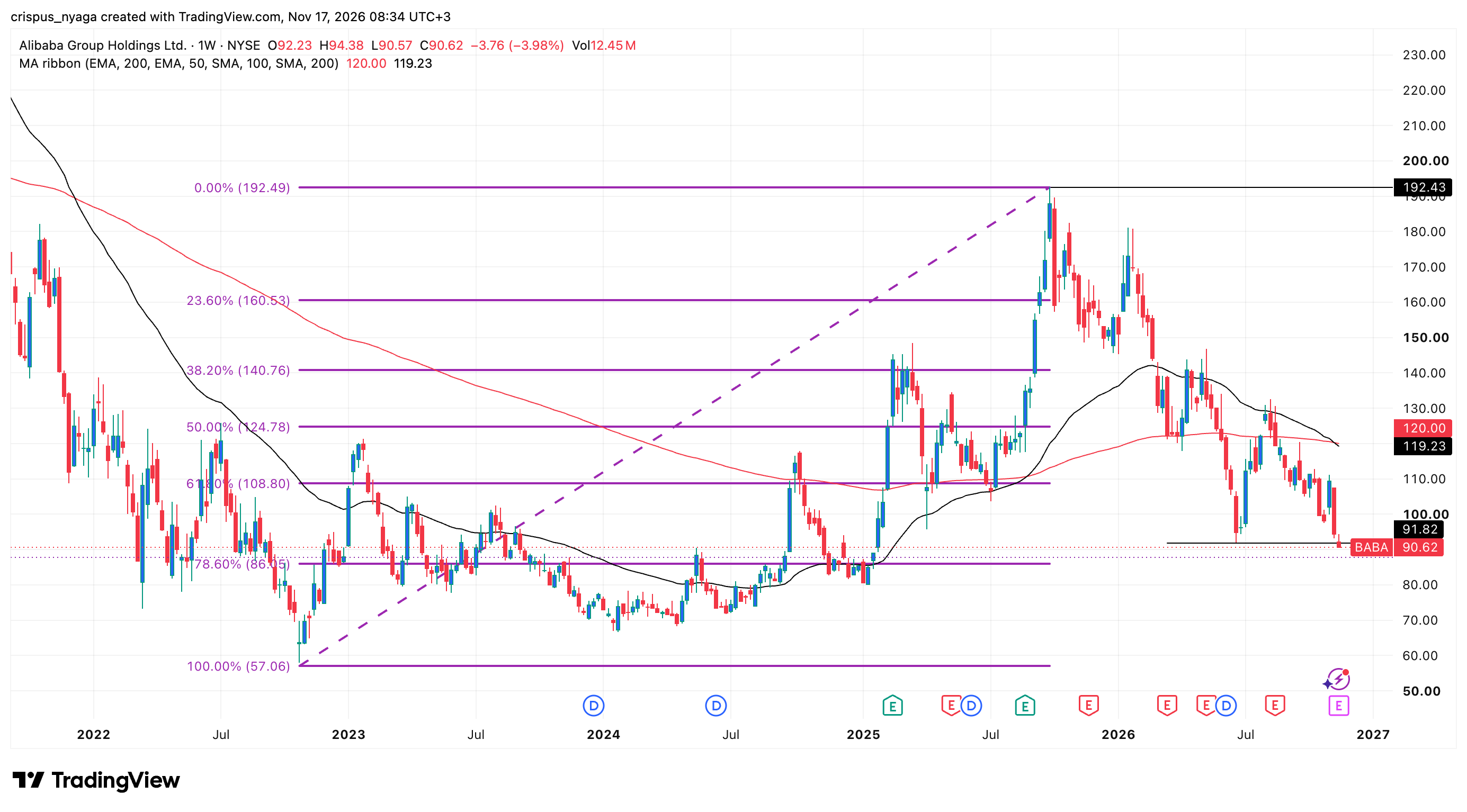
The weekly chart shows that Alibaba stock has been in a strong sell-off this year. It has now formed a death cross pattern, which happens when the 50-day and 200-day Exponential Moving Averages (EMA) cross each other. This death cross is important as it has formed on the weekly chart.

The stock has slumped below the important support level of $91.8, its lowest level on June 22nd. Moving above that level invalidated the double-bottom pattern. It has also plunged below the 61.8% retracement and is now eyeing the 78.2%. 

Therefore, the stock will likely continue falling in the near term, with the next key target being at $80. A move above the resistance at $100 will invalidate the bearish outlook.

The post Alibaba stock flashes the risky death cross pattern as earnings loom appeared first on Invezz

Telus (TSX: T) stock closed 12.9% higher on November 16 after the telecommunications giant disclosed that its board is evaluating a takeover proposal from Québecor. The announcement gave Telus stock a significant boost, although considerable uncertainties remain surrounding the proposed transaction.

Telus’ Special Committee is assessing the proposal, including its regulatory, financial and governance implications. However, the committee has flagged considerable regulatory hurdles and execution risks. The transaction would require several regulatory approvals, which are far from guaranteed.

Beyond regulatory concerns, the deal value appears to be another major sticking point. Telus said that the proposed offer does not adequately capture the company’s business value.

Despite the sharp post-announcement jump, Telus shares remain under considerable pressure. The stock is still down more than 19% year-to-date and trades approximately 33% below its 52-week high. This weakness reflects broader operational and financial challenges facing the telecommunications provider, including pressures on profitability, heightened competition, and regulatory challenges. These headwinds have also prompted management to reduce its dividend, weakening one of the stock’s traditional investment attractions.

Source: Getty Images

What’s ahead for Telus stock?

Telus is taking steps to improve its financial position as uncertainty surrounding the proposed Québecor merger adds to the challenges the company faces. For years, Telus was one of the top TSX dividend stocks, consistently paying and increasing its payouts. However, it reduced its quarterly dividend by approximately 55% to $0.19 per share.

The reduction reflects mounting financial pressures stemming from aggressive industry pricing, intense competition, slower population growth, and regulatory challenges, all of which have constrained margins and earnings.

Telus expects to save approximately $2.7 billion in cash through 2028, which will help lower debt and strengthen its balance sheet. It is also working to control capital spending, sell non-core assets, and improve operating efficiency.

As its major PureFibre expansion nears completion, TELUS intends to prioritize investments that offer stronger returns rather than pursue extensive network expansion. Key growth areas include wireless services, fibre connectivity, digital solutions, and artificial intelligence infrastructure.

Telus is seeking to capitalize on Canada’s emerging AI infrastructure market by supplying connectivity to independent data centres and developing sovereign AI capabilities.

Overall, Telus still faces considerable challenges, and its recovery may take time. Although dividend reductions and spending discipline may weigh on investor sentiment in the near term, successful deleveraging, improved cash flow, and growth in higher-return businesses could strengthen its financial position and support its longer-term growth prospects.

Is Telus stock a Buy, Sell, or Hold for 2027?

Telus stock is a Hold for 2027, as its recovery remains uncertain despite the recent rally triggered by Québecor’s takeover proposal. While the proposed transaction could boost its stock, regulatory hurdles and valuation disagreements make completion far from certain. Moreover, intense competition, margin pressures, and the substantial dividend reduction continue to weigh on its investment appeal.

However, Telus’ efforts to reduce debt, improve operational efficiency, and prioritize higher-return investments could gradually strengthen its financial position. Its expanding opportunities in fibre connectivity, digital services, and AI infrastructure also provide longer-term growth potential. Nevertheless, these initiatives will take time to translate into stronger earnings and cash flow.

Given the ongoing financial and operational challenges, investors should hold existing positions. A sustained improvement in profitability, cash flow, and debt levels would provide a stronger basis for a more bullish outlook.

Photography by Tom Pilston


Noah Vickers


11 min read6 hr

Defence Secretary Wes Streeting talks to Noah Vickers about his abandoned Labour leadership bid, the future of European security, and the strength that comes with being openly LGBT.

Before our eyes, Wes Streeting has undergone something of a metamorphosis. 

As Sir Keir Starmer’s health secretary, he was known as the straight-talking media performer who regularly took to the TV studios to knock back the pay demands of striking doctors and who always seemed to have a well-rehearsed joke up his sleeve. 

In his new role as Andy Burnham’s Defence Secretary, the public has seen a little less of the 43-year-old MP for Ilford North, dealing as he now is with classified information and tasked with keeping the country safe from the gravest of threats. 

But Streeting, who strides into the grand surroundings of Westminster’s Horse Guards building for his interview with The House, does not seem to have found the job-switch too disorientating. He argues, in fact, that there is a common thread linking his past and current cabinet roles.

“I feel very privileged to have had the honour and responsibility of leading two of the greatest institutions that Labour governments have ever built, which is the National Health Service and the Nato alliance – both of which have the same collectivist principles at their heart: an injury to one is an injury to all.

“We pool risk and share responsibility. We take care of each other. That’s true of the health service and it’s true of Nato allies.”

Streeting says he has felt “vindicated” every day since the events which led to his new job: his resignation from Starmer’s government and decision to throw his weight behind Burnham, rather than pursue his own Labour leadership bid. 

“There was definitely more than a small feeling of liberation in that moment of deciding to back Andy,” he says. 

“To be honest, I knew that when I resigned from Keir’s government – at the time that I did, in the way that I did – I kind of had a sense then that that was the end of my leadership ambitions.”

The end of those ambitions forever? 

“Yeah,” he replies, “and I did it because it was the right thing to do. I do not regret it for a second. There has not been a single moment where I’ve regretted the decision to resign or the decision to back Andy…

“He was unquestionably the best candidate and I think he has shown on every single one of those hundred days that we have been in office under his leadership why he is the right person to lead our country. He has undoubtedly given Labour a second hearing with the public.”

The Prime Minister, Streeting adds, is willing to “run towards difficult issues that others would either try and avoid or kind of tiptoe around” – including on Britain’s relationship with Europe. 

But while Burnham has promised to adhere to Starmer’s 2024 manifesto on EU relations, it remains unclear what the PM would do in the event of securing a second term for Labour. Opinions among his MPs, needless to say, are varied. 

Foreign Affairs Select Committee chair Emily Thornberry, for example, has said the government could simply re-apply for EU membership if it wins the next election on a manifesto promising to do so, rather than having to “bother” with a fresh referendum on the issue. Does Streeting agree?

“I think we’re some way from that,” he says. “One of my reflections, having been in Parliament for 11 years and for all of the post-referendum aftermath, is that Brexit isn’t an on and off switch. You can’t turn the EU membership off and then just switch it back on again. 

“The EU has changed a lot in the last decade and it’s not clear what the terms of re-entry would be either.”

Indeed, the bloc has taken an increasingly protectionist turn as it pursues a ‘Made in Europe’ industrial policy designed to boost its own manufacturers. Burnham has said he will make the case for Britain to become a “trusted partner” under that framework, though any agreement will inevitably depend on what conditions EU member states try to attach to it. On this, Streeting issues a stark warning.

“I see Made in Europe as both an opportunity, but if got wrong, it could actually be a threat to our collective security across Nato,” he tells The House.

“What I see and what I’m part of leading in Nato is greater co-operation when it comes to our military readiness. Our defence industrial base and our economic co-operation is absolutely integral to that, and so I’ve warned our allies that whether it’s America First or Made in Europe, we mustn’t allow healthy competition and an understandable focus on building our domestic industrial capacity to become self-defeating protectionism – that’s the risk.

“The Prime Minister’s drive to look at what we can do to build a stronger partnership with the EU, and to deal with the shortcomings of the Brexit deal that the Tories botched, is all about understanding both the opportunity of Made in Europe, if it applies to Britain – a European country – but also the threat to British industry if it doesn’t.”

In addition, Streeting confirms that while the government remains interested in joining the EU’s Security Action for Europe defence fund, it will not do so at any price. Talks collapsed last year after France pushed the EU Commission to demand more than €6bn in entry fees from the UK, even though the price tag was later reportedly slashed to €2bn.

The Defence Secretary says of any new negotiation: “If it’s a good deal for Britain, we’ll be willing to sign up and if it’s not a good deal for Britain, we won’t.”

He welcomes, nonetheless, the EU’s increased focus on defence issues, arguing that Europe cannot simply wait out Donald Trump’s presidency in the hope of the next US administration taking on more of the continent’s security burden.

“There’s always been a danger that as President Trump has been challenging European countries to spend more on defence, that people think ‘Well, we’ll just wait for President Trump to leave the Oval Office and then things can go back to normal’. I think that’s wrong on two counts,” he says. 

“Firstly, President Trump is not the first US president to express frustration with European over-reliance on the US and those frustrations haven’t been confined to Republican presidents, so the idea that the next president will be relaxed about European over-dependence I think is for the birds.

“But secondly, and even more importantly, European countries stepping up and taking greater responsibility for our own continent is the right thing to do, especially with the threat environment we face. We don’t always see eye to eye with President Trump, but I think in the fullness of time, history will thank him for challenging Europe to the extent that he has.”

“There has not been a single moment where I’ve regretted the decision to resign”

The House turns to the recent controversy over Ukraine’s access to the Starlink satellite network, after its owner Elon Musk admitted imposing speed restrictions which disrupted Kyiv’s military operations. 

As a backbencher positioning himself for Labour’s leadership, Streeting was unafraid of taking Musk to task, having accused him of “meddling” in British democracy and saying he should “bugger off”. 

But asked how it can be acceptable for a tech billionaire’s whims to hold such sway over Ukraine’s ability to defend itself, he takes care to avoid any personal rebuke, saying: “I have often railed against monopolies, and one of the challenges I think we have is a lack of competition between key capabilities and platforms.”

Britain and its EU allies should be asking how they can develop alternatives to systems like Starlink, by backing home-grown innovation and getting behind “the Elon Musks of the future who are Brits”, he suggests.

“The question is: why haven’t we got a British version? Or where’s the European version? Making sure that you don’t concentrate too much power in too few hands is one of the central questions of this remarkable technological revolution we’re all living through.”

He adds, however, that the episode has served to further underline how “the intelligence support that the US provides for Ukraine has been life-saving and game-changing”. 

Wes Streeting
Photography by Tom Pilston

At a meeting last month in Washington with his US counterpart, Pete Hegseth, Streeting says he reiterated that the UK will “back Ukraine to the hilt”.

Like Streeting, Hegseth is a practising Christian and The House asks whether that proved helpful in striking up a positive relationship with him. Did the subject of faith come up at all?

“No, we haven’t spoken directly about our faith. We come from different political traditions and different Christian traditions,” he says with a smile.

But of Hegseth – who in his book American Crusade called for “a 360-degree holy war for the righteous cause of human freedom” – Streeting adds he finds the US defense secretary “a straight shooter”. 

“I know with Pete Hegseth who I’m dealing with, what he thinks. We can be quite open with each other. We have a very candid relationship, which is really important.”

More generally, the MP acknowledges that his faith has helped shape his own worldview as a politician. 

“One’s faith is inseparable from how you view the world,” he says. “It’s not that I’m making decisions and then applying a Christian lens across. It’s more that there are a whole set of ethical and philosophical values that I hold that are undoubtedly informed by my upbringing, by political influences and by my Christianity.”

He regrets that people who aren’t religious often view politicians of faith with suspicion, for fear that they may legislate against others’ rights or hold prejudiced views.  

“For me, Christianity is about love, acceptance, inclusion, the importance of valuing every human being, to take care of one another. I would definitely describe my kind of politics as drawn from both Labour’s revisionist tradition, but also the Christian socialist tradition of the left.”

Ministry of Defence staff are said by Streeting to have told him how proud they are that Britain now has its first gay Defence Secretary, though his new job has also come with a torrent of homophobic abuse online.

“Why is it that I have had a daily deluge of online homophobia since my appointment?” he asks. “It is because for those people who are prejudiced against LGBT people, there’s a perception that to be gay is to be weak, or to be trans is to be weak.” 

For Streeting, this couldn’t be further from the truth. He takes, for example, LGBT members of the armed forces, including those who served when it was illegal to do so. 

“Despite the prejudices of the state at the time, and the prejudice written into the law of the land, there were still LGBT people who were willing to put on a uniform and make the ultimate commitment to their country… I think that was an extraordinary act of courage and bravery,” he says. 

“Those kids who grew up in school being themselves and facing down bullies? Those are strong people. 

“Those who walk the streets being openly themselves, whether that’s holding hands with someone of the same sex, or matching your appearance to your gender identity, knowing the risks of physical harm that trans people face – those are courageous acts and courageous people.

“I feel inspired by LGBT people who serve in our armed forces and I think they are the embodiment and epitome of the notion that to be authentically yourself – and to be LGBT and out and proud – is also to be strong.”

Streeting may be less visible than he was in Starmer’s government, but if he was disappointed by his new job, he is hiding it well. He also appears convinced that with Burnham at the helm, the tide is turning for his party – something he may take an especially personal interest in given his majority of 528 votes in Ilford North. 

“I am finding, more and more, there are people out there in the country who have quietly and cautiously – considering everything that’s happened in recent years – begun to believe again,” he says, slowly and reverently. “Believe in Labour and believe in Britain, and that is a credit to Andy’s leadership.” 

A stock can fall after a good report and make you feel like you’ve missed a page. The business sold more, kept more cash and still left shareholders with less money by closing time. That’s the market’s way of reminding us that good results come with a price tag.

Source: Getty Images

For sale

A selloff resets the price you can pay today. It doesn’t tell you what the business will earn over the next decade. I’d look at what investors expected before the report and what the company actually delivered, then decide how much of the next several years I’m being asked to buy in advance.

For growth stocks, I like to look at free cash flow, or cash left after operating expenses and investment in equipment and other capital assets. It helps me see what the business has available to reinvest. I’d look across several quarters so a seasonal cash bump doesn’t get mistaken for the pace the business can sustain.

There’s also a timing issue. The holiday shopping period can tell investors a lot about what merchants are selling and which services they’re using. I’d look at the results alongside spending ahead of that rush, especially if it takes another quarter or two for the payoff to show.

I’d also be careful with how much room a growth stock takes up inside a Tax-Free Savings Account (TFSA). Gains can grow tax-free. A loss in the account doesn’t give me new contribution room to replace it, which makes position size worth deciding before I hit buy. So let’s dive in.

SHOP

Shopify (TSX: SHOP) sells tools merchants use to set up stores, take payments and handle online and in-person orders. It can earn more as sellers grow and use more services. That gives me a way to own a piece of the infrastructure behind a sale without choosing which brand of jeans will be popular next year.

Revenue rose 32% in the third quarter. Shopify reported a 22% free cash flow margin, meaning about $0.22 of every revenue dollar became free cash flow by its definition. Growth at that pace is more appealing when the business is also keeping a meaningful amount of cash.

I’d watch what new shopping tools do for merchants before assigning them much value. If they bring more sales through Shopify’s checkout or give sellers a reason to pay for more services, the investment can help earnings. If the tools cost more to run and shoppers barely use them, the bill still shows up.

The test

The stock fell 8% on November 3, the day it reported. At that price, I’d put the shares next to a conservative estimate of annual cash flow per share in Canadian dollars. For illustration, at 40 times that cash flow, the stock would need about $5.26 per share to support the current share price. At 30 times, it would need about $7.02.

I’d buy a small position if the price and my estimate leave room for slower growth. Then, I’d hold if the business keeps delivering and the position hasn’t grown too big. I’d wait if my estimate only works when merchants spend more, margins rise and investors keep paying a high multiple all at once. That means I can change my mind in either direction. If the share price falls because the business starts keeping less cash per sale, a lower price alone won’t make me buy. If the economics get better, the same price may offer a different deal.

That’s my way of keeping a stock I like from becoming a stock I need to be right about. There’ll be other chances to buy during a stock market correction, and Shopify will have more quarters to show what it can earn from the changes it’s making.

Bottom line

I’d hold Shopify at a size I’m comfortable owning through a rough year. A better price or several quarters of stronger cash generation would make it easier for me to add without asking an excellent business to deliver a perfect decade.

Rocket Lab stock has rebounded in the past few days as investors reacted to its earnings report, which showed that its revenue growth and backlog continued growing. RKLB jumped to a high of $67, its highest level since October 9. Still, the company could be at risk after SpaceX’s Starship launch.

Rocket Lab published strong earnings

RKLB stock jumped after the company published its financial results, which showed that its business continued to grow. 

Rocket Lab’s revenue jumped by 73% in the third quarter as demand for its services soared. It made $268 million, with its backlog soaring by 52% to $3.6 billion. This backlog is spread across its key products like Electron, HASTE, and Neutron.

For example, the company secured over $515 million in Neutron contracts from constellation operators. These contracts brought its backlog to 16 missions ahead of its launch. 

Most notably, the company now expects that its revenue will keep growing over time. The company expects that its revenue will jump to between $270 million and $290 million, higher than the average estimate of $270 million.

This guidance is notable because it excludes any Neutron revenue, which was expected to happen to start this quarter. In the earnings call, the management justified the Neutron delay to 2027 after it found voids in the propellant tanks forward dome. 

The team has surged to manufacture a replacement part. After this is done, it will go through several stages to ensure that it is safe for launch. The view is that a premature launch would be more costly than the delay. In his statement, Peter Beck, the founder and CEO said:

“The massive surge in Neutron bookings this quarter is the strongest signal yet of where the launch market is headed. We signed eight missions for roughly $515 million, with multiple flights sold at an elevated base price of $70 million per launch. Neutron’s first 16 launches are booked.”

Analysts are bullish but skeptical about RKLB stock

Top analysts tracking the company are generally bullish on its stock, but have scaled down their targets until Neutron is up and running. Michael Filatov, a Berenberg Bank analyst maintained a bullish view and set a target of $85, up modestly from where it is today. 

Kristine Liwag, a Morgan Stanley analyst, lowered his target from $105 to $103, while Needham’s Ryan Koontz, slashed the target from $120 to $100. Other analysts who slashed their targets are from Barclays, KeyCorp, Cantor Fitzgerald, and Piper Sandler. Most of these analysts believe that the company will need to prove that Neutron works. 

Rocket Lab stock is reacting to the latest SpaceX rocket launch. The company caught part of its Starship rocket on return to earth, a move that will lower the cost of these launches. 

Also, investors are waiting for the closing of the Iridium transaction. It has already raised the funds through a combination of debt and equity.

Rocket Lab stock technical analysis

RKLB stock chart | Source: TradingView

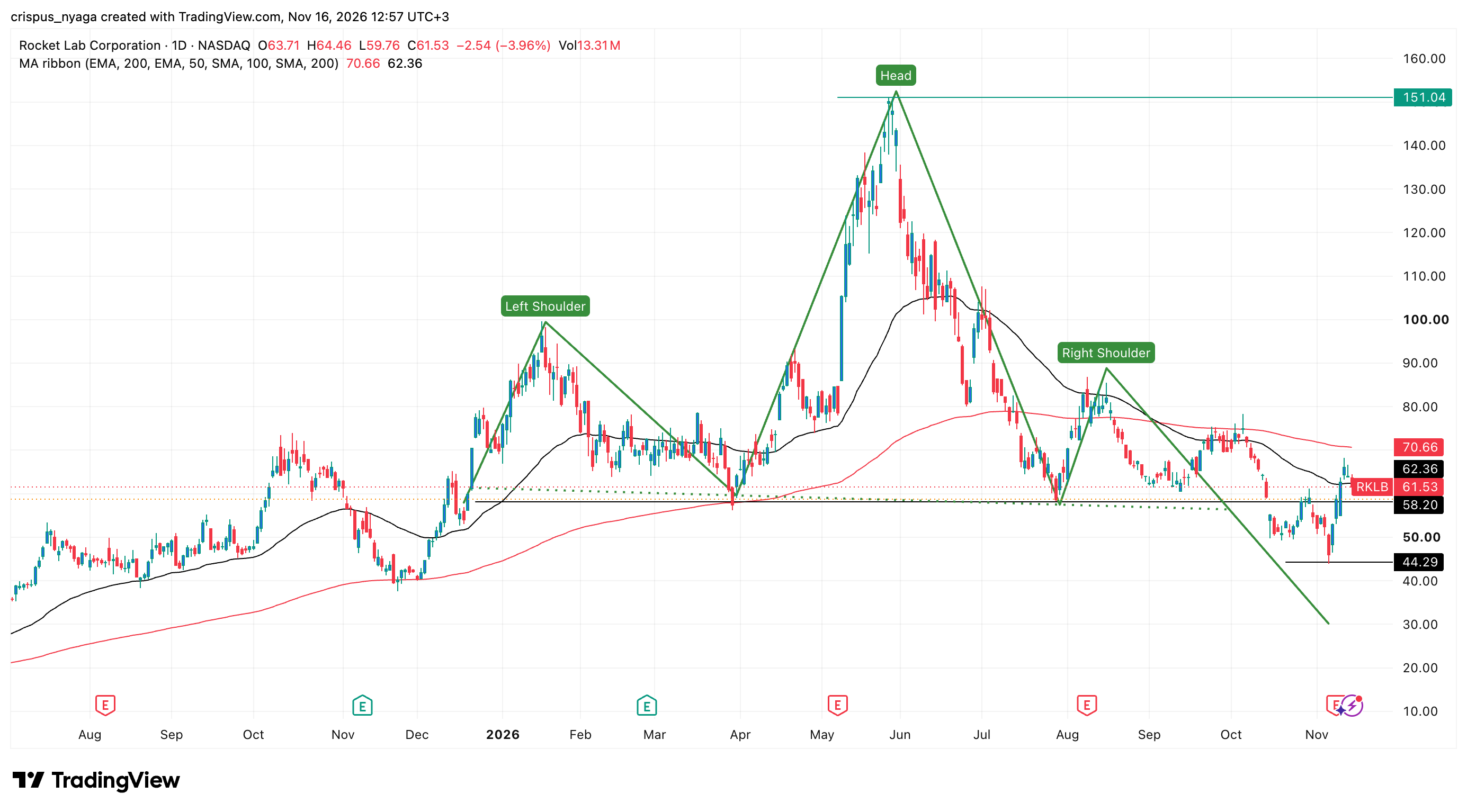
The daily chart shows that the RKLB stock has been in a strong sell-off in the past few months, moving from a high of $151 in June to a low of $44.30. It recently dropped below the important support level of $58.20, the lower side of the head-and-shoulders pattern. A H&S pattern is one of the most common bearish reversal patterns in technical analysis.

The stock has plunged below all moving averages and has retested the lower side of the H&S pattern. Therefore, there is a likelihood that the stock will resume the downward trend, potentially to this month’s low of $44.30. A move below that level will point to more downside. 

The post Rocket Lab stock jumped after earnings, but key risks points to a reversal appeared first on Invezz

Canadian retirees and other income investors are searching for good TSX dividend stocks to add to their self-directed Tax-Free Savings Account (TFSA) portfolios focused on generating steady tax-free cash flow.

In the current economic environment where central banks are starting to raise rates again to get inflation under control and stock prices look stretched in some sectors, it makes sense to search for companies with long track records of delivering steady dividend increases through the full market cycle.

Source: Getty Images

Enbridge

Enbridge (TSX: ENB) trades near $68 per share at the time of writing. It soared from $45 three years ago to as high as $80 this past summer. The subsequent pullback in recent months is giving investors who missed the rally a chance to buy a meaningful dip and pick up a solid 5.7% dividend yield.

Rising borrowing costs are responsible for the pullback, and additional rate hikes will likely be a headwind for the stock. That being said, Enbridge continues to grow through a combination of strategic acquisitions and a robust capital program.

The company recently announced more than US$3 billion in new acquisitions focused on American oil storage, transmission, and marketing assets that will complement the extensive existing oil infrastructure in the country. Enbridge provides producers with access to domestic refineries and its own export terminal located in Texas.

The oil infrastructure deals follow a string of purchases in other segments. Over the past few years, Enbridge bought three American natural gas utilities and added an American solar and wind project developer to diversify the asset portfolio. These moves have proven to be well-timed. New gas-fired power generation facilities and renewable energy developments are being built to provide electricity to tech companies as they expand data centres. Enbridge’s extensive natural gas transmission and distribution network should see strong volume growth.

On the development side, Enbridge is working on $38 billion in capital projects with roughly $10 billion in growth investments planned per year over the medium term. As the new assets are completed and go into service, the boost to earnings and distributable cash flow is expected to be around 5% annually. This should enable Enbridge to maintain steady dividend increases. The board raised the dividend in each of the past 31 years.

Fortis

Fortis (TSX: FTS) recently announced its 53rd consecutive annual dividend hike and is providing guidance for ongoing yearly increases of 4% to 6% through at least 2031.

The company owns and operates electric and natural gas distribution utilities, power generation facilities, and electricity transmission grids. These provide rate-regulated revenue streams from products and services that companies and households need regardless of the state of the economy.

Fortis sees good growth potential in both Canada and the United States in the coming years as demand for power rises. The current capital plan of more than $32 billion is already significant and will be spread out over the next five years. Fortis is evaluating other growth projects that could be added to extend the outlook. These would potentially support additional dividend increases in the coming years.

Fortis isn’t as cheap as it was a few weeks ago, but the stock should still deliver solid long-term total returns for new investors.

The bottom line

Enbridge and Fortis pay good dividends that should continue to grow. If you have some cash to put to work, these stocks deserve to be on your radar.

(Gareth Fuller/PA Images/Alamy)


Noah Vickers


3 min read2 hr

A government summit focused on tackling issues facing men and boys across Britain has been delayed until next year, PoliticsHome has learned.

Former prime minister Keir Starmer and his justice secretary David Lammy promised last year to hold a National Summit on Men and Boys in 2026, aimed at addressing issues like men’s mental health and online misogyny.

But with no date set and only six weeks left in the year, sources told PoliticsHome the summit is no longer expected to happen before 2027.

Approached for comment, justice minister Jake Richards said the summit would “likely” take place “early next year”. Further announcements are expected over the coming days.

Luke Evans, Conservative MP for Hinckley and Bosworth, said news of the summit’s delay was “disappointing, but unsurprising”, as he has been asking the government for updates since the summer. 

“We know that men and boys are less likely to talk about the challenges facing them, whether it be youth unemployment, rising suicide rates or health concerns, and the summit was an opportunity to put a spotlight on that and encourage people to talk and open up,” he told PoliticsHome.

“It’s a step forward that the government has identified a minister, Jake Richards, to work on a strategy, but it must not take the place of the summit.

“I met with Jake recently to press him on the need to take issues facing men and boys seriously, and to target issues such as steroid abuse and suicide. I’m pleased he is proactively looking at it. However, the summit is only the first hurdle; action must come, and sooner rather than later.”

In a parliamentary debate in September, Richards told MPs that Prime Minister Andy Burnham had “made it explicitly clear” to him “that the cross-government men and boys agenda would be right at the heart of his government”.

He added: “The conversations I have had with him, both prior to and post him entering Downing Street, have only cemented that. We will undertake a summit in due course and at the right moment, and the change of Prime Minister and government gives us an opportunity to work out the best mechanism for doing that.”

He also hinted at a wider programme of activities to come alongside the summit, saying: “It is one thing to hold a summit in Downing Street, but could we be more interactive across the country?

“We are looking at different mechanisms to make that a real moment for the country to talk about these issues and would be genuinely open to suggestions on a cross-party basis about how we can get that conversation going, out of this building and around the country, not just in Westminster. That is an ongoing discussion, and no doubt we will be able to update the House.”


Insider Brief

  • Tesla is inviting select customers to purchase its Cybercab for $29,990 before taxes, with a required $299 monthly Autonomy Subscription and initial deliveries expected in December in Austin.
  • The two-seat vehicle has no steering wheel or pedals and is limited to supported service areas, with personal, non-commercial use required unless Tesla authorizes other applications.
  • Tesla CEO Elon Musk said nationwide availability will depend on regulatory approvals and suggested lowering the subscription fee, while the National Highway Traffic Safety Administration continues reviewing the Cybercab’s compliance with federal vehicle safety standards.

Tesla is inviting select customers to buy a Cybercab for personal use at $29,990 before taxes, plus a required Autonomy Subscription of $299 a month, according to an X post from the company’s official Robotaxi account.

The two-seat car has no steering wheel or pedals and Tesla’s order page says the subscription and regular vehicle maintenance are required to operate it, with the first month included in the purchase. Orders require a $1,000 nonrefundable deposit, and the monthly fee is billed separately until it is canceled, excluding taxes. Tesla estimates December delivery in Austin.

An order-page screenshot shared by Marques Brownlee also lists Dallas, Fort Worth, Houston and San Antonio as delivery cities, and he wrote that orders are limited to one vehicle per customer. Electrek, citing Tesla’s invitation email, reported that the car is only available in supported service areas.

Ashok Elluswamy, Tesla’s vice president of AI, said in an X post that the Cybercab will work unsupervised inside all the same areas as Tesla’s Robotaxi service while serving its owners’ needs. Electric vehicle news site TeslaNorth, citing screenshots of Tesla’s Autonomy Subscription Agreement, reported that it is limited to personal, non-commercial use and cannot be used for Robotaxi, ride-hailing, delivery or rental platforms unless Tesla authorizes or enables that use.

In a reply to Brownlee, CEO Elon Musk said the vehicle will be available nationwide as the company receives regulatory approval. He also said the monthly fee is too high and should match the cost of Tesla Full Self-Driving and connectivity on other models, which he put at about $115 a month.

The National Highway Traffic Safety Administration has an open audit query into Tesla’s certification that the Cybercab meets all applicable Federal Motor Vehicle Safety Standards. The agency opened that review after Tesla began commercial Cybercab service in Austin, to examine the technical data and processes the company used to certify a vehicle without traditional human controls, including whether Tesla treated some standard requirements as not applying to its automated vehicles.

Tesla first showed the Cybercab at its We, Robot event as a two-door robotaxi priced under $30,000. The company later started production of the vehicle, and its third-quarter update said Robotaxi rides in Cybercabs had begun in Austin, with nearly 2 million cumulative unsupervised Robotaxi miles by the end of the quarter. At the time, every unit coming off the Texas line was going to Tesla’s own fleet, though Lars Moravy, vice president of vehicle engineering, said the company was trying to get Cybercabs to customers by year-end.

Elluswamy noted on the same call that customer-owned cars could start joining the Robotaxi fleet around the second quarter of next year. Musk also pointed out that Tesla would own most of the vehicles and offer them as a transportation service.

Trump Media stock bounced back this week after the company announced its financial results, which showed strong revenue and profitability growth. DJT jumped to $5, up by over 40% from its lowest point this month. Still, the company faces some major risks as Bitcoin falls and as Democrats prepares to take power.

Trump Media stock jumps after earnings

Trump Media, the parent company of Truth Social, published its third-quarter report, which provided insights about its business. The results showed that the company’s revenue jumped by 205% in the third quarter to $3 million. This revenue was driven by Truth API, the newly launched service that gives users the ability to pay for early access of Trump’s social media posts.

Most notably, the company said that its profit jumped during the quarter. It jumped to $409.7 million in the third quarter, much higher than the losses it generated in the same period last year. 

However, the reality is that these growth catalysts face some major risks ahead. First, Democrats won the midterm elections by a large margin. They are on track to win 56 seats in the Senate and more than 250 in the House of Representatives. Since corruption was one of the biggest issues in this election, Democrats will likely probe Trump Media for the Truth API solution.

Critics argue that the company is engaging in illegalities by allowing Trump to benefit from his social media posts. In other words, he is allowing rich high-frequency trading companies to have market-moving information before the rest of the market.

The other crucial risk that Trump Media faces is the ongoing Bitcoin price weakness. Bitcoin plunged to $67,700, down by over 22% from its highest point in September this year. It has moved to its lowest level since August 20th this year. 

The ongoing Bitcoin weakness is important for Trump Media because it is one of the biggest holders. It holds 15,649 coins, making it the 9th-largest Bitcoin holder in the world. Its Bitcoin holdings explain why its profit jumped in the third quarter as the coin jumped from $57,700 to $126,300 in October.

Further, the decision to merge with TAE Technologies faces risks since the company is not yet profitable. It was established in 1998 and has spent this period researching on its technology. While it has made substantial progress in this period, it is still unclear whether it will become a profitable company in the long term. 

Meanwhile, data compiled by SimilarWeb shows that Truth Social is not a popular social media platform. Its website visitors dropped by 22% in October from September. It has dropped by over 50% from a year earlier, a trend that has accelerated as Trump’s approval rating plunged. This trend will continue after the last midterm election in which the Republican party lost big.

DJT stock price technical analysis

Trump Media

Trump Media stock chart | Source: TradingView

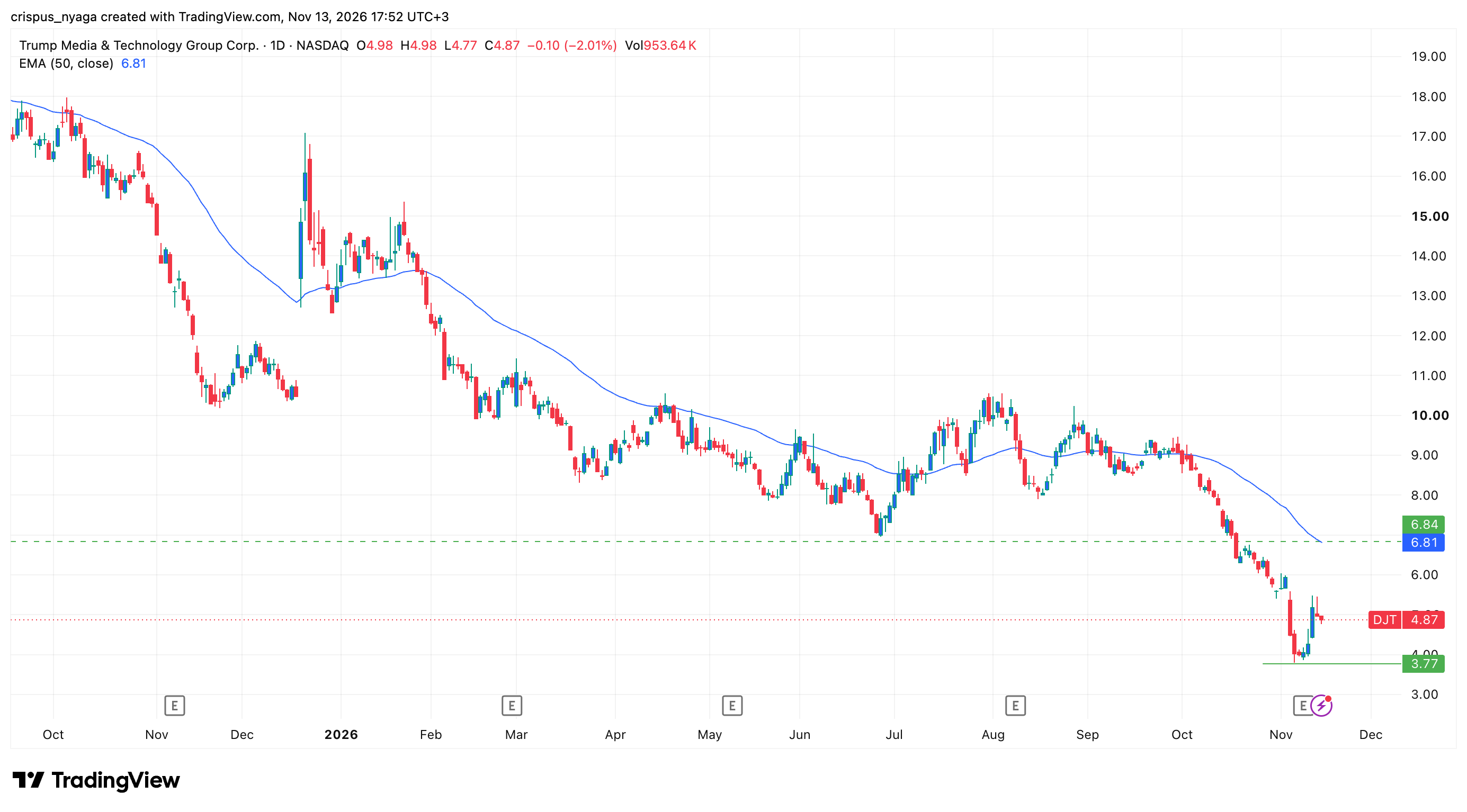
The daily chart shows that the Trump Media stock has been in a strong freefall this year and is now hovering near its all-time low. It has remained below the important support level of $6.85, its lowest level on June 26. 

The stock has remained below the 50-day and 100-day moving averages and the Supertrend indicators. Also, there is a risk that the ongoing rebound is a dead-cat bounce, a temporary rebound that is often followed by a retreat.

Therefore, the stock will likely resume the downward trend, and retest the support level of $3.7, its lowest level this week. A move below that level will point to more downside, potentially to the psychological level of $3.0. 

The post Trump Media stock jumped after earnings: beware of key risks appeared first on Invezz