
Author

admin

Browsing

Greens have raised concerns over the party’s failure to begin candidate selection (Alamy)


3 min read11 November

Green figures have expressed alarm that the party is yet to begin selecting parliamentary candidates despite speculation about a snap general election.

“Local parties need to crack on with getting their candidates selected, so they’re not caught with their trousers down if Burnham calls a snap election, which could come any moment,” a senior source told PoliticsHome.

They added: “The Greens have put themselves into a great position to advance at the next election, and they can’t squander it by failing to be prepared.”

A different source said they felt selection was yet to begin because the party had been busy “firefighting elsewhere” during a challenging few months for the Greens.

“That’s understandable, but the clock is running. Leave it much longer, and we’ll be rushing candidates through, which is not the best approach, especially with a potential snap election looming,” they said.

Prime Minister Andy Burnham has ruled out calling a general election in the next year, saying the public wants his Labour government to get on with delivering for the country.

However, speculation that the PM could look to capitalise on Labour’s position in the opinion polls and call an election in the coming months persists in Westminster.

While other parties have started selecting candidates, the Greens are yet to do so. PoliticsHome understands this is because the central party is finalising guidance that it will give to local branches to help them carry out selections. 

The party says it is taking time to learn from previous elections, as well as design an approach that can handle a larger number of target seats than it is used to.

Another Green source told PoliticsHome that the party was facing “a capacity issue”, rather than a failure to appreciate the urgent need to select candidates, explaining that it was trying to deal with a large influx of new councillors after a strong performance at recent local elections. It is a case of being “a victim of your own success,” they said.

However, the same source added that there had been a “certain degree of naval gazing” within the Greens in recent weeks following the fallout from the contentious “Zionism is racism” motion passed at its October conference in Brighton.

A spokesperson for the Green Party told PoliticsHome: “The Green Party is ready whenever an election is called. Voters are keen to hear our messages on climate action and tackling the cost of living, and fed up of Labour’s backtracking and lack of action.”

The Greens surged in the polls when Zack Polanski took over as leader in September 2025 and went on to make significant electoral gains, such as victory over Labour in the Gorton and Denton by-election.

Since then, however, the party has fallen back in the polls, and Polanski’s personal ratings have dropped sharply, with Labour under Burnham winning back left-wing voters.

The “Zionism is racism” motion has triggered a divide within the party, as well as calls for reforms to how the party is structured and decides policy. The motion was backed by 1,002 votes – 0.4 per cent of total party members – to 813.

Jonathan Bartley, who co-led the Greens between 2016 and 2021, said last month that there is a “toxicity of the Green Party brand” and that allegations of antisemitism are clearly having an impact”. He spoke to PoliticsHome after Polanski lost to Labour in the by-election to represent the North London seat vacated by Keir Starmer.
 

A 15-year utility investment should outlast a few interest-rate scares. It also needs to survive the less dramatic problem of paying too much for dependable earnings. Electricity and gas bills keep arriving, but shareholders still depend on regulators, financing, and sensible management. Between two familiar utilities, a major proposed merger now makes the long-term choice less straightforward than comparing dividend streaks.

Source: Getty Images

CU

Canadian Utilities (TSX: CU) supplies energy infrastructure, including electricity and natural gas networks. Regulated assets can earn through approved customer rates, giving investors a more structured earnings model than betting directly on the price of power.

In October, Canadian Utilities, Emera, and ATCO announced a combination. Under the agreement, outside Class A Canadian Utilities shareholders would receive 0.755 Emera shares for each share held. Required approvals remain outstanding. A new buyer therefore needs to want the proposed future investment as well as the business currently trading.

That’s a different 15-year decision from buying a standalone utility and expecting it to stay much the same. The combined operation would broaden exposure, while adding merger execution and the eventual financing and regulatory demands of a larger company.

H

Hydro One (TSX: H) operates Ontario electricity transmission and distribution. Transmission moves power over longer distances, while distribution connects local customers. It earns through regulated service, with new infrastructure potentially increasing the asset base on which it can earn an approved return.

Second-quarter earnings rose to $0.62 per share from $0.54. For shareholders, that means more profit attached to each share. Investment needs to translate into that kind of improvement, since a bigger spending plan alone doesn’t pay a dividend.

The quarterly payment is $0.3531, annualizing to $1.4124. At the recent close of $57.18, the indicated yield is about 2.5%. I’d be paying for future earnings and dividend growth as well as current income, making entry discipline part of the holding strategy.

Creating cash

Here’s what separate $10,000 budgets buy at recent prices. Canadian Utilities currently produces about $100 more annual income on that budget. Its yield is around 3.5%. That larger payment is relevant for someone spending the income now, but it shouldn’t be projected unchanged over 15 years if the merger completes.

COMPANYRECENT PRICENUMBER OF SHARESANNUAL DIVIDENDANNUAL TOTAL PAYOUTFREQUENCYTOTAL INVESTMENTCU$53.27187$1.8492$345.80Quarterly$9,961.49H$57.18174$1.4124$245.76Quarterly$9,949.32

The exchange ratio also means a Canadian Utilities purchase is partly a decision about Emera’s future share value. I’d review the final transaction terms and resulting payment policy before treating the current income advantage as permanent. Until closing, the businesses continue independently.

Considerations

For new money, I’d prefer Hydro One’s simpler operating exposure, with a lower entry price than today’s. At a 3% starting yield, for example, the current annual dividend implies $47.08 per share. A 15-year horizon can make waiting feel unnecessary, but the starting price still affects the return.

Growing $10,000 at an assumed 6% total return produces about $23,966 after 15 years. At 4%, it becomes about $18,009. Both include reinvested dividends, illustrating how modest annual differences accumulate.

Higher borrowing costs, storm repairs, and unfavourable rate decisions can reduce either utility’s progress. I’d keep the holding among other Canadian dividend stocks and avoid using money needed soon. Essential service doesn’t turn the shares into guaranteed savings.

Bottom line

Hydro One is my 15-year preference for a long-term Canadian portfolio, with the purchase waiting for a more comfortable price. Canadian Utilities could suit someone deliberately choosing the proposed combined business. I’d wait for that transaction to become clearer while giving Hydro One’s future earnings a price I can live with.

Figma stock remains under pressure and is hovering near its record low as concerns about disruption from artificial intelligence (AI) continue to weigh on sentiment. The shares recently dropped to $18.90, just a little above the all-time low of $16.48, and they have now slumped by more than 86% from their peak. So, will the stock fall further or bounce back?

Figma stock has dropped amid AI concerns

Figma, a top company in the design industry, has come under pressure since going public, as investors remain concerned about the potential disruption from artificial intelligence (AI) tools, a situation now known as SaaSpocalypse.

Its sell-off has mirrored that of other companies in the software industry. ServiceNow has dropped by over 37% from its highest point in October, while Salesforce has fallen by 20% from its peak. Other top software companies like Workday and Adobe have also slipped.

On the positive side for Figma, its business has continued growing and defying expectations, a sign that demand for its products is strong. The most recent earnings report showed that its revenue jumped by 43% in the third quarter to $391 million, with its gross margin rising to 80%.

Most notably, the number of companies using its platform continues to grow such that the net dollar retention rate was 131%. Its paid customers spending over $10,000 has jumped to 15,566, while those paying over $100,000 rose to 1,117. 

The company has also seen the number of customers using AI on its platform increasing in the past few quarters. In a statement, the company’s CEO said: 

“AI is opening up new possibilities for how products get built, and we see incredible opportunity for Figma to shape what comes next. As code becomes abstracted, the products that are built will be defined by the judgment and the creativity of the humans behind them.”

Analysts see Figma’s growth continuing

Top analysts expect the company’s revenue to keep growing in the coming years despite the AI disruption. The average estimate among analysts is that its fourth-quarter revenue will be $403 million, representing a 33% annual increase. 

In its earnings report, the company estimated that its revenue would be between $401 million and $404 million. As such, chances are that the company will release stronger-than-expected results, as it has always done since going public.

Analysts have a bullish outlook for the company, even as most of them slashed their outlook. Citigroup’s Tyler Radke has a target of $34, while JPMorgan has a target of $24. Royal Bank of Canada sees the stock rising modestly to $24, while Wells Fargo expects it to hit $30. 

Figma share price technical analysis

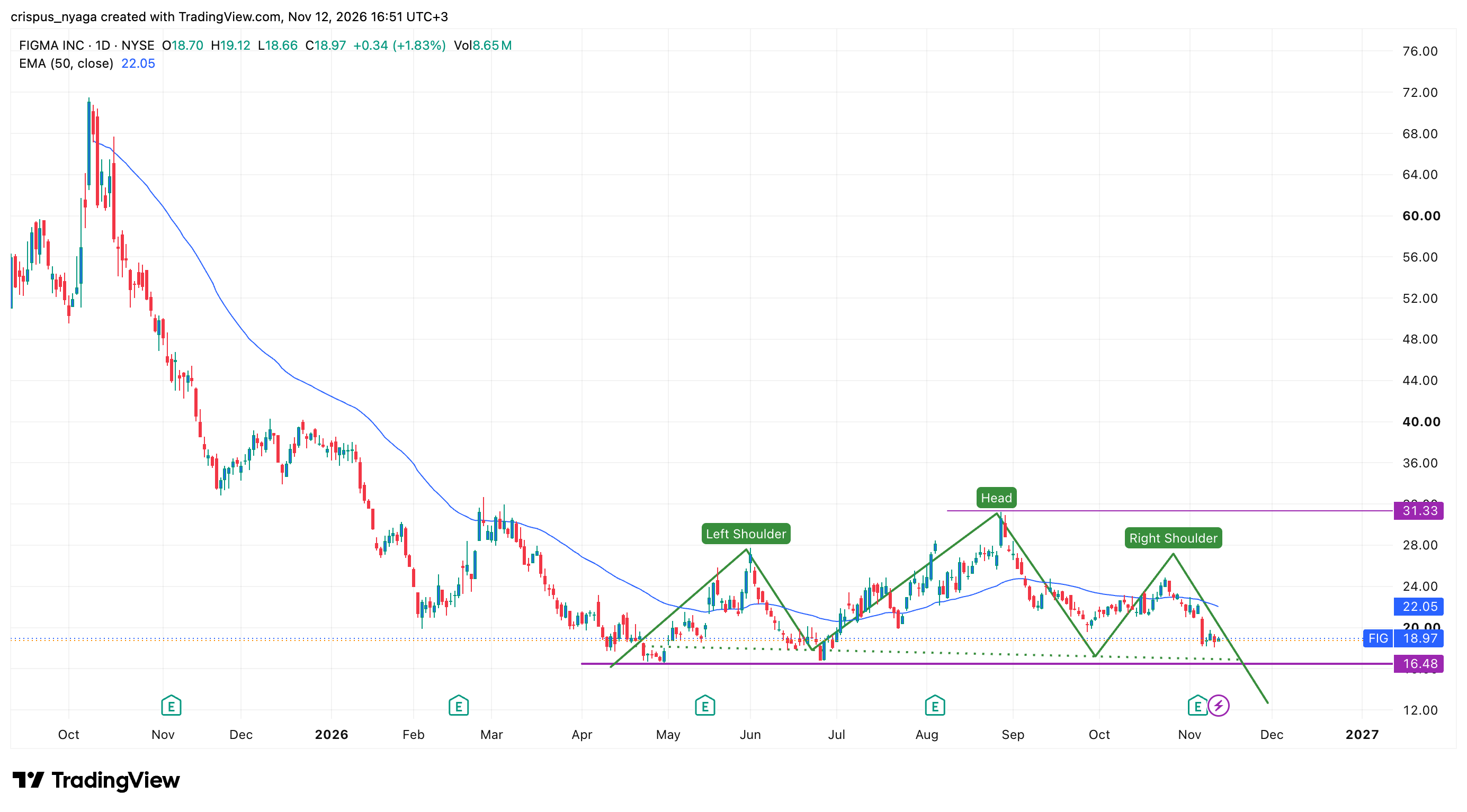
FIG stock chart | Source: TradingView

The daily chart shows that the Figma stock has come under pressure in the past few weeks, moving from $31.3 on August 27 to $18.97. It has remained below the 50-day Exponential Moving Average (EMA).

The stock has formed a head-and-shoulders pattern, which is a common bearish reversal sign in technical analysis. Its neckline, in this case, is at $16.48. Therefore, there is a risk that the stock will continue falling, potentially to the support of $15. 

In the long term, however, the stock seems to be in the accumulation stage, which often leads to a short squeeze. That is a possibility considering that the company has some solid  fundamentals, including strong growth and a path towards profitability.

The post Figma stock sits near record lows as a risky chart pattern signals further downside appeared first on Invezz

Canadian retirees are searching for ways to get better returns on their savings to help offset the impact of inflation.

One popular investing strategy involves owning a combination of GICs and top TSX dividend growth stocks inside a self-directed Tax-Free Savings Account (TFSA).

Source: Getty Images

TFSA limit in 2026

The cumulative maximum TFSA contribution limit is $109,000 in 2026 for anyone who has qualified to make TFSA contributions every year since the launch of the TFSA in 2009. All interest, dividends, and capital gains earned inside a TFSA on qualifying investments are tax-free.

GIC pros and cons

Rates offered on Guaranteed Investment Certificates (GICs) have increased in 2026 in step with rising bond yields. At the time of writing, investors can get non-cashable GICs paying more than 4% from Canada Deposit Insurance Corporation (CDIC) members. This is comfortably above the current rate of inflation in Canada, so it makes sense to consider GICs for a TFSA portfolio today.

Money invested in a GIC is 100% safe as long as the GIC is offered by a CDIC member and the amount is within the $100,000 limit. This is comforting for investors who don’t want to put their invested capital at risk, but still want to get a decent return. On the downside, the best rates are offered on non-cashable GICs, so the funds are locked up for the duration of the certificate. In addition, rates on GICs are fixed for the term, so there is a risk of missing out on higher rates if funds are locked up for several years.

Dividend stock pros and cons

The TSX is home to many stocks with long track records of delivering steady dividend growth. Each time a dividend is increased, the yield on the initial investment rises. This helps investors build in some inflation protection into their savings. Stocks can also be sold at any time to access the investment funds in case there is an emergency cash requirement.

There is a trade-off, however, for this expected dividend growth and the potential capital gains. Stock prices can fall below the purchase price and dividends can be cut if a company runs into cash flow issues. Even top dividend-growth names can see their share prices pull back considerably over short periods of time.

Enbridge (TSX: ENB), for example, trades near $67 per share at the time of writing. This compares to $80 a few months ago, despite solid financial results and annual dividend hikes in each of the past 31 years.

Investors with a buy-and-hold strategy can take advantage of dips to pick up a higher dividend yield. Enbridge’s stock currently provides a yield of 5.8%.

Enbridge is working on a $38 billion capital program that is expected to drive steady growth in earnings and distributable cash flow over the medium term. Market conditions are favourable for energy infrastructure companies amid rising demand for oil and natural gas. Enbridge moves close to 30% of the oil produced in Canada and the United States and 20% of the natural gas used by American homes and businesses.

The bottom line

The right mix of GICs and dividend stocks depends on a person’s risk tolerance, need for access to the funds, and the required minimum yield.

In the current environment, it is quite easy to put together a diversified portfolio of GICs and top TSX dividend stocks to get an average yield of 4.3%. On a TFSA of $109,000 this would generate $4,632.50 per year in tax-free passive income. That works out to an average of about $386 per month.

Target is in the middle of a significant business overhaul as it tries to reverse a prolonged period of uneven performance and give shoppers more reasons to choose its stores. 

The company has been working to sharpen its merchandise assortment, improve its shopping experience, and make its operations more competitive as consumers increasingly expect convenience alongside value.

One of the biggest pieces of that effort involves getting merchandise into customers’ hands faster.

Target is investing heavily in same-day and next-day fulfillment, a strategy that reflects how much online shopping habits have changed. But its approach also highlights an interesting difference between two of America’s biggest retailers.

While Target is leaning into faster delivery, Costco has built its business around giving customers compelling reasons to make the trip to a physical warehouse.

The two companies are pursuing very different approaches to winning shoppers, and both have found ways to make their respective strategies work.

Target sees faster fulfillment as a competitive advantage

Target’s second-quarter 2026 earnings call offered evidence that its investments in convenience are gaining traction.

During the quarter, Target fulfilled nearly 30% more same-day and next-day units than it did during the same period last year, executives said. The company also reported digital comparable sales growth of 8.7%, with same-day delivery growing more than 25%.

Those gains are part of a broader effort to improve the retailer’s digital business while making its physical stores more productive.

Target is also investing in inventory reliability and its supply chain. The goal is to make sure products are available where customers need them and get orders to shoppers more quickly.

Target’s Shipt acquisition is central to that strategy. The delivery platform gives the retailer access to an established network of shoppers and delivery infrastructure, helping it compete in a market where consumers increasingly expect online orders to arrive quickly.

“Same-day is becoming table stakes, but it’s about competing with Walmart, not Costco. Shipt has proven to be Target’s best purchase ever,” TheStreet Co-Editor-in-Chief Daniel Kline said.

That distinction matters. 

Target isn’t necessarily trying to convince Costco members to abandon warehouse shopping. Instead, it’s competing with retailers like Walmart that have made convenience a central part of their value propositions.

And the opportunity is significant. Target Circle 360, the company’s paid membership program, also benefits from its delivery capabilities, giving shoppers another reason to consolidate purchases with the retailer.

The company reported that Target Circle 360 membership revenue increased more than 40% year over year in the second quarter.

Kenishirotie/Shutterstock.com

Costco is betting on the warehouse experience

While Target is trying to get products into consumers’ hands faster, Costco has little reason to make rapid delivery the centerpiece of its business.

The warehouse club has built its reputation around affordable bulk merchandise, quality products, membership perks, and an in-store shopping experience that encourages customers to discover products they weren’t necessarily planning to buy.

That treasure-hunt experience is an important part of Costco’s appeal. Shoppers visit warehouses to find rotating merchandise, seasonal products, food court favorites, and deals that can be difficult to enjoy elsewhere.

The strategy also supports Costco’s membership model. The company wants customers to renew their memberships and visit frequently, giving them reasons to spend more during each warehouse trip.

That doesn’t mean Costco is ignoring digital shopping. The retailer offers same-day delivery through third-party partners, including Instacart, and has invested in improving its website, app, and digital shopping experience.

But those investments largely complement its warehouse business rather than replace it.

Costco CEO Ron Vachris has emphasized that the physical warehouse remains central to the company’s value proposition. The retailer wants technology to improve convenience and member loyalty without losing the experience that differentiates it from competitors.

That approach has helped Costco maintain strong customer loyalty. Its U.S. and Canadian membership renewal rate reached 92.3% in the fourth quarter of 2026, according to the company’s most recent earnings call.

For Target, the challenge is different. It needs to make shopping easier for consumers who increasingly expect to receive purchases quickly, while also improving the merchandise and in-store experience that brings customers through its doors.

Ultimately, Target and Costco are pursuing the same broad objective of building customer loyalty and increasing spending. But their strategies demonstrate that there isn’t just one way to accomplish that.

Target wants to make getting products easier. Costco wants to make visiting its warehouses worthwhile. And for now, both retailers are doubling down on what makes their businesses different.

Maurie Backman owns shares of Target and Costco.

Related: Target copies Costco food court with new in-store snack bar

Insider Brief

  • Hasbro’s Sixth Wall Studio and Dynamic Creatures are partnering to develop interactive robotic characters that can greet visitors, engage in conversations and remember previous encounters at theme parks and resorts.
  • The collaboration combines Sixth Wall’s AI character software with Dynamic Creatures’ SnowJay robotics platform, which coordinates movement, facial expressions, conversation and memory.
  • The companies are exploring applications in hotels, cruise ships and retail venues, with memory-enabled interactions subject to guest permissions and initial Sixth Wall applications focused on audiences ages 13 and older.

Hasbro’s Sixth Wall Studio and Dynamic Creatures are developing robots based on licensed characters that could greet visitors, interact with them and remember previous encounters at theme parks and resorts.

According to Dynamic Creatures, the partnership combines Sixth Wall’s AI software for managing character personalities and behavior with Dynamic Creatures’ mobile robots, which use movements, facial expressions and gestures to interact with people.

“Sixth Wall brings the character intelligence and creative framework,” Dynamic Creatures co-founder and CEO Marc Theermann said in the announcement. “We bring the physical expression and presence. Together, we want to make meeting a favorite character feel like the beginning of an ongoing relationship.”

Dynamic Creatures, which emerged from stealth in September 2026, develops custom robotic characters using existing robot platforms. The Boston company is also Boston Dynamics’ official hospitality and entertainment partner. Its SnowJay robotics AI platform coordinates how robots perceive their surroundings, move and behave, bringing together conversation, memory, facial expressions and animatronics to support interactions with visitors.

Sixth Wall, launched by Hasbro in June 2026, develops technology designed to keep licensed characters consistent with their established personalities, voices and stories. Its CharacterOS platform and Behavioral Licensing framework will be adapted for use in physical robots.

“Bringing a character to life means preserving the personality, voice, and story that fans love while opening up new ways to interact,” added Sixth Wall Studios CEO Roberta Thomson. “Our partnership with Dynamic Creatures takes that ambition into the physical world. We envision characters that can share an adventure with you while feeling unmistakably authentic from the first hello.”

Dynamic Creatures pointed to an example where a robotic character at a resort could welcome a guest, send them on a quest and ask about the adventure when they meet again. Beyond theme parks and resorts, the companies are looking at how characters could be put to use in hotels, cruise ships, retail destinations and other entertainment settings.

The companies said experiences involving memory would be developed around guest choice and clearly defined permissions, with specific arrangements determined for each venue. Initial applications involving Sixth Wall technology will focus on audiences ages 13 and older.

Oracle stock has slumped this year and is significantly underperforming other big technology companies like Microsoft, Meta Platforms, and Cisco. It was trading at $117.90 on Wednesday, down 52% from its highest level this year, with its market capitalization falling from over $713 billion to $356 billion. While the company looks cheap, several risks could weigh on its performance.

Oracle’s business is growing, but risks remain

Oracle’s most recent financial results showed the business is doing modestly well, helped by ongoing demand for its services. Revenue jumped 30% to $19.3 billion, making Oracle one of the fastest-growing big tech companies in the industry.

The company has benefited from a surge in demand, especially from OpenAI, the creator of ChatGPT. The deal between the two companies is worth over $300 billion. In the last report, the company said that the remaining performance obligations (RPO) jumped by $209 billion to over $664 billion. 

Despite this growth, Oracle faces major challenges, which help explain why its stock has tumbled this year. One key risk is OpenAI, its top partner. According to The Wall Street Journal, OpenAI’s revenue continued to grow, but its losses surged in the third quarter. As such, there is a risk on whether OpenAI will be able to honor the deal, considering that it recently failed to hit its $30 billion target.

The company has faced other challenges. For example, it recently terminated a $7 billion deal with Tencent after coming under political pressure. Microsoft has also started winding down some of its relationship with Oracle. 

Meanwhile, its Project Jupiter data center in New Mexico has faced substantial challenges, especially around power. The company has already issued a force majeure notice on the project, which means it may face delays.

Most importantly, the company has continued raising capital to fund its data center rollout. Just recently, it announced that it will raise $20 billion through a combination of debt and equity. In its earnings report, the company said that its total debt has jumped to over $174 billion. Because of its risks, its bond yields have continued rising this year.

Oracle is a bargain on most metrics

There are signs that the company has become highly undervalued. Data shows that the company has a forward price-to-earnings ratio of 14.4, much lower than that of other companies. The median multiple of the technology sector is 19.8. 

The same is true of the forward PEG ratio of 0.48, which is also much lower than the technology sector median of 1.09. Similarly, a discounted free cash flow (DCF) calculation by Simply Wall St shows that the fair value of the stock is $185, much higher than where it is today.The cheap multiples are because investors believe that the company has major risks ahead. 

Analysts tracking the company have a bullish outlook. The average target for the stock is $249, representing a 111% jump from the current level. KeyCorp, BTIG, and HC Wainwright have a bullish outlook.

Oracle stock price technical analysis

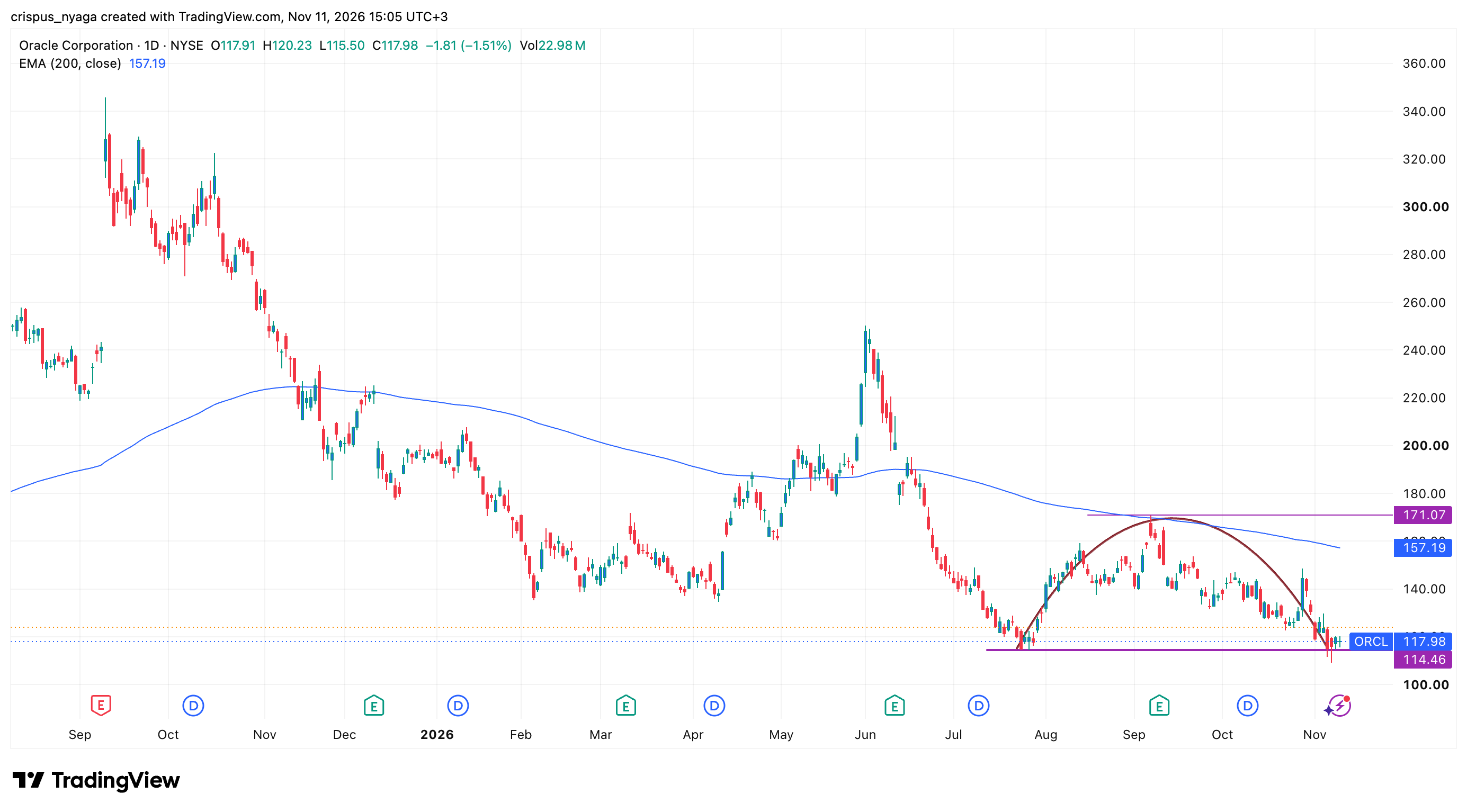
ORCL stock chart | Source: TradingView

The daily chart shows that the ORCL stock has been in a downward trend in the past few months. It reached a low of $114.46, its lowest swing in July this year. It is common for stocks and other assets to rebound after hitting such an important support level. 

The stock has also formed an inverted cup-and-handle pattern, which is a common continuation sign in technical analysis. It also remains below the 50-day moving average. 

Therefore, while Oracle is highly undervalued, technicals suggest that the stock may continue its strong downward trend.

The post Oracle stock is a bargain, but key risks suggest it may drop to $100 and below appeared first on Invezz

Canadians can turn the TFSA (Tax-Free Savings Account) into a source of monthly passive income by owning quality dividend stocks that offer a monthly payout.

In this article, I have identified two high-yield dividend stocks that should be on top of your monthly income watchlist in November 2026.

Source: Getty Images

How much do you need in a TFSA to earn $400 a month tax-free?

Canadians seeking to earn $400 a month in tax-free dividend income will need to invest around $120,000 at a 4% yield. If the dividend yield rises to 6%, the investment falls to $80,000. Basically, the dividend yield and share price of a company have an inverse relationship.

In 2026, the TFSA contribution room has increased to $7,000, bringing the maximum cumulative contribution room to $109,000.

Notably, dividends or capital gains earned by qualified investments in a TFSA are exempt from Canada Revenue Agency taxes.

Should you own this 13% dividend stock in the TFSA?

Timbercreek Financial (TSX: TF) is a Canada-based non-bank commercial real estate lender that provides customized debt financing solutions to commercial real estate investors. The company focuses on structured bridge and transitional loans secured by income-producing commercial properties, with an emphasis on multi-family residential assets across Canada.

It aims to generate stable monthly dividend income and preserve capital for shareholders. In November 2026, it offers an annual dividend of $0.69 per share, which translates to a yield of over 13%.

On its July 30 earnings call, the company reported distributable income of 14.6 million, or $0.18, indicating a payout ratio of 97%.

Here’s why the loan book looks conservative.

  • Most of Timbercreek’s loans sit first in line. About 94% are first mortgages, so Timbercreek gets repaid before other lenders.
  • Roughly 81% are properties that bring in rent, such as apartment buildings.
  • On average, Timbercreek lent 68.3% of each property’s value.

Stage 3 balances, which are defined as loans under stress, have fallen by 51% over the last two quarters. However, about 20% of the portfolio is still in Stage 2 or Stage 3, well above the usual 7% to 10%. Resolving those loans has a cost, and higher credit loss provisions cut net income to $7.8 million in Q2 from $12.4 million in the prior quarter.

Why Diversified Royalty’s 8% yield looks steadier

Diversified Royalty (TSX: DIV) is a multi-royalty corporation and pays an annual dividend of $0.29 per share, or a yield of almost 8%.

In Q3, it reported revenue of $31.5 million, up from $18.3 million in the year-ago period. Its combined contribution rose to $24.9 million from $19.6 million, while distributable cash climbed 21.9% to $15.5 million.

The payout ratio improved to 86.9% from 91.9%, which leaves more room compared to Timbercreek.

In July, the company sold about 12.3 million shares at $4.66 and used the money to fund the $38.5 million acquisition loan for the Mr. Lube + Tires franchisor business.

What a $400 a month TFSA portfolio looks like

You need to invest about $45,200 split evenly between the two TSX dividend stocks to earn $400 a month in passive income.  

COMPANYRECENT PRICENUMBER OF SHARESDIVIDENDTOTAL PAYOUTFREQUENCYTimbercreek Financial$5.204,346$0.0575$250MonthlyDiversified Royalty$3.626,243$0.02375$150Monthly

Over the last five years, a similar investment in the two monthly dividend stocks would be worth around $62,000 today, after adjusting for dividend reinvestments.

In this period, Timbercreek has delivered negative returns while Diversified Royalty has almost doubled.

We can see that investing in a dividend stock with a lower payout and a sustainable yield is a much better option than chasing high-yield stocks.

In a reddit AMA on Friday, in between jokes about gay bears and JD Vance’s potential username being CushionCasanova, Grindr CEO George Arison answered a question about the economy. He didn’t hold back.

“Inflation is terrible, and there’s a massive affordability crisis in this country that our government has ignored since at least 2020,” he wrote in the r/wallstreetbets subreddit, where, following the release of the company’s quarterly earnings report, he took questions from users.

It was a startling admission from the man whose company is about to release a subscription offering intended to price out most Grindr users. On November 17, Edge, a “premium tier” with some AI-powered features costing $120 a month, will be available to members worldwide, according to the report. Early access opened today.

The document suggests that Edge will help users find connections “with less effort” and will include a personalized recommendation feature, Insights, to “understand compatibility and the likelihood of a reply,” as well as Reconnect, which “brings past connections back into view.” The app will have an entirely new design, interface, and icon intended to create a vastly different experience for users willing to foot the high price tag.

But even if you can afford it, you may not get in. As with Raya, an invite-only app where some people have been on the wait list for as long as seven years, the company is planning to turn Edge into a digital gated community of sorts: Sign-ups will be limited to 1 percent of global monthly users.

The goal is to “deliberately [manage] the growth of the Edge community to preserve exclusivity” for “a select community” who can pay “meaningfully more,” the report noted. According to figures from the company, only 1.4 million of its current 16 million users pay to use Grindr.

Edge’s official rollout comes following pilot programs in Australia, New Zealand, Canada, and the US, and a year’s worth of speculation about how much it would cost and what exactly would separate it from other apps that provide comparable features at a lower price.

“These VIP tiers make me think of [it as a] digital version of expensive hustler bars,” one user said on Instagram. “The men who will pay hundreds for access are rarely the hot men you would log on for.”

Grindr is the world’s largest dating app for gay, bi, and trans people, but it has consistently struggled with user concerns of data privacy and user safety. And as it unveils its latest upsell, many members say the app’s fundamental infrastructure remains broken.

“Grindr is a top-tier example of enshitification and predatory monetization,” one person wrote in the reddit AMA from last week. “You need to stop with the intrusive ads and start getting in touch with reality,” posted another.

In September, the company agreed to a $35 million class action settlement over allegedly sharing users’ HIV status and testing information with third-party vendors; the details of the settlement included no admission of liability on Grindr’s behalf. That same month, Grindr acquired the telehealth company Freddie, which helps people get access to the HIV-prevention medication PrEP. The purchase builds on Arison’s investment into health care and turning the app into a social network. Currently, Grindr sells erectile dysfunction pills and GLP-1 weight-loss medication through its Woodwork program.

Critics will likely argue that pivoting to luxury dating in an economy where more and more people are struggling isn’t great optics, but Arison is betting that improved features and a “deliberately limited membership” will create opportunity for “substantially higher pricing over time,” the report noted.

BCE (TSX: BCE) and Enbridge (TSX: ENB) are two popular Canadian dividend stocks offering attractive yields for income investors. With their dividend yields currently sitting at about 5.7% and 5.9%, respectively, both deserve consideration. However, when it comes to generating reliable passive income, I believe one has a clear advantage.

While BCE offers an intriguing turnaround opportunity following its dividend reset, Enbridge’s stronger dividend track record, healthier payout ratio, and more predictable growth outlook make it my preferred choice for income today. Here’s why.

Source: Getty Images

Dividend history and safety: Enbridge has the edge

BCE investors haven’t forgotten the 56% dividend cut in May 2025. The reduction was necessary to address an unsustainable payout and help protect the company’s leveraged balance sheet. Nevertheless, investors should focus on whether today’s dividend is sustainable.

Following the cut, BCE’s dividend appears more manageable. Based on its 2026 free cash flow guidance of $2.1 billion to $2.3 billion, its payout ratio is expected to be approximately 81%. Management is also targeting $1.5 billion in structural cost reductions by 2028, which could strengthen future cash flow. BCE maintains an investment-grade BBB credit rating from S&P and has held its quarterly dividend at $0.44 per share since the reduction.

However, Enbridge offers considerably more dividend certainty. The energy infrastructure giant has paid dividends for more than 70 years and delivered approximately 30 consecutive years of dividend growth. Its recent annual increases had been around 3%.

More importantly, Enbridge targets a sustainable dividend payout ratio of 60–70% of distributable cash flow (DCF). Its stronger BBB+ credit rating from S&P also provides additional financial reassurance.

For investors prioritizing dependable income, Enbridge is the clear pick.

Recent results and growth outlook

BCE’s latest third-quarter (Q3) results showed signs of operational progress, but also highlighted its ongoing challenges. Revenue increased 2.2% year over year to nearly $6.2 billion, while adjusted EBITDA (a cash flow proxy) rose 0.9% to approximately $2.8 billion. Adjusted net earnings declined 5.2% to $695 million.

Operating cash flow increased 16% to $2.2 billion, but free cash flow fell 15% to $854 million, reflecting substantial investments in a fully contracted 300-MW AI data centre project in Saskatchewan and U.S. fibre expansion through Ziply Fiber. The data centre’s first phase is expected to come online in the first half of 2027.

For 2026, BCE expects revenue growth of 1–5% and adjusted EBITDA growth of 0–4%. However, adjusted earnings per share (EPS) could decline 5–11%, while free cash flow is forecast at $2.1 billion to $2.3 billion, down 28–34% from the previous year.

Enbridge, meanwhile, delivered more encouraging quarterly results. Q3 adjusted EBITDA increased 3.9% to $4.4 billion, adjusted earnings climbed 7.7% to nearly $1.1 billion, and adjusted EPS rose 6.5% to $0.49. DCF increased 4.8% to $2.7 billion.

Management reaffirmed its 2026 adjusted EBITDA guidance of $20.2 billion to $20.8 billion and DCF per share guidance of $5.70 to $6.10. It also expects approximately 5% average annual growth in adjusted EBITDA, DCF per share, and EPS over the medium term.

That visibility gives income investors greater confidence in Enbridge’s ability to sustain and gradually grow its dividend.

Valuation and my preferred income stock

Both stocks appear to trade at good valuations. At $30.57 per share at writing, BCE trades approximately 18% below the analyst consensus price target, implying potential upside of nearly 22%. Enbridge, at $66.14, trades about 15% below its consensus target, suggesting upside of approximately 18%.

The bottom line

I’d prefer Enbridge for income. Its slightly higher 5.9% dividend yield, more sustainable payout ratio, stronger dividend growth history, and clearer medium-term growth outlook provide a better mix of income and reliability.

BCE shouldn’t be dismissed, however. Successful execution of its AI data centre investment, U.S. fibre expansion, and cost-reduction initiatives could support a meaningful turnaround and potentially restore dividend growth over time.