Author

admin

Browsing

Vodafone share price remained on edge on Tuesday after the company published its financial results, which showed that its growth continued. It has slipped by over 13% from its highest point this year, meaning that it has moved into a technical correction. Technicals suggest that the stock has more downside in the near term. 

Vodafone shares fall despite strong numbers

VOD stock has been in a slow downward trend in the past few weeks, a trend that may continue in the coming weeks. In a statement, the company said that its service revenue rose by 11.4% in the first half of the year to €21.9 billion, helped by its service revenue. 

The company’s growth also accelerated because of its recent acquisitions, including Safaricom, Three, and Telekom Romania. In Germany, its top market, organic service revenue rose modestly by 0.4%, even as its customer base dropped by 75,000 in the first half of the year.

The same growth happened in the UK, where its organic revenue rose by 0.9%, while in Africa, the revenue soared by 13.4%. 

Most notably, the company’s adjusted EBITDAaL, which jumped by 12.6% to €6.5 billion, while its net loss stood at €3.6 billion. The loss was mostly because of a non-cash charge, with the management citing:

“impairment in Germany, primarily driven by adverse changes in interest rates, and a write-down of deferred tax assets in the UK following the buyout of CK Hutchison Group Telecom Holding Limited from VodafoneThree.”

Most notably, the company upgraded its guidance for the year. It now expects its adjusted EBITDAaL will be between €13.2 billion and €13.4 billion, up from the previous €13 billion and €13.3 billion. 

Additionally, the company now expects its adjusted free cash flow to be between €2.8 billion and €3 billion. The management also expects that its Europe gross savings will be €2 billion through 2030. It continues cutting costs through job cuts, including in Germany, its biggest market. 

Vodafone faces challenges ahead

Vodafone faces some major challenges ahead. For example, like other telecommunications companies, there is a risk that the company will be disrupted by SpaceX, which recently acquired low-band spectrum in the United States. If this approach is successful, there is a likelihood that it will expand its services in countries where Vodafone operates. 

Vodafone is also losing market share in other countries. In addition to Germany, its UK mobile contract customer base dropped by 62,000 in the first half of the year. It also lost 65,000 customers in six markets, including Romania and Portugal. 

Vodafone share price technical analysis
Vodafone share price

Vodafone stock chart | Source: TradingView

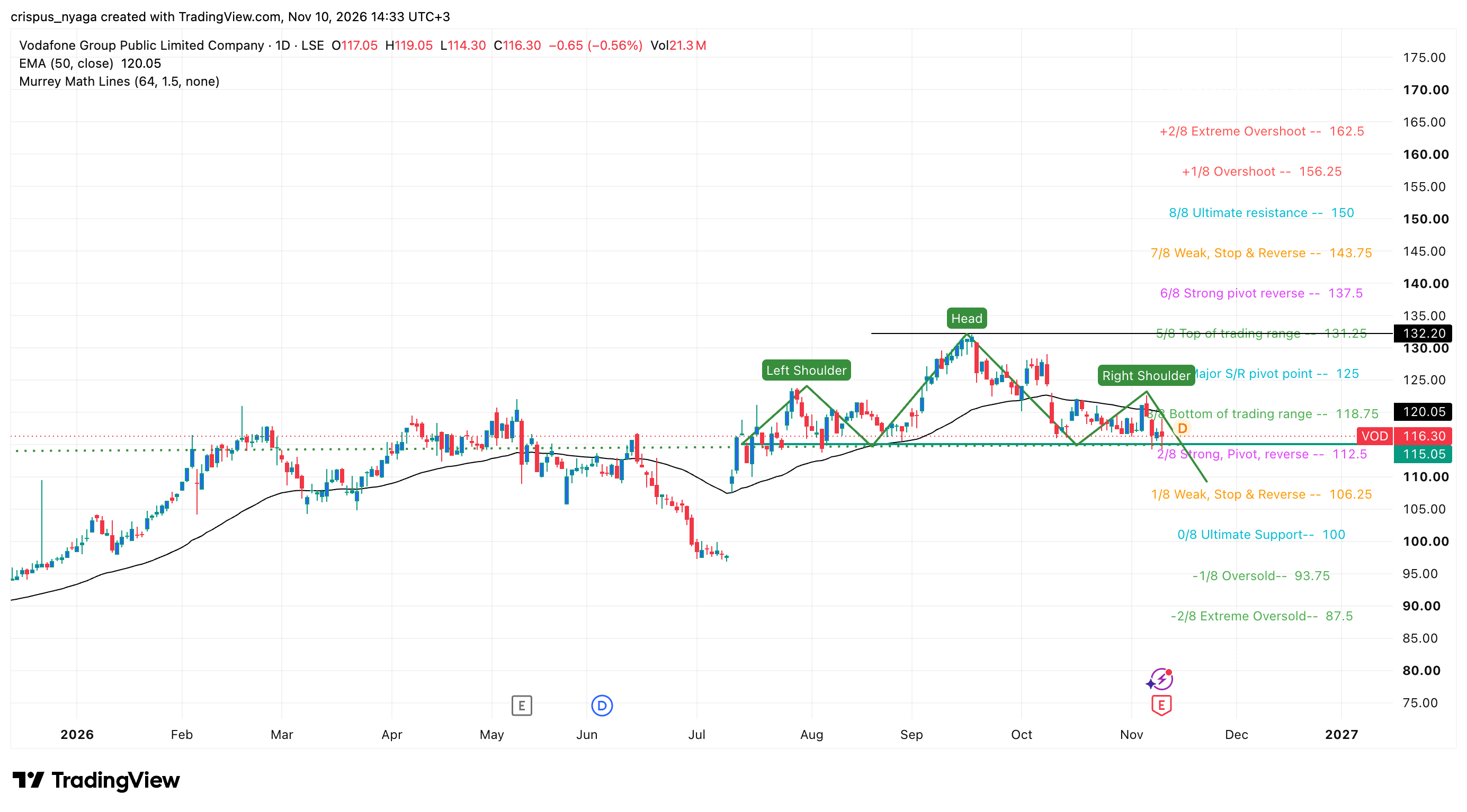
The daily chart shows that the VOD stock has slumped in the past few weeks. It has dropped from a high of 132.20p in September to the current 115. 

The stock has slumped below the 50-day moving average. Most importantly, it has formed a head-and-shoulders pattern, a common bearish reversal sign in technical analysis. This pattern normally leads to more downside over time. 

The stock is also hovering along the Strong, Pivot, reverse level of the Murrey Math Lines tool. It has also dropped below the Supertrend indicator. Therefore, the most likely scenario is where the stock may drop to the Ultimate Support of the Murrey Math Lines tool at 100p. 

On the flip side, a move above the key resistance level of 125p will invalidate the bearish outlook and point to more downside. 

The post Vodafone share price forms a risky pattern: Will it drop further after earnings? appeared first on Invezz


There’s a big difference between investing in a great company for the long term and buying its stock at the right price. And that difference becomes even more important when a business is growing rapidly, but its shares already carry a sky-high valuation due to enormous expectations.

Shopify (TSX: SHOP) could be a perfect example of such a stock. The Canadian e-commerce giant recently delivered another impressive quarter, with strong revenue growth, improving profitability, and healthy cash flow generation. Yet its stock has struggled to maintain consistent upward momentum, even as the underlying business continues to expand. This contrast raises an important question for long-term investors about how much future growth is already reflected in its share price.

Let’s take a closer look at Shopify’s latest financial performance and find out whether its premium valuation still leaves room for attractive returns in the long run.

Source: Getty Images

Shopify stock

After rallying by 46% over the last six months, SHOP stock currently trades at $210.47 per share with a massive market cap of $270.7 billion. However, the stock has slipped 4% over the last year and trades nearly 18% below its 52-week high.

While these recent fluctuations reflect an uneven share price performance, Shopify’s underlying business continues to deliver impressive results.

A great quarter backed by strong growth

Shopify’s latest quarterly financial performance gives investors several reasons to remain optimistic, even as its expensive valuation raises concerns.

In the third quarter, the Canadian commerce giant’s revenue jumped 32% year-over-year (YoY) to US$3.7 billion. This growth was backed by a 35% YoY increase in its merchant solutions revenue to US$2.9 billion. Meanwhile, its subscription solutions revenue rose 20% to US$836 million.

Shopify’s gross merchandise volume, which represents the value of orders processed through its platform, also climbed 29% YoY in the latest quarter. Similarly, its monthly recurring revenue climbed about 19%, highlighting continued growth in its subscription business.

Shopify’s profitability and free cash flow are also improving

Interestingly, Shopify’s profitability improved at an even faster pace in the September quarter. Its operating income surged 66% YoY to US$568 million as revenue growth outpaced the increase in operating expenses. As a result, the company’s quarterly net profit jumped 75% to US$462 million.

Adding to the optimism, Shopify’s free cash flow soared 61% YoY in the third quarter to US$816 million. Its free cash flow margin also improved to 22% from 18% a year ago, reflecting the company’s ability to turn growing sales into cash.

Can Shopify justify its premium valuation?

While Shopify’s latest results are impressive, its lofty market valuation means investors also need to pay close attention to its future growth prospects.

The good news is that Shopify isn’t showing signs of slowing down anytime soon. For the fourth quarter of 2026, the company expects revenue to grow at a low-thirties percentage rate YoY, while gross profit is projected to increase at a high-twenties rate.

Beyond these near-term expectations, Shopify continues to focus on expanding its commerce platform across more sales channels, including emerging artificial intelligence (AI)-powered shopping experiences. These efforts could help it reach more merchants and benefit from the growing adoption of digital commerce.

However, with a market cap exceeding $270 billion, investors are already paying a substantial premium for Shopify’s future growth potential. This leaves SHOP stock vulnerable to sharp corrections if business growth slows or profitability falls short of expectations.

Foolish takeaway

Overall, Shopify’s strong financial performance, expanding cash flow, and promising growth opportunities make it an attractive long-term growth stock. Still, given its sky-high valuation, I believe patient investors may find a better opportunity to buy SHOP stock during a pullback.


3 min read09 November

Inflation is eating into the NHS budget, putting waiting times and treatment targets at risk, a leading think tank has said.

On Monday night, the Health Foundation warned that the health service was facing a “perilous” situation after “little additional money” was included in the Autumn Budget.

Writing for The House, the think tank’s senior economist, Eric Yang, said that while the £1.1bn increase to the Department of Health and Social Care (DHSC) day-to-day budget since the Spring Statement is welcome, the department needs an additional £1.6bn “to cover inflationary pressures alone”.

“This means the settlement is potentially some £0.5bn short and leaves no cushion in what NHS leaders expect to be a very difficult year,” he wrote.

The think tank also said a 1.8 per cent cut to the DHSC capital spend budget means it’ll be harder for the NHS to improve its productivity. 

PoliticsHome understands the NHS capital budget, which covers hospital equipment and infrastructure, is being cut to help fund greater defence spending.

The Chief Secretary to the Treasury, Emma Reynolds, recently told PoliticsHome’s podcast The Rundown that the Labour government will have to make “difficult” decisions at next year’s Spending Review to fund its priority areas while sticking to its fiscal rules. 

“With little additional money in the Budget, the test now is whether trusts can balance their books without cutting the capacity, staff and investment needed to improve care. On current evidence, the road ahead looks perilous,” Yang wrote.

Responding to the think tank’s warning, the DHSC pointed to a recent written answer by minister Karin Smith, who said: “The Department’s contribution to the Defence Investment Plan will avoid any impact on the delivery of frontline NHS services, patient safety, investment in technology, or the New Hospital Programme.”

She added that large capital projects are “designed to be flexible” so that funding can be redeployed “without affecting their overall delivery”.

The think tank’s intervention comes as the health service prepares for another challenging winter period.

On Monday, the government announced that GPs would receive an additional £40m to provide extra care to people with frailty and long-term conditions in the coming weeks. Funded by cash reallocated elsewhere in the NHS budget, it is hoped that extra GP checks and tests will help reduce the number of hospital admissions this winter.

According to the Health Foundation, NHS urgent and emergency care is “under severe strain even before winter”, with figures showing that, in September, more than 50,000 patients waited over 12 hours in A&E after a decision to admit them. 


Humans are intuitive by nature. We can sense meaning beyond the literal words that we encounter. Now, a new artificial intelligence-assisted learning platform developed by MIT engineers is enabling robots to read larger meaning into a human’s natural language commands. 

In a study to be presented at the annual Conference on Robot Learning this month, researchers from MIT and New York University introduce FLEX, a flexible feature-editing pipeline for robot motion-planning. 

With FLEX, humans can interact with a robot by giving it instructions in natural, conversational language. The robot can not only follow the instructions literally but also read into the words to draw larger generalizations that help to improve its motion-planning task. 

The team demonstrated FLEX in several simulated scenarios, including one in which a robot serves a cup of coffee. In these virtual scenarios, a person interacts with a robotic arm by typing commands in natural language. As the robot moves the coffee cup over a cluttered table, the person might type “Don’t spill on the laptop!” In response, the robot will reason about why it should avoid the laptop. For this, FLEX incorporates a large language model (LLM) — a type of AI system that is trained on enormous libraries of text, including social media posts, video transcriptions, and web content, which the LLM uses to identify larger trends, patterns, and generalizations. 

“LLMs have seen so many texts from the internet,” says study author Nathan Dennler, a postdoc in MIT’s Computer Science and Artificial Intelligence Laboratory (CSAIL). “People might have written about, ‘Oh, my phone dropped in the water and now it doesn’t work,’ or ‘I spilled coffee on my computer and now it doesn’t work.’ So LLMs pick up on the idea that liquids plus devices leads to things not working.”

Through the LLM, the robot reasons that it should also avoid bumping into all electronics. In its updated path, the robot adjusts to avoid both the laptop and a nearby phone, without the person having to explicitly spell this out.

“The idea is that there is some higher-level intention behind the words that you say,” Dennler says. “People naturally get this. But you have to carefully explain that to a robot, which takes time and effort. FLEX gives you an interface of communication with a robot to say, ‘When people say this, they mean that.’”

The study was led by Andreea Bobu, assistant professor of aeronautics and astronautics at MIT. Co-authors are Audrey Lee SM ’26 and Ilia Sucholutsky of New York University.

Beyond what we say

At MIT, Bobu heads up the Collaborative Learning and Autonomy Research (CLEAR) Lab, where her group develops autonomous agents that learn to work for, with, and around people. She is focused on developing assistive and household robots that can carry out physical tasks, and reason and adapt in real-time, in response to a person’s natural, conversational commands. 

“Robots use math to do their trajectory planning. But we can’t expect a consumer to learn to do this math in order to tell a robot what to do,” says Dennler, who is a member of the CLEAR Lab. “Instead of having to get people to learn how to use a robot in a specific way, the goal is to interact with the robot through natural language.”

There is a large effort in the robotics community to incorporate natural language into robotic learning pipelines. Various strategies include using language to clarify a task’s goal, redirect a robot’s trajectory, and update its understanding of what is a safe path to take. These existing methods use natural language to tell the robot how to physically perform a task. But a robot could potentially learn much more from what we tell it. 

Bobu and her colleagues are expanding what robots can learn from natural language commands. In their new study, they focused on enabling a robot to interpret a person’s underlying, unspecified preference from limited natural language commands.  

Absorbing common sense

The team’s new robot learning platform, FLEX, is a three-step process that helps a robot read more into a natural language command, beyond what it is explicitly told to do. 

The first step, “Add,” instructs a robot to add a feature to its list of things in its environment that matter for the task at hand, based on a user’s natural language command. For instance, as a robot is moving a bowling ball from one location to another, a person might interject with “Don’t drop it on my mug!” The robot would then add the mug to a list of things to avoid in its path. This first step is how previous methods have worked. Every time a person makes a correction, the robot adds to its features list, and updates its trajectory to avoid those features. 

“The problem happens when your feature list becomes super long, and some features are no longer relevant because your environment may have changed,” says Dennler, who notes that this approach can grow tiresome if a person has to specify every specific feature to avoid. 

The second step, “Generalize,” is the new solution that FLEX provides. This step incorporates an LLM — in this case, GPT-4o — that considers the mug, along with any other features that the person has so far specified to avoid. The LLM automatically searches through its vast cache of data for patterns and connections among these features, to ultimately make a generalization that it should avoid objects that are fragile, even when the person has not explicitly said so. 

“LLMs have seen so many texts from the internet, from all sorts of people and places,” Dennler says. “Because they’ve trained so much on those things, some of that common sense gets absorbed into the LLM.”

In the third step, “Mask,” the robot’s standard computer vision system assesses its environment to determine what objects are no longer present, and then deletes those objects from its features list. This entire three-step process takes about five seconds. 

The team tested FLEX in simulations of a robot arm carrying out three different tasks: serving a cup of coffee, moving a candle, and carrying a bowling ball. In all three scenarios, volunteers interacted with the virtual robot by typing natural language commands, such as “Don’t spill on my laptop,” “Stay away from the stack of paper,” and “Don’t drop on the mug.” With FLEX, the robot followed all three commands literally and also reasoned at a higher level to not spill on electronics, stay away from flammable objects, and not drop its cargo on fragile things. 

“Everyone’s homes are different, and everyone cares about different things, so no robot comes out of the box knowing what matters to you,” Bobu says. “What excites me about FLEX is that it can pick that up from a sentence or two instead of asking you to spell out every rule — and that’s the difference between a robot people put up with and one they actually want in their home.” 

This work was partly supported by the MIT Generative AI Impact Consortium and the MIT Schwarzman College of Computing’s Social and Ethical Responsibilities of Computing program.

The US stock market came under intense pressure last week, with the S&P 500 and Nasdaq 100 indices falling hard. The S&P 500 Index dropped to 7,376, its lowest level since July 29, down by 6% from its highest point this year. Similarly, the Nasdaq 100 moved further into a correction after falling by 13% from its peak. This article looks at some of the top US stocks to watch this week.

Rocket Lab in focus ahead of earnings

Rocket Lab and other companies in the space industry have slumped in the past few months following the much-anticipated SpaceX IPO. RKLB has dropped by 65% from its highest point this year.

The stock dropped after the company announced a $8 billion purchase of Iridium, a move aimed at boosting its vertical integration. It also slumped after the company postponed its Neutron launch to 2027. This was a notable move because the company is betting that Neutron to supercharge its growth.

The company will be in the spotlight this week as it publishes its financial results. Analysts expect the results to show that its revenue jumped by 65% in the third quarter to $257 million, with the fourth-quarter guidance coming in at $265 million. 

Rocket Lab has a mixed performance after its earnings. For example, it was barely moved when it published the last financial results. It rose by over 35% after releasing its strong results in April. 

Cisco Systems

Cisco Systems stock has come under pressure in the past few months. After peaking at $130 in June, the stock has slumped by 28% to the current $93.85. This sell-off has coincided with the ongoing decline in technology stocks, including popular firms like Nvidia and AMD. 

Cisco Systems will publish its earnings report this week, meaning that it will likely have some substantial volatility. The stock dropped by nearly 10% after the last earnings report. Before that, it jumped by as much as 20% in April. 

Analysts expect the upcoming report to show that the revenue rose by 21% in the third quarter to over $18.12 billion. The earnings per share (EPS) is expected to come in at $1.32, much higher than the $1 it made in the same period last year.

Applied Materials

Applied Materials is a top company that designs, builds, and sells wafer fabrication tools that deposit, etch, implant, and polish materials on silicon wafers. Its top technologies include chemical vapor deposition (CVD), physical vapor deposition (PVD), and atomic layer deposition (ALD).

The company’s business has done well during the ongoing artificial intelligence boom that has led to more demand from companies like TSMC, Intel, GlobalFoundries, Samsung, and SK Hynix. 

Applied Materials will publish its financial results this week. Analysts expect the results to show that its revenue jumped by 51.4% on a YoY basis to $10.3 billion. After that, analysts expect the results to show that its revenue will hit $10.74 billion. 

Applied Materials’ earnings per share are expected to come in at $4.06, much higher than the $2.17 it made last year. 

The other top companies to watch this week are Constellation Energy, KKR, Occidental, Skydance, CoreWeave, On Holding, Corteva, Nu Holdings, Nebius, and Cerebras.

The post Top US stocks to watch this week: Cisco, Applied Materials, Rocket Lab appeared first on Invezz

In this piece, we’ll check in on a top-tier, but still highly underrated insurance play that might make sense to stash away for the dividend growth as well as relative stability when the market waters get really nasty. With the Nasdaq 100 imploding more than 6% while the S&P 500 collapsed over 4% in a single trading session, just two days after the U.S. midterm elections, it certainly feels like the AI trade is crashing viciously.

Of course, some may argue that it’s too soon in the game to call it a crash, but with the Nasdaq 100 in a full-blown correction and a bear market not all too far off, investors might wish to reconsider some of the less-tech-exposed names that were wrongfully dragged lower on a day that may have seen indiscriminate selling and more than a fair share of margin calls from those retail investors who thought it’d be a good idea to lever up.

Source: Getty Images

Sun Life Financial

Either way, shares of Sun Life Financial (TSX: SLF) stood out as one of the hard-hit names that’s an absolute steal after Thursday’s turbulent trade session. Despite not being remotely close to the AI or semiconductor theme, the shares imploded, tanking just over 10% in a single day in what was a vicious move that only got worse as the day progressed. Indeed, all it took was a day, and shares of SLF are now in a correction.

The big question moving forward is whether the $57 billion financial can bounce back, even as the market continues to be dragged lower by the weight of the unravelling AI and semi trade. Of course, it was also a terrible day for the broader TSX Index, which was off just north of 2% on the day.

With some pretty underwhelming third-quarter results released on what was an absolutely brutal bloodbath of a day on Wall and Bay Street, perhaps investors look at the name as more of an opportunity, especially now that the yield is around 3.3%.

For $100 a month in dividends, you’d need $1,200 per year. And based on Sun Life’s yield, you’d need to invest just shy of $37,000 in the name. After a brutal plunge, I’d certainly not put down a full position all in one go, though. Instead, dollar-cost averaging (DCA) could be the way to tame volatility.

Life isn’t all too bright for Sun Life after a brutal market-wide decline

In my humble opinion, the third-quarter results themselves weren’t as bad as the post-earnings reaction would suggest. It was an abysmal day for the financial sector in particular, as the big banks led the way lower in the Canadian market. In my view, the poorly received, but still quite decent quarter just acted as salt in the wounds. As interest rates look to rise while restructuring costs make a bit of an impact, perhaps there’s reason for investors to show a bit of pause and take a bit of profit off the table.

After all, the name was up nearly 33% year to date, at least before Thursday’s bloodbath. The shares were overheated and quite expensive. After a 10% drop, the shares still look mildly frothy (maybe fairly priced) at 17.4 times trailing price-to-earnings (P/E) despite new macro concerns that investors might have.

While I wouldn’t back up the truck, I would consider nibbling on the way down, especially if the broad market sell-off intensifies. At the end of the day, Sun Life stands out as an indirect AI winner (via significant cost savings and operating efficiencies). With a strong dividend growth track record, I’d not sleep on the name.

If you are a parent, you are going to appreciate this. 

Imagine a Saturday morning: you’re driving with your kids and spouse to a sit-down diner, looking forward to hot, strong coffee and a plate of eggs Benedict. Then your kids start whining about wanting a bacon cheeseburger and french fries. 

We’ve all been there, and most of the time, parents are those who choose to make a compromise. Now, with new dual-branded restaurant concepts, this common family friction is less likely to happen.  

For Dine Brands Global, the parent company of Applebee’s Neighborhood Grill & Bar and International House of Pancakes (IHOP), resolving this relatable family disagreement is an important part of the new concept. 

Dine Brands closed 208 restaurants across 2025 and 2026, and it just confirmed more closures as it expands its dual-brand concept. 

Applebee’s and IHOP parent closed 208 restaurants in 2025 and 2026 

On November 4, 2026, Dine Brands reported third-quarter total revenue of $248.9 million, compared to $216.1 million for the same quarter of 2025. The company attributed the increase in revenue to restaurants acquired and opened since the third quarter of 2025. 

During the third quarter of 2026, the company also closed 28 restaurants and opened 23 (including seven dual-branded openings). 

Applebee’s and IHOP parent closed 208 restaurants in 2025 and 2026.

Scott Olson / Getty Images

Analyzing the company’s official documents, I found that Dine Brands closed more than 200 restaurants in nearly two years. 

In 2025, Dine Brands closed a total of 110 restaurants, while opening 73 new locations, resulting in a net decline of 37 restaurants for the year, according to Dine Brands’ 2025 earnings report. 

In 2026, so far, Dine Brands confirmed that it closed 40 restaurants in the first quarter of the year, 30 locations in the second quarter, and 28 in the third quarter, for a total of 98 restaurants. During this period, Dine Brands also opened 60 restaurants, revealing a net decline of 38 locations in 2026. 

In those seven quarters, Dine Brands’ gross closures across Applebee’s and IHOP amounted to 208, while the net decline was 75 locations.

Why Dine Brands keeps closing restaurants 

While the closure of 208 restaurants might sound like a dramatic retreat, Dine Brands’ management says the closures are part of the normal course of business. 

“We’ve got restaurants that are 20, 30, even 40 years old. Landlords change, markets change, leases change, and so it’s all part of the normal course of business. For a system our size, one can expect up to 2% a year of restaurant closures, and that’s where we are and where we’ve been,” CEO John Peyton told Restaurant Dive in August 2026. 

Dine Brands’ numbers run slightly higher than Peyton’s figure on a gross basis: it closed 110 restaurants in 2025, about 3% of the more than 3,500 it had across its three brands at year-end, and 98 in the first three quarters of 2026. But openings offset much of that, so the net decline was about 1% of the system each year. 

Peyton didn’t say whether his 2% referred to gross or net closures, so the comparison isn’t exact. Either way, the pace is modest.

Peyton also revealed the reasoning behind some location shuttering. 

Some restaurants close because they don’t generate enough revenue, but adding another brand can make it a more viable location, Peyton told Restaurant Dive. 

During the fourth quarter of 2025 earnings call, the management explained that dual-branded restaurants are used to “offset closures of underperforming single-brand units.” 

Why the dual-branded concept might work 

Dine Brands is rapidly scaling its dual-branded Applebee’s and IHOP footprint. By the close of the third quarter on September 27, 2026, Dine Brands officially reached 49 domestic dual-branded locations (plus 41 international units, totaling 90 globally), on its stated march toward 80 domestic units by the end of 2026. 

While earlier restaurant co-branding experiments often flopped, company leadership argues this model works because the two chains do not compete for the same meal hours.

Speaking at the Piper Sandler 5th Annual Growth Frontiers Conference, CEO John Peyton explained that past industry attempts struggled because brands stole each other’s traffic, whereas Dine Brands pairs a breakfast diner with an evening favorite:

“When other brands in the past have tried duals like KFC and things like that, they’re competing day parts. What’s so compelling about this is Dine Brands just happens to own the premier AM and premier PM brand. IHOP, since it was invented in 1967, has been trying to address dinner as its most difficult day part.”

For restaurant operators, this setup eliminates the hours where a standalone dining room sits empty and bleeds money. 

“And so for the IHOP franchisees, this is a solution to dinner that they’ve been looking for, for 60 years,” Peyton continued. “For Applebee’s franchisees, it’s the morning day part, which they’re closed for. So it’s a whole new revenue opportunity they didn’t have.”

Dine Brands’ 15.2% revenue increase to $248.9 million in the third quarter was not driven by dual-brand sales. Instead, the company bought back franchised restaurants, so it records their full sales as revenue rather than only collecting royalties and fees. 

Addressing corporate conversion performance on the company’s third-quarter earnings call, CFO Vance Chang said company-owned dual-branded units are seeing a slightly higher sales lift than franchised ones, partly because they start from a lower base. 

“With our own dual brands, they are all fairly new, but we are seeing slightly higher top-line lift than the franchise units just because the starting point is a little bit lower for these restaurants… All in all, [we are] pleased with the progress, and we are going to continue to refine and improve the operations.”

Related: Portillo’s closing locations as consumers pay more but visit less

Prime Minister Andy Burnham has said the results of the US mid-term elections are an opportunity to tackle the cost of living and end the war in Iran. (Alamy)


Nadine Batchelor-Hunt


2 min read04 November

Heavy losses for Donald Trump’s Republicans in the US present the world with an opportunity to focus on ending the Iran war, Prime Minister Andy Burnham has said.

“I think people want to see the world coming together, and focusing on the things that matter to people. And that’s what the voters, in my view, are saying in the United States,” Burnham told reporters on Wednesday.

The PM spoke to the media after a devastating set of mid-term elections for the Republicans across the Atlantic.

The Democrats claimed victory in several traditionally Republican states like Kansas, South Carolina and Texas to take control of both the House of Representatives and the Senate.

The Trump administration’s ongoing war in Iran and the impact it is having on prices at home were seen as the key issues for voters going to the polls in the US. 

Responding to the mid-term results, characterised by US-based commentators as a political earthquake, Burnham said the world has an “opportunity now to unite” around ending the war in the Middle East and tackling cost-of-living pressures.

“That has been the issue that I have put front and centre in my first three months in Downing Street, and we’ve made moves, but I can’t get people’s cost-of-living pressures down until the conflict in the Middle East is resolved, the conflict in Ukraine started by Russia…

“These are things we have to focus on now,” the PM said.

He continued: “I think people want to see the world coming together, and focusing on the things that matter to people. And that’s what the voters, in my view, are saying in the United States. Let’s get focused in a laser-like way on those cost of living issues.”

Responding to last week’s Budget, the Office for Budget Responsibility and the Institute for Fiscal Studies think tank said that the US-Iran war was driving cost-of-living pressures in the UK, resulting in higher energy prices, interest rates and inflation.

In response to US and Israeli attacks, Iran has made it more difficult for ships to pass through the Strait of Hormuz – a vital global shipping lane relied on by countries including the UK for gas and oil.


Earning an extra few hundred to a couple of thousand dollars a month goes a long way toward building a strong financial safety net. You can ask the seven-million-plus adult Canadians currently engaged in gig work. Of this group, roughly four million hold full-time jobs but moonlight to cope with rising living costs.

Financial stress is no longer exclusive to low-income households. According to the National Payroll Institute’s 2026 Annual Survey of Working Canadians, financial stress affects 44% of employed Canadians, including some high-income earners.

However, your earning potential should not be limited to side hustles or gig work, not to mention work bonuses or a CRA tax refund. Don’t let extra cash sit idle. Instead, consider boosting your financial resilience by investing. By putting this surplus to work, you can reduce anxiety and build serious wealth over the long term.

Source: Getty Images

Avert a potential crisis

Financial stress can escalate quickly when an emergency arises. Major and minor inconveniences could include medical bills, home maintenance, or car repairs. Any unplanned expenses disrupt household budgets. Often, it forces families to borrow or increase credit card balances.

One way to avoid a potential crisis is to earn more with your extra money. Canadians 18 years and older can utilize the Tax-Free Savings Account (TFSA) to earn tax-free passive income. The yearly limit is actionable ($7,000 in 2026), though it doesn’t matter how much you can contribute for as long as the investment brings in more money.

The TFSA isn’t only for building an emergency fund. It can also help you meet short- and long-term financial goals, including retirement. Any capital gains, interest, or dividends earned inside your account grow completely tax-free. You can withdraw at any time without tax penalties. I’m raising this awareness to help Canadians lessen financial stress, if not eliminate it.

Build recurring passive income

Many Canadian domestic stocks provide passive income through dividends. You can create an active secondary income stream to boost your employment income or side-hustle earnings.

For example, Emera (TSX: EMA) is a dividend growth stock that pays cash every quarter. This top-tier utility stock is also ideal for risk-averse investors. The $22 billion energy and services company derive earnings from cost-of-service, rate-regulated electric and natural gas utilities.

If you invest today, EMA trades at $71.83 per share and pays a 4.1% dividend. A $5,000 position will generate $51.75 every quarter ($207 annually). Emera has raised its dividends for 20 consecutive years and targets an annual dividend growth rate of 1% to 2%. The company expects its $20 billion capital investment plan to achieve 5% to 7% average adjusted EPS (earnings per share) growth through 2030 and support dividend growth.

Furthermore, the business outlook is extremely positive with the impending merger with Canadian Utilities Limited. According to Board Chairman Karen Sheriff, bringing together Emera and Canadian Utilities will create an even stronger enterprise. A North American energy infrastructure powerhouse will emerge in late 2027.

Make every dollar work.

Every dollar of extra income can work just as hard as you do. If deployed properly, you can improve your financial resilience and significantly reduce stress.

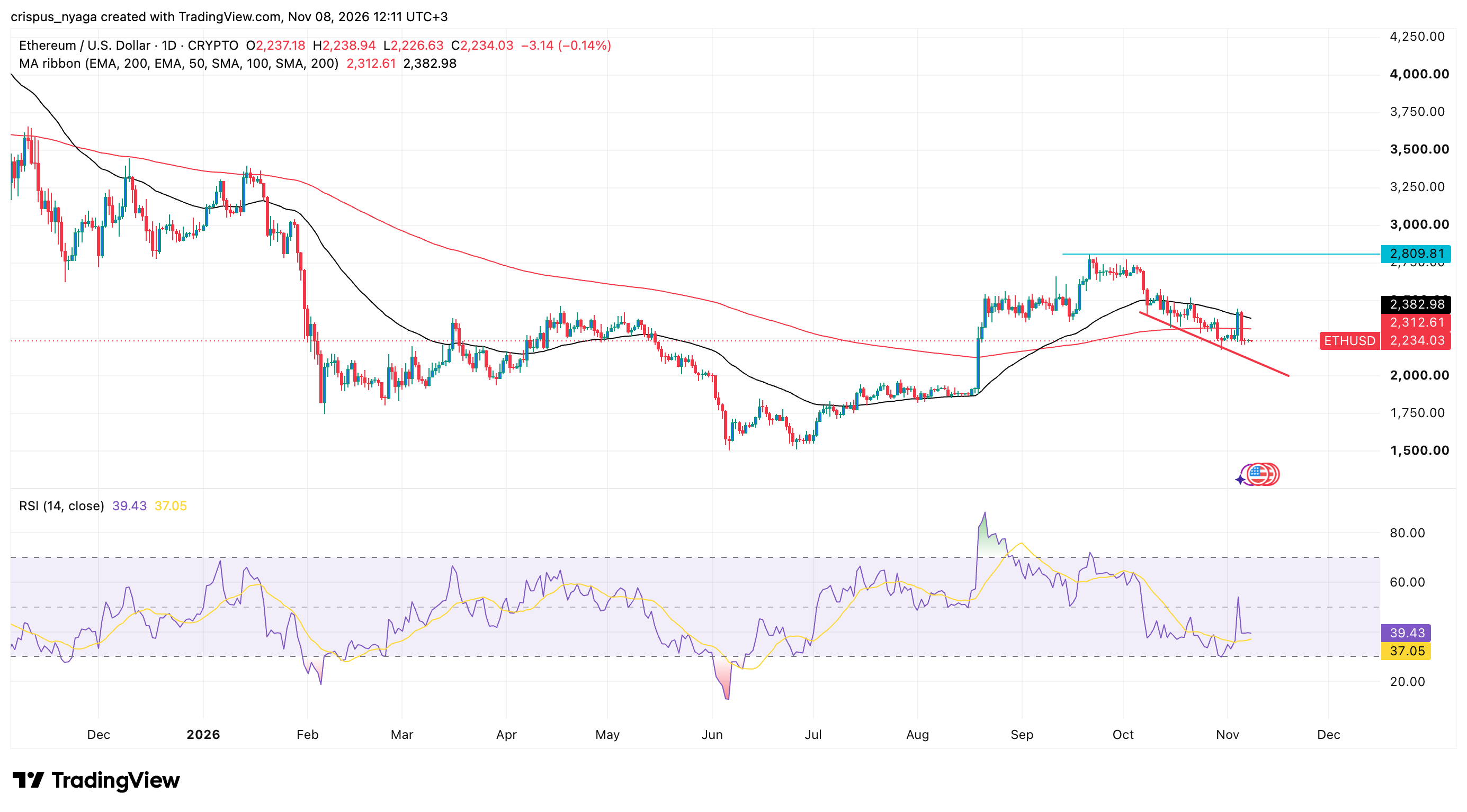
Ethereum price has remained under pressure in the past few months, mirroring the performance of other coins. It was trading at $2,235 on Sunday, a few points below the crucial resistance level of $2,781. So, what next for the coin as ETH ETF outflows surge?

American investors are dumping their Ethereum ETFs

American investors are selling their ETH ETFs aggressively, a sign that they expect the coin to remain under pressure in the foreseeable future. 

Spot Ethereum ETFs shed over $93 million on Friday after selling $99 million on Thursday. These funds shed over $431 million last week, the six consecutive side of outflows. They have now shed over $365 million this month after losing $1.6 billion last month. 

These outflows are substantially higher than that of other coins, including Bitcoin, Solana, and XRP. The trend seems to be accelerating after the US midterm elections, in which Democrats won by a large margin.

Democrats are on track to win 56 seats in the Senate. They may also win 260 seats on the House of Representatives. Therefore, there is a likelihood that the party’s officials will focus on the crypto industry. For example, Senator Elizabeth Warren, who will chair the Senate Banking Committee has been one of the industry’s biggest critics. 

The ongoing ETH ETF outflows have also coincided with the waning on-chain metrics. For example, the total value locked (TVL) in the network dropped to $43.2 billion from this month’s high of nearly $50 billion. 

Erthereum’s stablecoin growth has also deteriorated. Its market capitalization dropped to $137 billion from the year-to-date high of nearly $170 billion. This is important because analysts were expecting stablecoins to keep growing, especially in the payments industry. 

Ethereum is also not generating as much fees as it did in the past. It has made just made $25 million in fees this quarter down from $34.6 million in the previous quarter. At its peak, Ethereum was making over $549 million in fees and was the most profitable chains in the industry. 

More data shows that the DEX volume has continued to fall in the past few months. Its DEX volume fell to $54 million this quarter from a peak of $298 billion in the September quarter of last year. 

Ethereum price technical analysis

ETH price chart | Source: TradingView

The daily chart shows that the ETH token has been in a steady downward trend in the past few months. It has dropped from a high of $2,809 in September to the current $2,235. It has already dropped below the 50-day and 100-day Exponential Moving Averages (EMA).

The coin has remained below the Supertrend indicator, a sign that bears remain in control. Therefore, the most likely scenario is that it continues falling, potentially to the key support level of $2,000.

The post Ethereum price prediction as spot ETH ETF outflows surge after US midterms appeared first on Invezz