
Author

admin

Browsing

When it comes to dividend investing, Canadian Natural Resources (TSX: CNQ) and Enbridge (TSX: ENB) are two top names worth watching. Both these energy companies have impressive payout records, consistently paying and increasing their dividends over the years. Their strong asset bases, well-established businesses, and ability to generate healthy cash flow have helped them reward shareholders through different market conditions.

However, despite their similarities as reliable dividend payers, the two companies operate quite differently. This also means they offer investors different opportunities and come with different risks.

Source: Getty Images

CNQ vs. ENB: Operating model, opportunities, and risks

Canadian Natural Resources is one of Canada’s major oil and natural gas producers. Its operations span across Western Canada, the U.K. North Sea, and offshore Africa. One of its biggest strengths is its large reserve base and long-life, low-decline assets, which support steady production over time. Moreover, CNQ can benefit significantly when oil and natural gas prices are strong, although its earnings and cash flow are also more exposed to commodity price fluctuations.

Enbridge, on the other hand, operates a very different business. It operates an extensive network of liquid pipelines, natural gas utilities, and other energy infrastructure assets. Much of its revenue comes from regulated operations and long-term contracts, allowing it to generate relatively stable and predictable cash flow. This makes Enbridge particularly attractive to investors looking for dependable dividend income and less exposure to swings in commodity prices.

So, while both companies have a history of rewarding shareholders, their investment appeal differs. Canadian Natural Resources offers greater exposure to energy prices and potential upside when commodity markets are favourable, whereas Enbridge provides a more infrastructure-focused business with relatively predictable cash flows.

Before comparing their growth prospects and deciding which stock could be the better buy today, let’s first take a closer look at their dividend payment histories.

Dividend growth records: Canadian Natural Resources vs. Enbridge

Canadian Natural Resources and Enbridge stand out as top dividend payers and growers. CNQ recently increased its quarterly dividend to $0.63 per share, representing its 26th consecutive annual increase in 2026. Over this period, CNQ’s dividends have grown at an annualized rate of approximately 20%, reflecting the company’s strong cash-generation capacity.

Canadian Natural’s extensive portfolio of long-life, low-decline assets supports relatively stable production and limits ongoing capital requirements. Further, disciplined capital allocation, debt reduction, and strategic acquisitions strengthen its future growth outlook and support distributions.

Furthermore, its substantial reserve base offers opportunities for production expansion and operational improvements. With a dividend yield of approximately 3.6%, CNQ offers investors income and capital appreciation.

Enbridge, meanwhile, offers a more predictable income profile. It has distributed dividends for more than 70 years and increased them annually for 31 consecutive years. Its reliance on regulated operations and long-term contractual arrangements reduces direct exposure to commodity price fluctuations and adds stability. Management anticipates average annual growth of approximately 5% in adjusted EBITDA, distributable cash flow (DCF) per share, and EPS over the medium term. This indicates ENB’s dividend will grow in line with DCF per share. Moreover, its payout ratio of 60%–70% of DCF is sustainable.

Having returned approximately $39 billion through dividends over the past five years, Enbridge plans to distribute another $40–45 billion over the next five years. Growing demand for energy infrastructure, driven by AI data centres, advanced manufacturing, and broader economic activity, could further strengthen its growth prospects. With a yield of approximately 5.7%, Enbridge remains an attractive option for income-oriented investors.

Enbridge stock offers a more attractive mix of yield and stability

Overall, Enbridge appears to be the better dividend stock to buy now. While Canadian Natural Resources offers stronger exposure to commodity-driven growth and the ability to grow dividends rapidly, its earnings and cash flows remain more sensitive to energy price fluctuations.

Enbridge, in contrast, benefits from a more predictable cash flow profile, offers a higher dividend yield of 5.7%, and has a solid outlook for steady earnings and distribution growth. Its expanding energy infrastructure business provides opportunities to capitalize on rising electricity and natural gas demand. Therefore, for investors focused on low-risk dividend stocks, Enbridge looks like the more compelling buy today.


Victoria’s Secret shoppers who wait each year for deep holiday discounts may be a little disappointed this season, as the lingerie retailer’s products are selling more often at full price. For this reason, Wall Street expects the company to rely less on promotions in November and December.

In a Bank of America research note shared with me, analyst Mary Sport downgraded Victoria’s Secret & Co. (VSXY) stock to Hold from Buy. The call was based on the company’s valuation, and although she downgraded the stock, she also raised her price target to $112 from $95. The downgrade sent shares down 4.4% that day, closing at $105.01.

If a brand has good momentum, that usually takes the pressure off a store to cut prices during the holiday rush. Victoria’s Secret appears to be following that pattern right now, and it changes what shoppers should expect at its stores over the next six weeks.

A brand revival that is changing how products get priced

Victoria’s Secret has stores, outlets, and an online store that sells bras, panties, sleepwear, beauty products, and swimwear under the Victoria’s Secret and PINK brands. Its holiday performance usually depends on steep discounts to pull in customers, but that pattern is now shifting. The brand is winning back shoppers’ attention with new product designs and momentum from its Fashion Show.

Also read: An entire island just lost its KFC and Taco Bell overnight

Sport wrote in the BofA research note that “recent brand heat” should drive “strong full-price sales through holiday.” Because of that, she raised her full-year gross margin forecast by 50 basis points, and expects an increase of 250 basis points for fiscal year 2026. That means the company is now keeping more profit from every dollar it earns than it did a year ago.

The Fashion Show effect is spilling into holiday carts

The Victoria’s Secret Fashion Show returned on October 18, 2026, at Sony Pictures Studios in the Los Angeles area. The show drew about 3.64 million viewers across its livestreams. That’s nearly 33% more than last year, according to Streams Charts. Sport said the event created a “halo effect through the holiday.” She also raised the company’s same-store sales estimates for the third and fourth quarters to 9% and 6%, up from 8% and 5%, respectively.

Related: Chipotle is leaning on new menu items to bring diners back

The show’s viewership is great exposure for the bra category, which has become the company’s main growth engine. CEO Hillary Super said on the second-quarter earnings call transcribed by Investing.com that the bra business grew in the mid-teens and drove about half of the Victoria’s Secret brand’s overall growth. 

“Our bra business grew in the mid teens driven by strength in core franchises and by new innovation,” Super said. That kind of demand reduces the need for the company to run deep discounts into Black Friday and Cyber Monday.

Victoria’s Secret held its 2026 Fashion Show on October 18 in Los Angeles; Bank of America says Victoria’s Secret is lifting full-price sales into the holiday season.

lenta / Getty Images

Why Bank of America moved to Hold

Victoria’s Secret stock price has increased about 25% over the past month, while the S&P 500 fell about 2%, Yahoo Finance reported. That means much of the good news is already priced in. Even though Sport’s team raised Victoria’s Secret’s 2026 and 2027 earnings per share estimates by 13% and 11%, to $5.28 and $6.81, they still downgraded the stock.

More Retail Stocks

  • Nike is purposely selling fewer shoes as its shares keep falling
  • Boot Barn has a plan to win holiday shoppers, and BofA likes it
  • AI is changing the KFC and Taco Bell experience for customers

Her 2027 estimate is 20% higher than Wall Street’s consensus, and Sport argued that further gains would be harder to justify without operating margins reaching the low teens. She acknowledges the possibility over time, but feels it is unlikely in fiscal 2027. The reason is that freight costs could climb again, which would reduce some of the margin gains, and only half of store remodels will be complete by the end of fiscal 2027.

What investors and shoppers should watch next

Victoria’s Secret has rebuilt momentum, yet it seems like the easiest gains have already been made. New investors should focus on the company’s fiscal 2026 fourth-quarter and fiscal 2027 first-quarter earnings calls. That should reveal whether freight pressure is cutting into margins. 

Shoppers who usually wait for Victoria’s Secret discounts may want to buy earlier this year. BofA expects promotions to be lower this season than in past holidays. That is good news for VSXY shareholders, but a tough one for bargain hunters.

More Stocks News

  • Morgan Stanley doubles down on Microsoft stock with bold outlook
  • Goldman Sachs reset S&P 500 price target for 2027
  • Jim Cramer has a warning for Nvidia stock investors after CEO exit
  • Nvidia earnings — along with the baggage — top next week’s markets

Comparing Our Favorite Digital Notebooks

Our Favorite Smart Pens

Neo Smartpen M1+ for $129: If you don’t want an entire tablet to write your digitized notes on, you can get a smart pen to use on regular paper that will log your notes into its companion app. The Neo Smartpen M1+ was the thinnest and lightest smart pen former WIRED reviewer Medea Giordiano tried, and she easily used it with notebooks and planners alike. You’ll pair it with the Neo Studio app, which has a notebook system that’s easy to navigate and organize your notes.

Neo Smartpen Dimo for $59: This is the cheapest smart pen option and uses replaceable batteries. It isn’t compatible with Google Calendar, iCal, or Outlook like our other picks.

Honorable Mentions

Boox Note Air4 C for $470: If you’re looking for something a little more powerful than just taking notes and annotating, but still want the E Ink screen experience, then a Boox device is what you need. The Boox Note Air4 C has an e-paper screen and is primarily described as an “e-paper notebook,” but runs on Android 13 and has access to the Google Play Store, giving it more of a tablet feel that happens to have a colorful e-paper screen instead of your usual brightly lit iPad or Android tablet. You’re able to easily access the web (called NeoBrowser) right from the Boox homepage, which usually takes several steps and is incredibly slow on a true digital notebook. You’ll also access apps that look like a tablet, including an image gallery, calendar, music player, and tools like a clock, recorder, and calculator. It was a pick in this guide, but it’s now out of stock for US warehouses (you can still order from the Hong Kong warehouse, but you might have to pay extra tariffs and fees), and there’s a new version out, the Note Air5 ($530).

The 3rd Gen Kindle Scribe (left) and the Kindle Scribe Colorsoft.

Photograph: Nena Farrell

Kindle Scribe Colorsoft for $630 and Kindle Scribe (3rd Gen) for $500 and Kindle Scribe Without Front Light for $430: The new versions of the Kindle Scribe are still solid all-around devices that have a good mix of e-reader and digital notebook features, but I still prefer the older model’s price point. While the new Scribe Colorsoft is a nice option if you want color, I think these are too expensive for what they are. The price comes from all the AI features packed into the device, plus connectivity to services like Google and Microsoft, but it still isn’t as powerful as a ReMarkable or Supernote if you want better tools. My picks above are a better price for similar features, though the Scribe does have the most impressive battery life of any digital notebook device I’ve tried (and that’s still true for the older model that I recommend above, too, so you don’t need the newest model for the best battery life).

Moleskine Smart Writing Set for $225: Moleskine is already known for its notebooks, and the brand has a smart version now, too. Our team previously tested a version in 2018 that only cost $149, but the current version that’s $224 is next on my list to test. The set comes with a notebook and pen that will pair with the Moleskine Notes app to show you your notes.

Montblanc Digital Paper for $950: Yes, that Montblanc, the one with the famous pens, now has a digital notebook of its own. It’s no surprise that I’d call its digital pen one of the best. It’s got a super-lightweight feel while sporting three different buttons, two of which you can customize. (There’s no eraser, but I’ll give it up for that end of the pen to instead be a home button). I really like this device overall, but it’s pricey for what you get—aside from the customizable pen buttons, there’s not much to differentiate it from my top picks.

ReMarkable Paper Pro Move for $449: The ReMarkable Paper Pro Move is similar in size to a reporter’s notebook, which turns out to be a pretty great size for daily task and to-do lists. There’s room for a multilevel to-do list and brainstorming, and it’s a nice, small size with just a 7.3-inch screen. There are other small options on the market, but this is the only one designed like a long notebook rather than a square, e-reader-like design. I like this size to layer on top of a paper planner or slip into a bag. It can do everything the larger Paper Pro can, including packing a color screen, and honestly feels like you sliced off a bottom third of the device and kept using it.

Digital notebook inside of an open green case on top of checkered fabric

The ReMarkable Paper Pure.

Photograph: Nena Farrell

ReMarkable Paper Pure for $399: This is another good budget option if you want something larger than the Supernote Nomad. It has the same price as the second-generation Kindle Scribe I adore, but with more powerful digital notebook tools instead of a focus on reading. If you’re looking for a great digital notebook without spending the better part of a grand, ReMarkable’s new Paper Pure is its new basic digital notebook with a black-and-white screen, a lightweight feel, and a great writing experience that is one of the closest things you’ll get to writing on actual paper. It doesn’t have a front light, though, so you need to use it in lit rooms only.

ReMarkable 2 for $419 (Refurbished): This is the older ReMarkable digital notebook from 2020, and it’s still a great device with a great range of accessories—while they’re still available, that is. This device is only available refurbished or secondhand after getting essentially replaced earlier this year with the ReMarkable Paper Pure.

Rocketbook Fusion Plus for $30: If you really prefer the paper experience and don’t want something you need to charge, then Rocketbook is for you. Rocketbook makes several reusable notebooks, planners, and accessories like index cards and sticky notes. I like the Rocketbook Fusion Plus since it comes with a ton of different template styles, from your classic monthly and weekly pages to project management layouts and meeting notes, making it feel closer to the variety a digital notebook can offer you. Take notes with an erasable Pilot Frixion Pen (one comes with whichever item you buy), scan photos of the pages into the Rocketbook app, and erase the whole thing with the damp microfiber cloth (also included). The app is designed to keep everything organized and easily send things off to Google Drive, Slack, Trello, OneNote, and a handful of other options.

FAQs

Do You Need a Digital Note-Taking Device?

AccordionItemContainerButton

The short answer is no. These devices are expensive, usually costing several hundred dollars when a simple notebook and pen costs a few bucks. But if you like the physical act of writing but need to have digital copies, they’re worth considering.

Pros:

  • Digital notebooks are thin and light but hold hundreds of notes.
  • You can transcribe your notes into text files, making them easier to read and manipulate.
  • Depending on the device, you can export files as PDFs, Google Docs, Evernote files, and more.
  • Instantly digitizes your art, too.

Cons:

  • Expensive.
  • Need to be charged.
  • Have a learning curve.
  • Most smart pens need to be paired with an accompanying notebook. The upcoming Nuwa Pen promises smart notes on any paper.
AccordionItemContainerButton

E Ink notebooks are easier on the eyes and feel closer to paper than a glass-screened tablet. But in some cases, you might spend less getting an iPad and an Apple Pencil (and a keyboard if you also want to type sometimes). You can also do more on them thanks to the thousands of apps in the App Store. An iPad is pretty intuitive if you’re familiar with the Apple ecosystem (though both ReMarkable and Supernote’s ecosystems are also very intuitive). Past WIRED reviewers liked using an iPad with the GoodNotes and Notability apps; check out our guide to the Best iPads for more advice on which to buy.

I also have an iPad, and I’ll say the upside of a digital notebook is that the battery tends to last longer, especially if you’re the type to use it for a day or two and then forget about it for a few days. My trusty Kindle Scribe usually manages to have plenty of battery available for whenever I feel the note-taking itch, even if it’s been a week or two since I last touched it.

Why Are Digital Notebooks So Expensive?

AccordionItemContainerButton

Just because these devices look like paper doesn’t mean they’re as cheap to make as a sheet of paper. Like any tablet or smartphone, these devices are packed with features, a special ecosystem, and the E Ink technology is no small feat to perfect, along with a sensation similar to writing on paper. It’s an impressive piece of technology.

Prices haven’t gotten cheaper for this category in the wake of tariffs’ causing technology prices to rise. ReMarkable recently raised the price of our top pick, the ReMarkable Paper Pro. Another favorite of ours from Supernote has gone up a little less than $50, and Kobo also slightly raised its prices, though the $10 increase is pretty minor compared to other increases we’ve seen. We’ll continue to monitor prices and flag if more price changes are to come.

Power up with unlimited access to WIRED. Get best-in-class reporting and exclusive subscriber content that’s too important to ignore. Subscribe Today.

The Canadian equity markets have staged a healthy recovery this month, with the benchmark S&P/TSX Composite Index gaining 1.4%. However, the outlook remains uncertain, as elevated bond yields, persistent inflation, shifting trade policies, and ongoing geopolitical tensions continue to weigh on investor sentiment. In this environment, investors should consider diversifying their portfolios across growth, defensive, and dividend-paying stocks to balance wealth creation opportunities with stability and income generation.

Against this backdrop, let’s explore three Canadian stocks that I believe are worth considering right now.

Source: Getty Images

Celestica

Celestica (TSX: CLS) has staged a strong recovery, gaining more than 30% from last week’s lows. The rebound in AI-related stocks appears to have driven this recovery. Despite the recent rally, the stock still trades about 45% below its 52-week high, offering investors an opportunity to gain exposure to its growth potential at a discount.

Meanwhile, Celestica delivered impressive third-quarter results last month, with revenue and adjusted earnings per share (EPS) surging 83% and 109%, respectively. Following this strong performance, management raised its 2026 financial guidance, now projecting revenue growth of 69.5% and adjusted EPS growth of 90.9%.

Looking further ahead, Celestica’s management remains optimistic about sustaining its growth momentum, supported by increasing investments in AI infrastructure by hyperscalers. The company has also provided an encouraging outlook for 2027, forecasting revenue growth of 90.5% to approximately $40 billion. Further, management expects operating margins to improve to 9% and adjusted EPS to increase by 86% to $21.50.

Considering its impressive financial performance, strong growth outlook, and significant exposure to the expanding AI infrastructure market, Celestica appears well-positioned to deliver further earnings growth. With the stock still trading substantially below its 52-week high, I believe it could be an attractive opportunity for growth-oriented investors.

Fortis

Fortis (TSX: FTS), a reliable defensive stock, is my second pick. The utility provides essential electricity and natural gas services to approximately 3.5 million customers across Canada, the United States, and the Caribbean. Given the essential nature of its services, regulated asset base, and significant exposure to low-risk transmission and distribution operations, Fortis generates stable, predictable cash flows, making its financial performance relatively resilient to macroeconomic uncertainty and market volatility.

Supported by this resilient business model, Fortis has delivered an impressive total shareholder return of approximately 550% over the last 20 years, translating into an annualized return of 9.9%. Furthermore, the utility has rewarded shareholders with 53 consecutive years of dividend increases and currently offers a forward dividend yield of 3.2%.

Looking ahead, Fortis continues to expand its rate base to capitalize on rising demand for electricity and natural gas. After investing $4.2 billion during the first nine months of the year, the company remains on track to deploy approximately $6 billion in capital investments this year. Moreover, Fortis has outlined a new $32.2 billion capital investment plan, which could grow its rate base at an annualized rate of 7.5%, reaching $63.9 billion. Supported by these investments and its predictable cash flows, management expects to increase dividend payouts by 4–6% annually through 2032.

Given its defensive business model, regulated asset base, consistent dividend growth, and substantial investment pipeline, Fortis appears well positioned to deliver steady long-term returns.

TC Energy

My third pick is TC Energy (TSX: TRP), an established dividend-paying company that has increased its dividend for 26 consecutive years and currently offers a forward yield of 3.8%. The company operates an extensive natural gas pipeline network across North America, transporting natural gas under long-term, take-or-pay contracts. In addition, it owns seven power-generating facilities with a combined capacity of 4.3 gigawatts, with most of the electricity generated sold under long-term power purchase agreements (PPAs).

Notably, approximately 98% of TC Energy’s earnings come from rate-regulated assets and long-term take-or-pay contracts. This business mix reduces its exposure to commodity price fluctuations and economic cycles, supporting stable financial performance and predictable cash flows. These resilient fundamentals have enabled the company to maintain its impressive dividend growth record while continuing to invest in its business.

Looking ahead, TC Energy has a substantial growth pipeline, with approximately $30 billion in sanctioned projects and projects awaiting approval, alongside more than $40 billion in early-stage development opportunities. These investments should support its asset base expansion and strengthen its long-term earnings potential. Reflecting its growth prospects, management expects adjusted EBITDA to increase at an annualized rate of 5–7% through 2031. The company also anticipates maintaining annualized dividend growth of 3–5% in the near term.

Ethereum price has intensified its sell-off today, reaching its lowest level since August 19 this year. It has now slumped by over 31.5% from its highest point in August this year, and technicals suggest that it has more downside to go. For one, Culper Research, the research shop that warned about Jensen Huang affair also warned about Ethereum. 

Culper Research warned about Ethereum

Jensen Huang made headlines this week after confirming that he had an affair with a Chinese national whom US intelligence officials believe to be a spy. The report led to his resignation on Thursday.

While the report has shocked Wall Street, it was nothing new to Culper Research, a New York firm that warned about the affair with Alice Huang in May.

Investors have now turned their attention to Culper’s other warnings, including one it issued against Ethereum in March. At the time, the firm said it was short Ethereum, the second-biggest cryptocurrency in the world. It also disclosed a short position on BitMine, the biggest Ethereum holder in the world.

In its report on Ethereum, Culper Research said that Ethereum was in a “death spiral” after last year’s Fusaka upgrade. One of the aspects is that base fees collected on Ethereum will continue falling, meaning that less ETH is burned under EIP-1559. As a result, that means that Ethereum’s deflationary story will keep weakening.

This view has been confirmed by the recent data by DeFi Llama. The numbers show that Ethereum has generated just $27.3 million in fees this quarter, down from $34 million in the previous quarter. In total, the chain has made $153 million this year, down from $523 million last year.

Further, while Ethereum wallet growth has intensified, Culper Research found that most of this was because of spam. Indeed, the analyst found that 22% of all Ethereum transactions were tied to address poisoning. 

The analyst also warned that Vitalik Buterin had continuing selling his ETH coins, a sign that he expects the coin to remain under pressure. 

Ethereum ETF outflows have soared

Fundamentals also explain why ETH price has continued falling. Data shows that spot Ethereum ETF outflows have surged in the past few weeks. They have lost over $766 million this month after losing $1.6 billion last month. In total, they have lost over $2.6 billion in this period, a sign that demand has continued to wane.

More data shows that Ethereum’s futures open interest has continued to fall. The daily figure dropped by 6.5% in the last 24 hours to $23.5 billion. At its peak this year, Ethereum had an open interest of over $60 billion. A falling open interest is a sign that investors expect the coin to continue dropping. 

Ethereum liquidations have jumped in the past few months as exchanges closed leveraged positions, leading to more pressure.

ETH price technical analysis

Ethereum price chart | Source: TradingView

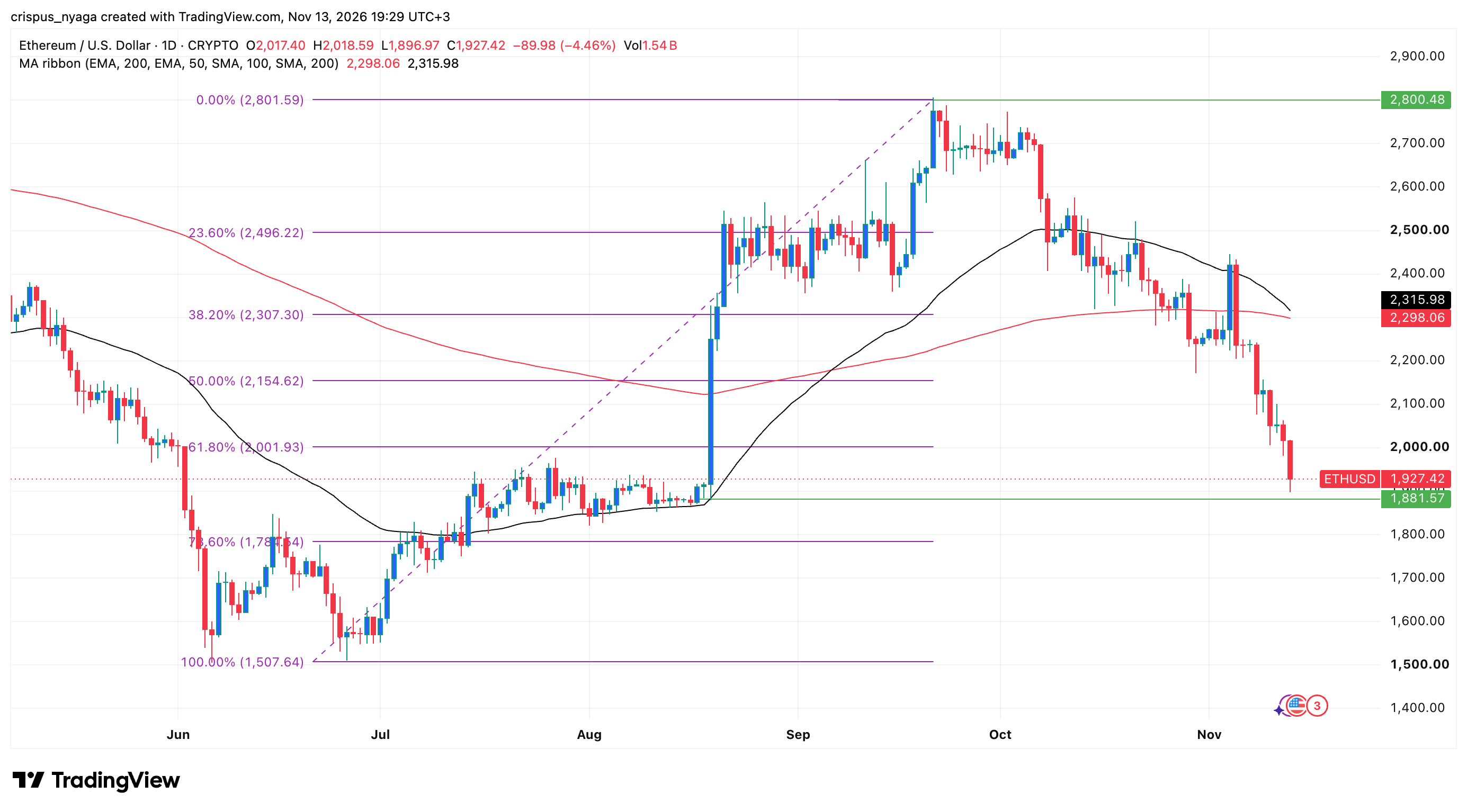
Technicals suggest that ETH price has more downside to go. It is about to form a death cross pattern as the spread between the 50-day and 200-day moving averages narrowed. This death cross pattern normally points to more downside.

The coin has dropped below the 61.8% Fibonacci Retracement level, confirming more downside. Therefore, the path of the least resistance for the token is bearish, with the next target to watch being at $1,500. On the flip side, a move above the 50% retracement level of $2,157 will invalidate the bearish outlook.

The post Analyst who warned about Nvidia and Jensen Huang flagged Ethereum price appeared first on Invezz

Many Canadians have made the Tax-Free Savings Account (TFSA) a major part of their retirement strategy. Income streams and withdrawals in the sunset years are not only tax-free, but they also avoid triggering Old Age Security (OAS) clawbacks. Prospective retirees don’t need to feel pressured to build a $1 million or larger nest egg.

The TFSA can help fund your retirement for far less. For example, $25,000, or about 23% of the maximum cumulative contribution limit as of 2026, is already a significant, actionable threshold inside your account. If you leave dividend income, including reinvested dividends, to compound tax-free, your TFSA portfolio becomes a self-sustaining, cash-generating machine in retirement.

Source: Getty Images

Your cash engine

Payout frequency matters if the primary objectives are to compound your TFSA balance faster and have a reliable retirement cash engine. Freehold Royalties Ltd. (TSX: FRU) neatly aligns with this strategy. Beyond the generous 6.3% yield, the energy stock pays cash every single month.

FRU rose 5.1% to $17.28 on November 11, 2026, a day after reporting strong Q3 2026 results, pushing its year-to-date gain to nearly 20%. The $2.7 billion energy royalty and mineral rights company has pegged the monthly dividend at $0.09 per share ($1.08 annualized) since September 2022. Holding the stock in your TFSA feels much like receiving fixed-income in retirement.

Assuming the stock price and yield remain constant, a starting $25,000 TFSA investment will compound to $118,785.70 in 25 years, including dividend reinvestment with zero price appreciation. After that period, the final balance will generate $618.68 per month or $7,424.11 in tax-free income per year.

By combining this dividend income from Freehold Royalties with government public pensions such as the Canada Pension Plan (CPP) and Old Age Security (OAS), your retirement income expands significantly. As of Q4 2026, the annual average CPP and maximum OAS at age 65 are $10,300.08 and $9,150, respectively.

You wouldn’t worry about triggering the OAS clawback because TFSA withdrawals don’t count as taxable income. Also, regular top-up contributions to your TFSA over time will bump up your withdrawable funds.

High margin business model

Freehold Royalties is not an oil producer, but owns vast tracts of land in Canada and the U.S, as well as non-government oil and natural gas royalties. The company collects royalties, or a percentage of top-line revenues, from third-party energy producers, drillers or operators on its land.

Because it has no capital, operating, or abandonment costs, Freehold easily converts revenues into cash flow. In Q3 2026, royalty and other revenue rose 34.8% to $100.3 million compared to Q3 2025. President and CEO David Spyker credits the strong quarterly results to stable royalty production and increased drilling activity levels. Freehold also reduced long-term debt by 12.3% to $248.8 million during the quarter.

The royalty platform is unique, offering low-risk oil and gas exposure. Freehold’s resources feature long reserve life, low geological risk, and strong well economics. An added competitive advantage is North America’s supportive regulatory environment. Spyker expects economic oil-weighted developments in North America and a well-funded operator base to support dividends and fund growth opportunities.

TFSA: Silent operator in retirement

A TFSA works quietly in the background during your working years. You have a permanent tax shield both before and throughout retirement. A $25,000 TFSA can provide a meaningful retirement income stream, and you can still increase your contribution for a bigger tax-free payout.

“In these environments, what really determines success is how the overall system performs,” explains Anthony Jules ’92, SM ’92, who co-founded the company with MIT Professor Emeritus Rodney Brooks. “The robot does some of the work, the people do some of the work, and the backend systems do some of the work. It’s that combination that determines how well your system performs. We believe it’s really important that people have an appropriate level of agency and input so that they’re always moving the system forward.”

Collaborative robots

Brooks was a faculty member at MIT from 1984 until 2010 and served as the director of the Computer Science and Artificial Intelligence Laboratory (CSAIL) from 1997 until 2007. While at MIT, he co-founded iRobot, which invented the popular Roomba vacuum and went public in 2005. Later, he co-founded the company Rethink Robotics, which also designed collaborative robots.

Jules met Brooks as a graduate student at CSAIL in the 1990s. The two never worked together, but their labs were on the same floor. The pair kept in touch after Jules graduated and co-founded the company Sapient, which went public before being acquired by Publicis in 2015.

In 2019, Brooks bumped into Jules at a robotics conference. He told Jules he was thinking of starting a robotics software company, which he compared to a video game engine for training robots. Robust AI was founded later that year.

The Covid-19 pandemic caused the founders to shift to creating robots that could autonomously disinfect surfaces, but when it was discovered that Covid-19 was not transmitted via surfaces, they had to pivot again.

“That forced us to decide how to use this technology we had been building, which was really about helping robots understand the world more fully,” Jules recalls. “Long story short, I said to Rodney, ‘I have an idea. You’re going to love it and you’re going to hate it. You’re going to love it because it’s solving problems for customers that we’ve been hearing about, and you’re going to hate it because we have to build hardware.”

The founders had been interviewing potential customers for years through Robust AI’s early pivots. They finally decided on logistics and manufacturing as the industries to target early on.

“When people think about automation in factories, they think about pictures of the 5 percent that are fully automated with $50 to $200 million dollar systems,” says Jules, who now serves as Robust AI’s chief innovation officer. “They don’t think about the vast majority of factories that aren’t automated at all. These factories don’t even have a conveyor belt. They are not going to tear everything out and replace it with a $200 million system.”

Robust AI’s robots can be phased into operations as needed and offer several workflows for customers. In one workflow, the robot can guide human workers to specific spaces to retrieve items. In another it can follow humans to important spots for loading. The primary workflows involve Carter robots moving things from one place to another, often in large warehouses or factories, where they say human workers can walk on average 30,000 steps a day.

“These are huge spaces, so a person might load the robot with things and then need to bring them to another station, but that could be 400 feet away,” says, Brooks, Robust AI’s chief technology officer. “Now the person can just say ‘done’ and the robot brings it instead. How the robots are integrated into the workspace is entirely up to the customer.”

Getting work done

Leila Takayama, Robust AI’s vice president of human robot interaction, recently discovered a peer-reviewed study of robots in hospitals, which were used to do things like gather dishes, move sheets, and transport other equipment. The researchers discovered that, in many hospitals, a large number of robots were turned off and against the walls. The nurses said they broke.

“What really happened was the nurses were rushing with a patient on a gurney, and the robot sees them in the hallway and stops dead, and they couldn’t get the gurney around them,” Brooks says. “The robots were getting in the way of nurses’ primary tasks.”

Robust AI’s approach to technology development is to understand workers’ primary tasks deeply and build features that accelerate those tasks, whether a human or a robot is doing them.

“We let humans do what humans are good at in the physical world, which we’ve had millions of years of evolution to get good at, and have the digital system respond to that and provide us with all the things that it is good at,” Brooks explains.

Rolls-Royce share price has rebounded in the past few weeks, erasing some of the gains it made between August and October. RR jumped to a high of 1,393p, up by 20% from its lowest point in October. This article explores what to expect after the company published its financial results on Thursday.

Rolls-Royce Group reaffirmed, but did not raise its guidance

Rolls-Royce Holdings is the biggest industrial company in the UK, focusing on industries like civilian aircraft engine manufacturing, defense contracting, power, and the small modular reactor (SMR) industries. 

The company has benefited as all these businesses have thrived after the pandemic as the civil aviation industry has thrived. It is also benefiting from the ongoing boost in defense spending in countries in Europe, Middle East, and Asia.

Rolls-Royce Holdings published its trading statement on Thursday. The management reaffirmed its full-year guidance of between £4.7 billion and £4.9 billion of underlying profit and between £3.8 billion and £4 billion of free cash flow. Unlike in the past, the company did not raise its guidance. 

The management announced an interim share buyback of £1.5 billion, which will be completed when it publishes its full year results on February 25. This buyback is part of the existing plan of repurchasing shares worth between £7 billion and £9 billion, which will conclude in 2028.

In the statement, the management noted that its business was growing across the board, with it aircraft engine backlog being 2,500. It recently received large orders from companies like Avolon, Cathay Group, and Air China.

Most importantly, the company has seen the large engine flying hours grow by 4% in the first ten months of the year. This is crucial because the civil aviation industry went through major challenges as jet fuel prices soared and several large airlines slashed their trips. Indeed, the EFH from its Middle East airlines has moved above the pre-conflict levels. 

Rolls-Royce Holdings has also seen a strong demand in its defence business as countries continue boosting their spending. Most importantly, its power business is booming because of the ongoing artificial intelligence (AI) boom. Its order intake in this business jumped by 62%, bringing the total backlog to £8.6 billion. 

The company noted that orders for gas engines has more than tripled YoY, driven by data center demand. Also, it is now in the process of finalizing a major contract with a top hyperscaler. In a statement, the CEO said:

“Our transformation and the actions we are taking are creating a Rolls-Royce with a diversified portfolio of high-performing businesses, with greater resilience and significant growth potential.”

Rolls-Royce share price technical analysis

Rolls-Royce stock chart | Source: TradingView

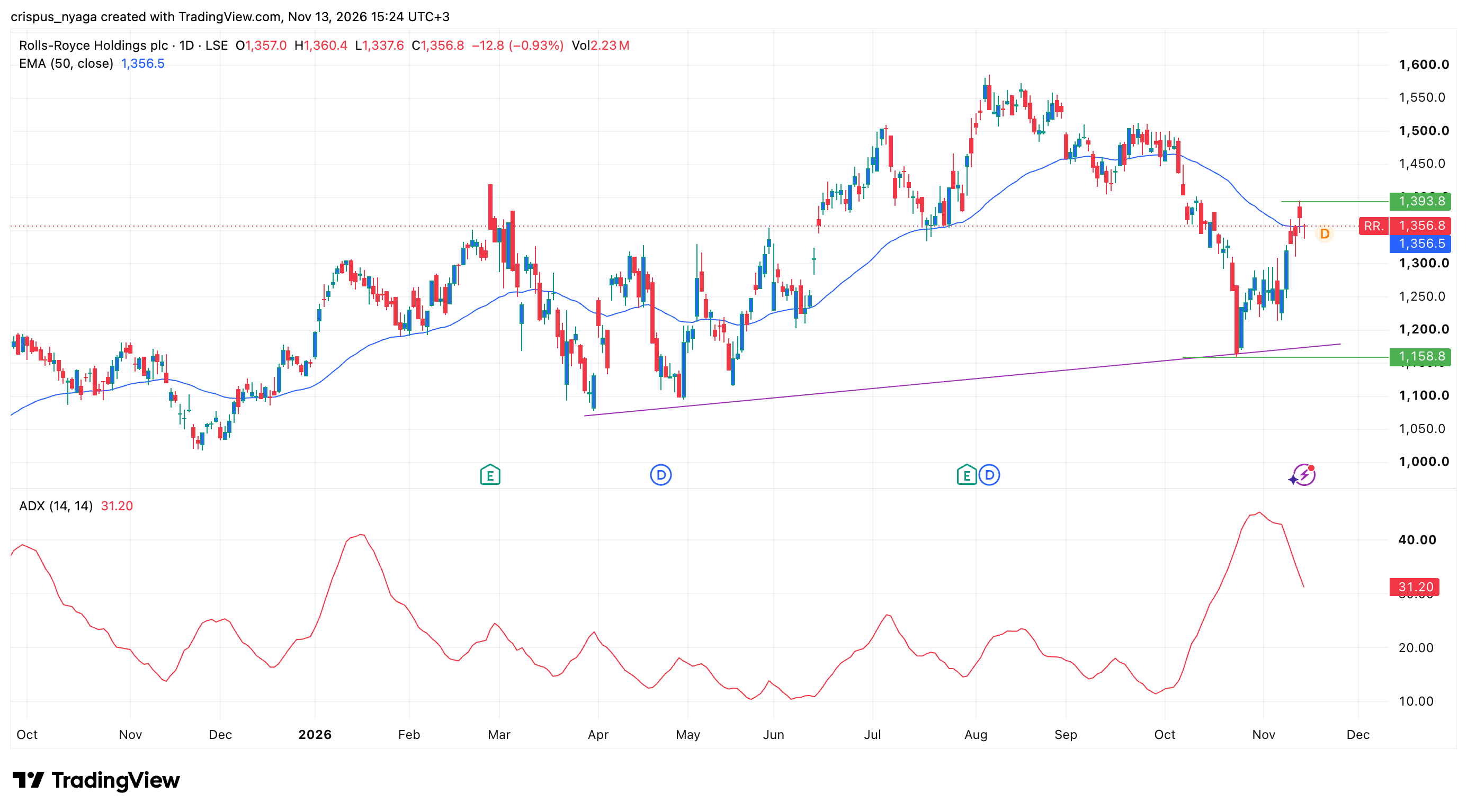
The daily chart shows that the RR stock price has rebounded in the past few weeks. It jumped from a low of 1,158p on October 23rd to a high of 1,393p. The stock has now pulled back to the current 1,354p. 

It is consolidating along the 50-day Exponential Moving Average (EMA). The risk, however, is that it has formed a hanging man candlestick pattern, a common bearish reversal sign in technical analysis. 

The Average Directional Index (ADX) has dropped to 31.20 from this month’s high of 45, a sign that the recent recovery has started to fade.

Therefore, there is a likelihood that the stock will pull back further, potentially to the psychological level of 1,300p and then resume the uptrend. In the future, the stock will likely rebound, with the next important target being at 1,500p. 

The post Rolls-Royce share price rebound has stalled: is it a buy as it reaffirms guidance? appeared first on Invezz

Steep intraday declines in gold, silver, and copper prices, coupled with largely mixed corporate results, pressured Canadian stocks on Thursday, reversing all of the gains from the previous session. The S&P/TSX Composite Index fell 275 points, or 0.8%, to close at 36,137 — trimming its week-to-date gains to 1%.

Even as firm oil and gas prices drove energy stocks higher, steep losses in most other key sectors, including mining, healthcare, and real estate, pushed the TSX benchmark sharply lower.

The decline in gold, silver, and copper prices raised fresh concerns about the near-term outlook for Canadian metals producers, while mixed quarterly earnings added to uncertainty about corporate profitability.

Top TSX Composite movers and active stocks

Aya Gold & Silver (TSX: AYA) fell by nearly 7% to $32.48 per share, making it the worst-performing TSX stock for the day. The decline came even as the Montreal-based precious metals miner reported strong third-quarter 2026 financial results, with revenue jumping 90% year-over-year.

Aya’s net profit also surged 182% in the latest quarter to US$35 million, while operating cash flow more than doubled to US$48 million. Encouraged by this performance, the company raised the lower end of its 2026 silver production guidance for the Zgounder mine. Despite these improvements, a 9% year-over-year decline in silver sales at Zgounder and a 7% sequential drop in average realized silver equivalent prices, along with intraday weakness in metals prices, seemingly weighed on investor sentiment, triggering a selloff in AYA stock.

Curaleaf, Discovery Mining, and Capstone Copper were also among the day’s bottom performers on the Toronto Stock Exchange, with each losing at least 6.5% of their value.

Despite the broader market weakness, shares of Cargojet (TSX: CJT) jumped more than 10% Thursday, making it the session’s top-performing TSX stock. This rally in CJT stock came after the Canadian air cargo services provider reported record third-quarter revenue and strong earnings growth.

Last quarter, Cargojet’s revenue climbed 30.3% from a year ago with the help of higher domestic network revenue, aircraft leasing, and charter revenues. As a result, the company’s net profit more than doubled to $19.1 million. These strong financial results, coupled with its focus on international expansion and operational efficiency, boosted investor confidence and fueled the rally in CJT stock.

Canadian Tire, Celestica, and Allied Properties REIT also inched up by at least 3.8% each, placing them among the day’s top gainers on the TSX.

Based on their daily trade volume, Enbridge, Capstone Copper, Telus, B2Gold, and Suncor Energy were the five most active stocks on the exchange.

TSX today

Commodity prices across the board were mixed in early Friday trading, pointing to a flat open for the resource-heavy main TSX index today.

While no major domestic economic releases are due, Canadian investors may want to keep an eye on the key U.S. wholesale inflation report this morning. This report, especially after the release of hotter-than-expected consumer inflation data earlier this week, could offer fresh clues about the Federal Reserve’s next interest rate decision and influence market sentiment.

Meanwhile, Canadian investors will monitor developments in Canada-U.S. trade negotiations after U.S. Trade Representative Jamieson Greer confirmed Thursday that officials from both countries had been in contact recently, although he offered no timeline for reaching an agreement.

Investors will also watch technology stocks after Nvidia announced the immediate resignation of CEO Jensen Huang yesterday, with longtime finance chief Colette Kress taking over as interim chief executive.

On the corporate events side, some TSX-listed companies like CES Energy Solutions, Onex, Kelt Exploration, and Americas Gold and Silver will release their latest earnings reports today.

These developments, along with movements in commodity prices, could influence the TSX’s direction in today’s session.

Market movers on the TSX today

Russell Brand was sentenced to 10 years in prison on Monday (Alamy)


Alain Tolhurst


3 min read12 November

The conviction of Russell Brand should lead to major reform of how gagging orders are used, the chair of the culture committee has told PoliticsHome.

Caroline Dinenage, Conservative MP for Gosport, said non-disclosure agreements (NDAs) are being used in “sinister” ways in the media and entertainment industries, “to stop people coming forward with legitimate concerns”.

Following a series of scandals involving high-profile figures in recent years, a new body was set up to protect workers in the creative sectors, the Creative Industries Independent Standards Authority (CIISA). However, there are fears that the widespread use of NDAs is still preventing whistleblowers from coming forward. 

Speaking on The Rundown podcast by PoliticsHome, Dinenage said people who take up jobs in TV and film are sometimes asked to sign confidentiality clauses, which then stop them from speaking out about mistreatment.

On Monday, entertainer Brand was sentenced to over 10 years in prison for one count of rape and three counts of sexual assault after an investigation by The Sunday Times and Channel 4.

A day later, entertainer David Walliams was revealed as the celebrity who had tried to get a legal injunction to prevent The Guardian and ITV from publishing stories accusing him of sexual misconduct and grooming. He denies any wrongdoing.

There are now renewed discussions about the difficulties facing people in the creative industries in reporting mistreatment, with Dinenage telling PoliticsHome: “The issue that I’ve raised in the chamber is around the use of NDAs and confidentiality clauses.”

“I’m very concerned about this,” the committee chair said.

“It just feels to me that they are frequently being used in the media and entertainment industry in particular to stop people coming forward with legitimate concerns. Workers way too often feel forced to sign them to secure employment, but that then silences them from reporting potentially criminal or unlawful misconduct.”

She said the CIISA, which last month set up a new independent online reporting service, has warned that gagging orders will prevent people from bringing concerns to them. 

“That’s properly sinister, isn’t it?” Dinenage added. “Gagging potential victims from speaking out through an NDA is a really unpleasant world to be living in.”

The government has said it will look again at exemptions for the way NDAs are used in light of recent events, but the Tory MP said she would like to see changes in the employment rights bill being brought forward to “reflect the concerns that this case has raised”.

“The fact is we’re in a situation where the law should protect victims, not shield wrongdoing.

“And yet, in so many cases, the law is being used to further offending behaviour, to intimidate victims, in some cases, just put a bit of sand in the wheels of investigative journalists who are trying to find out information to slow them down a bit, stack up a load of money against them to make it unbelievably expensive to pursue what they’re doing.

“This is all wrong, isn’t it?

“And this is where I think now is a unique opportunity for government and others to look at how this is working and pull out the bits that are just enabling wrongdoing and not protecting victims.”

Chair of the Women and Equalities Committee, Olivia Bailey, has urged ministers to extend the ban on misuse of NDAs so it applies to freelancers, volunteers, and fans, not just employees. The government should also extend other workplace protections and strengthen the industry regulator, the Labour MP argued in a piece for The House.

The Rundown is presented by Alain Tolhurst, and is produced and edited by Ewan Cameron for Podot

  • Click here to listen to the latest episode of The Rundown, or search for ‘PoliticsHome’ wherever you get your podcasts.