
Author

admin

Browsing

Prime Minister Andy Burnham told MPs he had ordered minsters to explore lifting standing charges on gas bills. (Alamy)


Nadine Batchelor-Hunt


3 min read21 October

The government is looking at removing standing charges from energy bills, Prime Minister Andy Burnham has announced.

Speaking in PMQs on Wednesday, Burnham said the decision to approve drilling at the Jackdaw gas field in the North Sea, confirmed earlier today, would allow ministers to do more to support people with energy costs.

He was responding to a question from Conservative Party leader Kemi Badenoch, who criticised how long it took the Labour government to green light more drilling at Jackdaw.

Burnham said that drilling at the Scottish site would “build a bridge to a renewable future” as well as allow the government “to do more to help people with bills”.

“I can tell the House today that I have asked the Chancellor and the Energy Secretary to look at whether we can remove standing charges from gas bills, and to report back to this House at the earliest opportunity,” the Prime Minister told MPs.

Standing charges are applied to energy bills regardless of how much energy a household uses, with the average daily charge currently at nearly 27p per day.

Environmental campaigners have criticised the Labour government’s decision to approve gas drilling at the Jackdaw site, claiming it flies in the face of the UK’s net zero ambitions. Green Party leader Zack Polanski said Labour had “abandoned all credibility in the fight against climate change.”

Speaking in PMQs, Burnham defended the move as a “pragmatic step” that did not undermine the country’s climate goals, and accused the Greens of an “ideological” approach. The PM added that it would also reduce the amount of energy imported from overseas.

Earlier today, Chancellor John Healey told broadcasters in Aberdeen, where the owners of Jackdaw are headquartered, that “the proceeds of this oil and gas coming ashore now can be invested for the future generations”. 

The government says drilling at the Jackdaw site is expected to increase domestic gas production by 6 per cent at its peak, with the supply of gas to British homes and businesses starting from the end of this month.

Foreign Secretary Ed Miliband had ruled out new oil and gas licenses in the North Sea when he was Energy Secretary in the Keir Starmer government, arguing that it would not significantly bring down energy bills because oil and gas are sold on internal markets.

However, critics of this position argued that approving more gas production at the Scottish site would boost the UK’s domestic supply, protect industry jobs, and produce funds that can be reinvested in green infrastructure.



I got my first set for Christmas from my siblings last year, and originally I stuck some pretty stickers on my case to tell the difference between my case and my husband’s. I’ve since upgraded to this stylish case from Troubadour (previously Mujjo), which makes it easy to see which is mine and clip it onto my keys. It’s a nice accessory if your mom already has AirPods but struggles to keep track of them or is looking for an easier way to differentiate hers from the other members of the house.

Gamer Gear

Once my kiddo is asleep, you can find me parked on the couch playing video games. I upgraded to a Nintendo Switch 2 ($449) earlier this summer so I could finally buy and play Pokopia ($70), since it’s exclusive to the new console, and I already can’t wait to use it to play the Legend of Zelda: Ocarina of Time ($60) remake coming out in November. It’s also quickly become an experience I can share with my son now that he’s 4; he’s been helping me and my husband replay Tears of the Kingdom, but he mostly requests we help him build monster-hunting robots and cook food for Link like he’s a starving Tamagotchi.

If you’re not looking to upgrade her console just yet but need a Switch-friendly cozy game for her, Stardew Valley has another big update in the works and only costs $15. I’m also hoping we see Fields of Mistria ($14) come to the Switch eventually, but the full launch came out in August for Steam users and has major quality-of-life improvements if she has played Stardew one time too many. My husband also upgraded his gaming setup this summer with a Steam Machine (from $1,049), and I have big plans to start using it often for Fields of Mistria. If your mom loves games, she’ll love any one of these new devices or new games if she already got herself the new gadget like I did.

Photo Spotlight

Aura

Aspen Digital Photo Frame

As a mom, I take a lot of photos of my family. A lot. And sometimes it feels like all those great photos of my son’s milestones go to my camera roll and photo storage to die. There are two solutions I love for this that are incredibly giftable: a digital photo frame she can instantly upload images to, and a printed photo book where you can take the best of the best and put them at her fingertips. I have and love both for different reasons. I love the digital photo frame to add all the photos from a fun weekend at the San Diego Zoo or Los Angeles Renaissance Pleasure Faire for me to relive again and again, but I also love being able to pull a photo book from the bookshelf and relive a specific moment I know is waiting there for me. Aura makes my favorite digital photo frames (followed by Skylight and the Calendar 2 if you want a multipurpose device, but Aura has no subscription fee if you only want photos), while Mixbook has been a favorite of mine for a while when it comes to printing photos, and has great starting prices for its photo books.

A Bird’s-Eye View

Netvue

Birdfy Smart Bird Feeder

If you know a mom who loves to bird-watch (I know one!), you can upgrade her bird feeder to a smart one. Smart bird feeders add a camera to the feeder so she can see a close-up feed of the birds that come to hang out in her yard, and they’re adorable to boot, for a little smart curb appeal. WIRED reviewer Kat Merck recommends the original Birdfy Lite as a great gift; it’s her favorite smart bird feeder and comes in adorable colors to brighten your mom’s yard and catch the eye of neighborhood birds. But the one she and I both have our eye on (her for her mother, me for myself) is the Birdfy Nest Duo, which is actually a birdhouse with two cameras so you can see the birds entering the nest outside and raising a family inside.

An Adorable Pan

Photograph: Matthew Korfhage

Field Company

Cast Iron Egg Pan

I didn’t know I needed a tiny cast iron pan until it arrived. Field Co’s hand-finished, preseasoned cast iron pans are already known for being both lightweight and handsome. But with a mere 5-inch cook surface, this one might even cross the line from handsome into “cute.” But that’s what makes it a good gift: Your mother almost certainly does not have a cast-iron pan this small, and yet it also has real utility. At just 2 pounds, this pan is easy to pull out and stash, easy to maneuver or flip a pancake, easy to serve from, and the perfect size to fit the perimeter of a two-egg omelet. In addition to an egg pan, it’s a great, low-effort, single-serving pan in general—whether for grilled cheese, a little bit of bacon or sausage, or a couple of chicken thighs. The egg pan can be bought all by itself. But for $60 more, the gift set is nice. It comes with a cleaning kit (with maybe my favorite chain mail scrubber in existence), some seasoning oil, and a leather handle cover in cognac, black, brown, or cherry. —Matthew Korfhage

Compression Care

  • Image may contain: Clothing, Coat, and Pants

    Photograph: Boutayna Chokrane

  • Image may contain: Clothing, Lifejacket, Vest, Coat, Jacket, Glove, Racket, Sport, Tennis, Tennis Racket, and Accessories

    Photograph: Boutayna Chokrane

  • Image may contain: Clothing, Coat, Jacket, and Racket

    Photograph: Boutayna Chokrane

  • Image may contain: Electronics, Stereo, Screen, Computer Hardware, Hardware, Monitor, Car, Transportation, and Vehicle

    Photograph: Boutayna Chokrane

Therabody

JetBoots Pro Plus

There’s a wellness gadget for everything now. Rings that track your sleep and blood oxygen levels, masks to make you look younger, massagers to relax your muscles, and now boots to improve circulation. WIRED reviewer Boutayna Chokrane says her mom loves these compression boots from Therabody to improve circulation, which is a common problem for many of our aging parents. These boots combine compression, vibration, and LED therapy into a single wearable device that comes with eight preset routines to focus on legs, knees, and joints. It’s a unique option if she wants better recovery for her legs or better circulation for her health.

Better Espresso

  • Image may contain: Cup

    Photograph: Matthew Korfhage

  • Image may contain: Cup, Beverage, Coffee, and Coffee Cup

    Photograph: Matthew Korfhage

  • Image may contain: Electronics, Hardware, Computer Hardware, Business Card, Paper, Text, Mobile Phone, Phone, and Monitor

    Photograph: Matthew Korfhage

  • Image may contain: Cup, Beverage, Coffee, Coffee Cup, and Espresso

The DeLonghi Rivelia is the best and easiest and most user-friendly superautomatic espresso machine I have tested. What’s superautomatic mean? It means you pour whole beans into the hopper, put milk in the milk carafe, and select the drink you want to make on the touchscreen menu. Then you let the machine do most of the rest. The style of espresso made by a superautomatic machine like this Rivelia is generally a bit smoother and less intense than the sort you get in a café. But the process is also less finicky; you won’t be dealing with coffee grounds and portafilters. What’s especially nice with this Rivelia is the ability to make multiple “profiles” for different coffee drinkers in the house, each with their own favorite drinks—and the ability to swap out bean hoppers to make decaf coffee in the afternoon. The Rivelia is also the machine my own mother, a drinker of lattes and dark-roast beans, loves unreservedly. Like others on the WIRED Reviews team, I often ask colleagues and those close to me to test my top-rated machines over long periods to see how they hold up over months or years of regular use. My mother thanks me nearly every month for letting her test the Rivelia. —Matthew Korfhage

For Ultimate Everything Showers

Image may contain: Indoors, Bathroom, Room, and Shower Faucet

Photograph: Matthew Korfhage

For most moms, showers are sacred—especially for moms of babies or younger kids. However, heavy metals, sediments, chlorine, and PFAS can cause health problems not just in drinking water, but in water that touches the skin, as well. They can also cause buildup on hair and shower surfaces, making them harder to clean. Many municipalities—including mine—treat water with chlorine, and when I asked him which filter he’d recommend for my own shower, WIRED water filter reviewer Matthew Korfhage suggested the Weddell Duo. It’s the only US filter he’s found that has certification for chlorine and lead removal from NSF International, and it also cites third-party testing by IAPMO R&T showing it can remove PFAS, though there’s no corresponding certification. Still, the Duo has a 2.5-gallon-per-minute flow rate and can remove most chlorine from over 8,000 gallons’ worth of showers. It’s an in-line filter, so it’s easy to install in minutes—just screw it in between your pipe and showerhead. It even comes with a little roll of waterproof tape to ensure a leak-free fit, and because of the horizontal orientation, installation won’t affect the showerhead height. The filter needs to be replaced every three months, but refills only run about $25, compared with competitors like Filterbaby or Rorra, which can cost $40 to $45. —Kat Merck

Power up with unlimited access to WIRED. Get best-in-class reporting and exclusive subscriber content that’s too important to ignore. Subscribe Today.

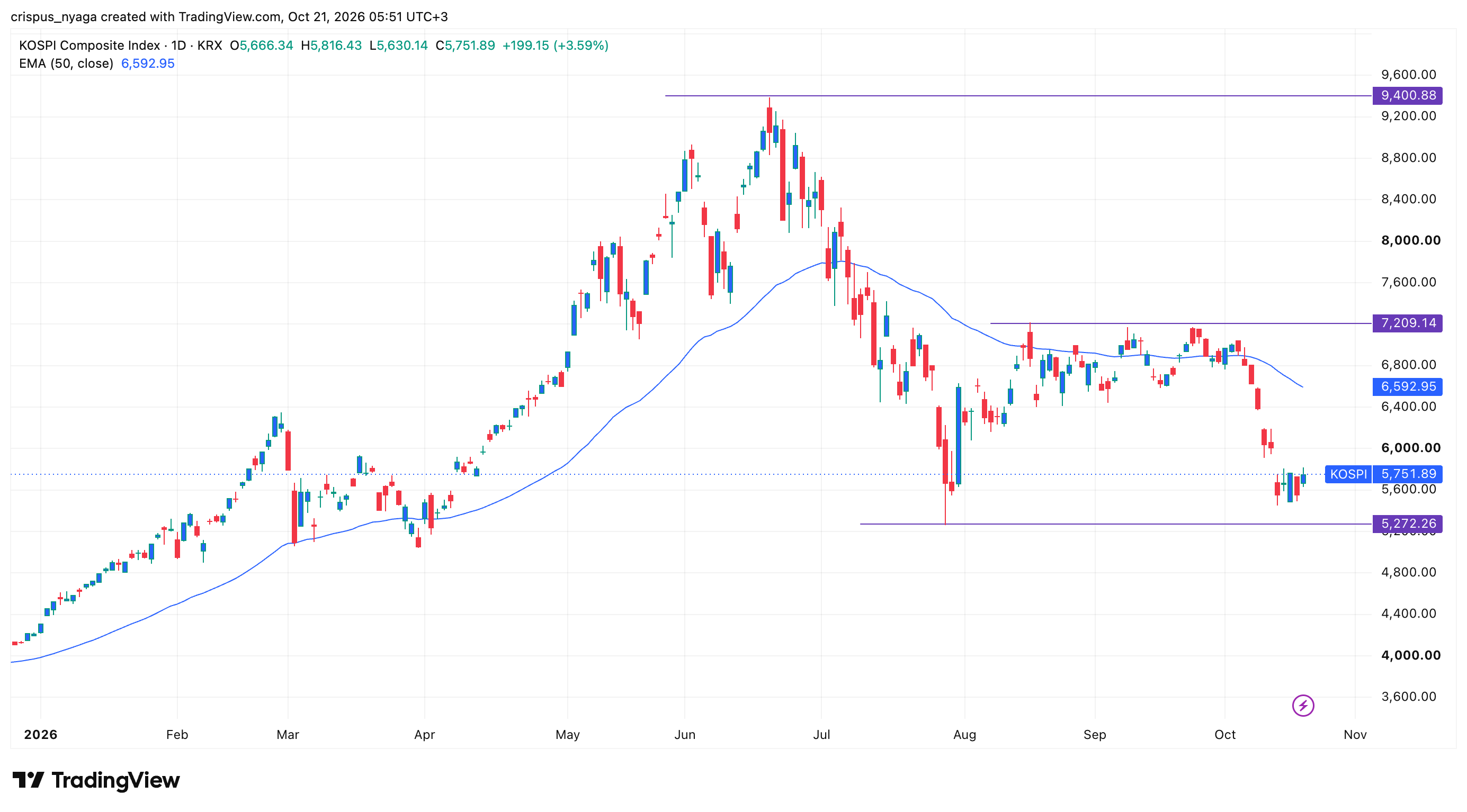
Kospi Index jumped by over 4% on Wednesday as companies in the memory industry bounced back. It rose to 5,772 points, up modestly from this week’s low of 5,465, mirroring what happened in the United States where the Dow Jones, Nasdaq 100, and S&P 500 soared.

Samsung Electronics and SK Hynix soar as Ken Griffin warns

The Kospi Index jumped by over 4% on Wednesday as global stocks bounced back. In the United States, the Dow Jones jumped by 530 points, while the S&P 500 Index was up by 25 points. 

The same trend is happening in other Asian countries, with Japan’s Nikkei 225 and Hong Kong’s Hang Seng rising modestly. 

US stocks jumped as bond yields and crude oil prices dropped amid hopes of a potential US and Iran deal to end the war. This retreat reversed on Wednesday, with Brent trading at $110 and the West Texas Intermediate (WTI) hitting $100.

The biggest South Korean stocks are in the green. Samsung Electronics jumped by 7.3%, while SK Hynix and SK Square jumped by 8% and 7%, respectively. This rebound coincided with the rally in memory and AI companies in the US, with Dell and Nvidia soaring by over 2%.

Still, concerns about the AI industry remains. In a statement, billionaire Ken Griffin said that the AI industry was certainly in a bubble right now. His statement is notable because Ken runs one of the biggest and most successful hedge funds in the world. He also runs one of the top market makers in the country. 

Billionaire Ray Dalio, who founded one of the top hedge funds, has also warned that the AI bubble will burst. The AI Stock Bubble Index has jumped to over 70. A burst in the AI bubble would negatively impact Kospi since its biggest constituents are in the industry. 

South Korea’s PPI and BoK interest rate decision

The Kospi Index also jumped after South Korea released the latest producer price index (PPI) data. The numbers showed that the headline PPI softened from 7.9% in October to 7.7% in September, which is an encouraging sign.

This report came a day before the Bank of Korea (BoK) releases its interest rate decision. A Reuters poll found that most economists expect the bank will leave interest rates unchanged at 3% as it assess ythe impact of the last back-to-back hikes. In a note, a BNP Paribas analyst said:

“The risks are tilted to the upside, given that growth is very strong on the back of semiconductors. This strong growth will ​spread into the domestic sector and domestic demand, (leading) to inflationary pressures.”

Kospi Index technical analysis

Kospi Index chart | Source: TradingView

The daily chart shows that the Kospi Index has remained under pressure in the past few days. It was trading at 5,755, a few points above the crucial support level of 5,272. 

On the negative side, it remains below the 50-day moving average and is forming a small bearish flag pattern. These technicals suggest that the index may resume the downward trend, potentially to 5,272 points soon.

The post Kospi Index analysis as Samsung, SK Hynix jumps despite key Ken Griffin warning appeared first on Invezz

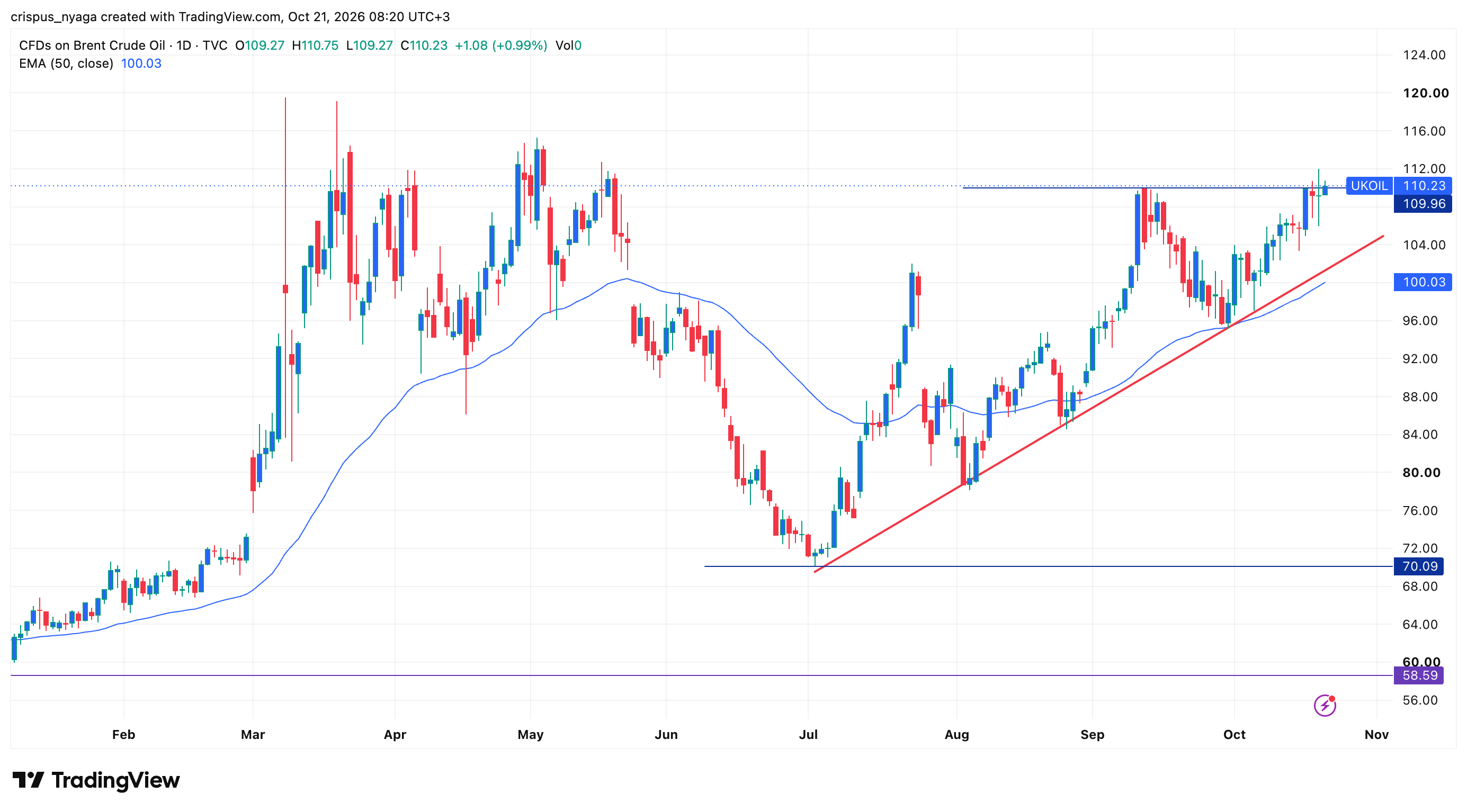
Brent crude oil price held steady above $110 on Wednesday, paring back some of the losses experienced a day earlier when odds of a US-Iran deal rose. It has jumped by over 56% from its lowest level in July this year. This rally may continue as the crisis in the Middle East escalates.

US-Iran crisis set to escalate

Brent and the West Texas Intermediate (WTI) have risen and settled at a crucial resistance level this week. This rally is being driven by the ongoing crisis in the Middle East, which analysts expect will escalate before or after the midterm elections.

Iran’s IRGC has continued shooting ships attempting to cross the Strait of Hormuz. As a result, ships are coordinating with Iran for passage as the cost of transiting continuing the upward trend. Insurance costs have soared, while ship captains are seeking as much as $1 million for transiting. 

The biggest risk is where the US-Iran crisis escalates. Analysts predict that the US and Israel will decide to focus on Iranian oil infrastructure, including Kharg Island, which handles 90% of its exports. Trump has warned that these strikes will start after the midterm elections.

Such a move would push Iran to retaliate against energy infrastructure in the region, a move that will lead to a prolonged energy crisis. 

READ MORE: Oil falls from five-month highs after report of US-Iran peace proposal

At the same time, Saudi Arabia and Houthis have continued attacking each other. Houthis have launched strikes against key energy locations and shut down the Bab el-Mandeb Strait that handles millions of oil barrels a day.

Ukraine has also intensified its attacks against Russian energy targets. Earlier this week, the country’s military launched strikes against a major refinery in St. Petersburg. These events mean that Russia will struggle to refine and export its oil.

The next major catalyst for Brent and the West Texas Intermediate (WTI) will be the upcoming US oil inventories data. Economists expect the report to show that oill inventories dropped by 0.3 million barrels last week after falling by 8.3 milion a week earlier. 

Brent crude oil price technical analysis

crude oil

Crude oil prices chart | Source: TradingView

The daily chart shows that Brent crude has staged a strong comeback after bottoming at $70 in July this year. It has remained above the ascending trendline that links the lowest swings since July. 

Brent has also held steady above the 50-day Exponential Moving Average (EMA), which is a bullish sign in technical analysis. It has remained above the Supertrend indicator.

A closer look shows that Brent is at an important level that coincides with the highest point on September 11. A move above that level will invalidate the double-top pattern and point to more gains towards the key psychological level of $115. Crossing that level will point to further gains towards $119. 

The post Brent crude oil price jumps to $110 as a double-top pattern forms: what next? appeared first on Invezz

These are volatile times. On one side, global tariffs, geopolitical uncertainty, and a move towards artificial intelligence (AI) are stagnating growth for some segments. On the other side, energy prices are surging to new highs. Canada is inviting global investments in Canadian energy, logistics, and AI infrastructure. As the largest North American oil and gas pipeline company, Enbridge (TSX: ENB) is playing an active role in this.

Source: Getty Images

Down 16% and paying 5.8%

Since July, energy infrastructure stocks have seen a sharp dip as they are investing large sums in building infrastructure. The capital investment phase can be risky as a significant amount is diverted to projects which will take three to five years to generate cash flow. The company takes on the risk of building these long-gestation projects, assuming things will remain as they are now. But if the geopolitical scenario changes or the regulatory landscape reduces the company’s freedom to set prices, the return on capital will take a hit, as it did with BCE and Telus Corporation.

However, investors should cut this short-term noise and view infrastructure projects from a long-term perspective. Enbridge is not building power projects and natural gas pipelines for two to five years of cash flow. It is looking at a minimum of seven years before considering buying back equity interest in new projects from investors. Until then, existing projects will fund current dividends and new projects will pay their financing costs.

The 16% dip in Enbridge’s share presents a similar opportunity to what we saw back in October 2024. Back then, Enbridge stock fell 6–7%, and as it completed the $14 billion acquisition of three U.S. natural gas utilities, the stock surged 32% to a new 52-week high. The recent 16% dip has increased the yield to 5.8%. The upcoming third-quarter earnings on November 6 will shed some light on whether it can grow dividends in line with distributable cash flow (DCF) by 5%.

I do not expect 3% dividend growth to accelerate to 5%, considering the ongoing capital programs. Now is the right time to expand and capture market share in West Coast natural gas exports. Enbridge can monetize today’s investments for decades and grow dividends at that time.

The case for buying Enbridge now

LNG export opportunity: Enbridge has always been a dividend stock. But now it could give you 20–30% capital appreciation annually for the next three to five years as it brings new projects online. It is building Woodfibre LNG to ship more liquefied natural gas (LNG) from the Pacific West. It is also investing heavily in the expansion of the West Coast system.

Government support: Moreover, the Canadian government’s initiative to expedite approval of major infrastructure projects could help Enbridge lower the risk of delays in approval and the resulting costs. It could be a key beneficiary of Canada’s proposed Productivity Mega Deduction, which will allow businesses to deduct 100% of the cost of oil and gas pipelines. If the proposal is passed, Enbridge can claim large depreciation and significantly reduce its tax bill.

Dividend payout: At a time when major dividend stocks slashed dividends amidst rising balance sheet debt, Enbridge maintained its payout ratio at 63% in the first half of 2026. Even if the project goes over budget or energy demand slows, Enbridge has financial flexibility to pay its current dividends.

Leverage ratio: Now is the time to buy Enbridge stock despite its more than $1 trillion long-term debt. That debt is 4.5 to 5 times its adjusted Earnings Before Interest, Taxes, Depreciation, and Amortization (EBITDA).

Investor takeaway

If you invest $6,000 in Enbridge today, you can buy 90 shares and expect the share price to grow by 20–50% in the next three years. Moreover, you can get an annual dividend of $363.70 in 2027, which can grow to $404.80 by 2031 if Enbridge maintains 3% dividend growth.

You can grow this dividend income by using the payout to buy more Enbridge shares. Consider using a Tax-Free Savings Account (TFSA) to avoid dividend tax.

YearDividend per share @ 3% CAGRSimple Dividend on 90 shares2026$3.88$87.302027$4.00$359.682028$4.12$370.472029$4.24$381.582030$4.37$393.032031$4.50$404.82

BJ’s Wholesale is changing course on its approach to holiday discounts as it continues to see members respond to economic pressures.

The company saw its comparable club sales (excluding gasoline) increase 3.1% year-over-year in the second quarter of 2026, according to its latest earnings report. BJ’s CEO Bob Eddy said on an earnings call in August that “consumers remain discerning with their dollars” as the “K-shaped economy persists.” 

That caution comes as consumer sentiment has been declining nationwide amid rising gas prices and persistent inflation. Preliminary October data from the University of Michigan’s Survey of Consumers showed consumer sentiment falling 1.8 index points from September. Sentiment fell more steeply among lower-income consumers.

“Frustration over cost-of-living continues to mount, as consumers across the political spectrum believe that the trajectory of the economy has weakened since the beginning of the year,” said Joanne Hsu, an economist and director of the University of Michigan’s Surveys of Consumers, in a statement.

Read more: BJ’s Wholesale customers will face a significant store change

BJ’s launches holiday sales early with lower discounts on some items

At a time of growing economic uncertainty, BJ’s has decided to kick off its annual Early Black Friday savings event earlier than last year, according to a recent press release.

In 2025, the event ran from Oct. 31 to Nov. 16. However, this year it kicks off on Oct. 23, and the official end date hasn’t been announced yet.

BJ’s Early Black Friday savings event offers members discounts (in stores and online) on leading brands in several categories for the holiday season.

For example, this year, the warehouse club is offering shoppers up to 20% off toy brands such as Hot Wheels R/C Let’s Race Snake and Tytan Magnetic Tiles, with an additional 10% off their entire toy purchase with a coupon. 

This year’s discount on toys, however, is less steep than last year’s Early Black Friday savings event, which offered up to 30% off select toys with the 10% off digital coupon, according to a Time Union report.

BJ’s is offering customers up to 40% off TVs and electronics this year. This includes products such as the Samsung 85” U8000HD Crystal UHD 4K Smart TV and Sony Wireless Noise Canceling Headphones. Customers can also get free delivery on select items in this category. 

Additionally, the warehouse club is giving shoppers up to 30% off and free shipping on select home and kitchen items, such as the Dyson V10 Konical Cordless Stick Vacuum and Cuisinart Smart Stick Immersion Blender, during the savings event. 

Yet, this discount is less generous than the one BJ’s offered last year for the event, which was up to 35% off home and kitchen essentials with free shipping. 

BJ’s Wholesale Club is launching its Early Black Friday savings event on Oct. 23, earlier than last year.

M. Suhail / Getty Images

BJ’s faces holiday competition as shoppers rethink spending

The move from BJ’s comes after several of its major competitors launched fall sales earlier this month, offering steep discounts across several popular product categories.

Amazon held its Prime Big Deal Days event from Oct. 6 to Oct. 7, offering Prime members deals across more than 35 categories. Target Circle Deal Days also ran Oct. 6 to Oct. 7, with discounts of up to 40% on thousands of items in categories such as toys, beauty, tech and apparel. 

Walmart’s Deals & More event lasted from Oct. 5 to Oct. 11, offering discounts of up to 50% on home products, 40% on tech, and 30% on toys, food and Halloween items. 

More Grocery News:

  • BJ’s Wholesale customers will face a significant store change
  • Kroger loses $12 billion as customer behavior takes a turn
  • Publix struggles to reverse concerning customer behavior

BJ’s decision to launch its Early Black Friday savings event earlier this year comes as consumers nationwide are changing their holiday shopping habits to stretch their spending.

According to a recent PayPal survey, 58% of U.S. consumers plan to shop for the holidays before Thanksgiving this year, while 29% plan to start shopping earlier than they did last year.

Nearly six in 10 Americans also report greater financial concern heading into the holidays.  In response, 36% plan to set and stick to a budget for their holiday shopping, while 32% plan to compare prices and 31% plan to wait for sales or promotions.

“What’s changing isn’t consumers’ desire to spend during the holidays, but how they’re going about it,” said Frank Keller, president of checkout solutions and PayPal, in the survey release. 

“Shoppers are starting earlier and taking a more intentional approach, looking for deals, rewards and cash back to make every purchase count while still prioritizing the gifts and moments that matter most,” Keller continued. 

Related: Kroger loses $12 billion as customer behavior takes a turn

Despite millions of years of evolution, the development of the human fetus remains a complex process that is vulnerable to genetic, environmental, and metabolic disruptions. These disruptions could result in developmental abnormalities, starting with one of the first organs to begin developing in the fetus that continues to develop after birth: the brain.

In a routine prenatal ultrasound, the sonographer will flag possible brain abnormalities for additional magnetic resonance imaging (MRI). But imperfect imaging can result in missed or incorrect diagnoses. 

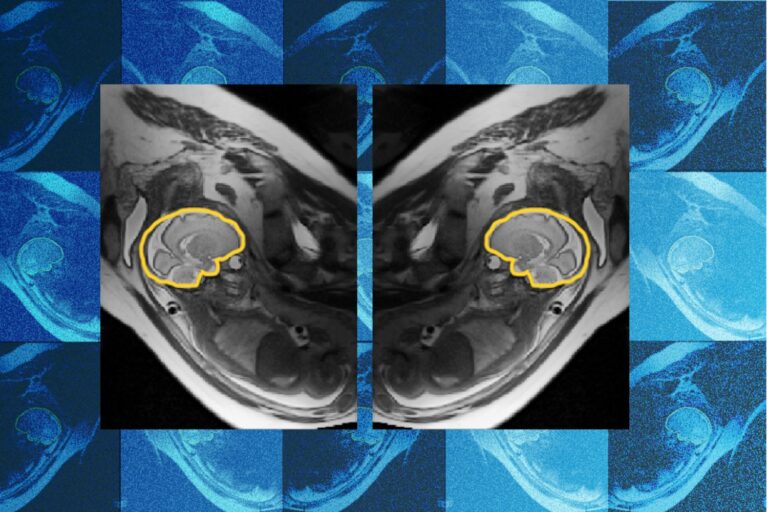
To assist with the early detection and treatment of these abnormalities, researchers at MIT, Boston Children’s Hospital, and Inria have developed and trained a deep learning model called E(3)-Pose that helps image the fetus’s head while it’s in motion to capture a high-resolution image that the radiologist can examine. A paper about the work was presented at the 2026 European Conference on Computer Vision. 

“One of the problems with having the baby move is that the slices are all over the place,” says first author Ramya Muthukrishnan. Muthukrishnan is an MIT PhD student in the lab of Sunlin (1966) and Priscilla Chou Professor of Electrical Engineering and Computer Science Polina Golland, who is a principal investigator at the MIT Abdul Latif Jameel Clinic for Machine Learning in Health (Jameel Clinic) and the MIT Computer Science and Artificial Intelligence Laboratory (CSAIL).

By slices, Muthukrishnan is referring to a series of 2D images taken during a fetal MRI scan. These 2D planes stacked together effectively make up one high-resolution, 3D image of the fetus’s head. But if the head shifts during imaging, each 2D image “slice” could end up being taken from a different angle, resulting in gaps in the final scan and unusual slice orientation. These problems may cause the physician reviewing the MRI to miss or incorrectly diagnose a pathology in the fetal brain.

“There are very fine details that you need a very good volumetric picture of the brain to see,” explains Muthukrishnan. “If you have coverage gaps, you can’t see critical regions, and you need to be able to see well to detect abnormal development.”

What makes E(3)-Pose particularly good at tracking fetal motion is its focus on physics. Rather than simply training the model to learn physics from the data, the very principles of physics are baked into the neural network: left-right symmetry of the fetal head is embedded in the model architecture, making it easier for the model to accurately identify the brain’s orientation. 

When Muthukrishnan began working on the project at the start of her PhD, she had no background in physics, let alone MRI physics. Most of her experience was in computer science. “I was surprised when I had to go and implement this on the scanner,” she recalls. “I was not prepared for how many times I would crash the scanner because putting things on hardware and getting it to work on hardware is a different beast than training a model to run on data on a GPU.” 

Despite the challenges, Muthukrishnan persisted. She remembers shadowing a radiologist who performed fetal MRI scans at Boston Children’s Hospital at the start of her PhD and observing the shared frustration of the patient and radiologist: the pregnant mother felt uncomfortable after spending an hour in an MRI, only to quit the scan halfway; the radiologist was unable to procure a full, high-quality MRI to monitor the development of the fetus.

“Seeing frustration about it helped me decide what I wanted to do with my PhD, because it felt like this was a pain point,” Muthukrishnan says.

Fortunately, she had help: Co-author Borjan Gagoski, an assistant professor of radiology at Harvard Medical School and a researcher at Boston Children’s Hospital, developed a sequence that acquires additional MRI scans to assist with training E(3)-Pose and worked with Muthukrishnan to help troubleshoot the scanner whenever it crashed. Co-author and Boston Children’s Research Assistant Aryn Lee recruited the pregnant volunteers and assisted with acquiring each of the MRI scans. Senior authors who helped guide the project include Elfar Adalsteinsson, MIT professor of electrical engineering and computer science; Ellen Grant, the Käthe Beutler Professor of Pediatrics and professor of radiology at Harvard Medical School; and Golland. Benjamin Billot, a researcher at Inria and a former postdoc in Golland’s group, helped Muthukrishnan get started with the initial method he developed.

“Ramya’s work elegantly combines geometric concepts like equivariance and symmetry with the power of deep learning to change how MRI scanners acquire the images, and to ultimately help the physicians detect and treat problems early in development. It’s an impressive research project that is deep and fundamental in how it models image acquisition, with clear clinical impact,” says Golland.

Grant, who directs the Fetal Neonatal Neuroimaging and Developmental Science Center (FNNDSC) at Boston Children’s, adds that Muthukrishnan’s work “will automate fetal brain MRI, replacing today’s slow, manual process with faster and more comfortable scans for mothers, while also providing higher-quality images for radiologists to interpret.”

E(3)-Pose’s applications could extend beyond motion tracking for fetal MRIs. It could assist with imaging other hard-to-image anatomy, and even autonomous driving applications, where limited sensors need to capture noisy, 3D data in order to track 3D objects.

For now, Muthukrishnan hopes to improve E(3)-Pose so that it can help with imaging second-trimester or younger fetuses, as the model is primarily trained on third trimester fetuses. Second-trimester fetuses are “so small, they move around a lot more because there’s more space in the uterus,” Muthukrishnan says. “They’re more important to focus on because the earlier you detect brain abnormalities, the easier it is to intervene.” 

This work is supported by the MIT Jameel Clinic, the MIT Takeda Program, the Chou Family Transformative Research Fund, the National Institute of Biomedical Imaging and Bioengineering, and the Eunice Kennedy Shriver National Institute of Child Health and Human Development.

One of the most pressing questions for those who are new to investing is whether to choose individual dividend stocks or dividend ETFs to invest in. Both can offer an opportunity to generate a regular income stream as well as provide some growth.

But which is better for your portfolio? Owning individual stocks requires understanding whether the businesses deserve your money and tracking how they perform. An ETF, on the other hand, handles the individual component holdings, but investors still need to understand what they own.

Let’s look at a case for both.

Source: Getty Images

What individual dividend stocks offer

Buying an individual dividend stock gives investors control over which businesses enter their portfolio. That’s especially true if you like a company’s prospects and believe the dividend is affordable.

A great example of this is Canadian Natural Resources (TSX: CNQ). The company is one of the largest oil and gas producers with a portfolio of long-life slow-decline assets.

That gives investors exposure to the energy sector through a company that has paid quarterly dividends for decades.

In fact, Canadian Natural Resources has provided healthy increases to that dividend for 26 consecutive years. The most recent uptick was announced earlier this year, which was a 6.4% increase to $0.63 per share.

That’s the appeal of dividend growth. It can help build income without contributing additional money, provided that those future increases keep coming. The other advantage is that unlike an ETF, there’s no fund fee that comes with owning those shares.

The challenging part is owning a single company, even a strong company like Canadian Natural Resources leaves you exposed to how the business performs.

In the case of Canadian Natural Resources, lower commodity prices can pressure Canadian Natural’s cash flow, even when the company is otherwise doing well.

What a dividend ETF does for you

Dividend ETFs offer a way to own multiple dividend-paying businesses through one purchase. That can be an attractive option for a new investor contributing smaller amounts who still wants some diversification.

One example to consider is iShares S&P/TSX Composite High Dividend Index ETF (TSX: XEI). This fund includes 75 dividend payers from across the Canadian market. That includes representation from multiple sectors such as energy, financials, utilities, telecoms, real estate, materials and industrials, to name just a few.

The ETF provides investors with monthly distributions that, as of the time of writing, work out to a yield of 3.5%. A monthly distribution is an appealing option for investors looking for regular income that matches a monthly budget.

In terms of fees, XEI has an expense ratio of 0.22%, which works out to about $22 per year on a $10,000 investment. Fortunately, those expenses come out of the fund’s assets rather than arriving as a separate bill.

Dividend stocks or dividend ETFs: Where should beginners start?

Both dividend stocks and dividend ETFs offer income and growth potential for investors.

For investors who want dividend exposure while not wanting to follow company reports, a dividend ETF makes investing easier. It also provides a larger basket of companies to invest in, even when the amount contributed is smaller.

Individual stocks, on the other hand, suit investors who want greater control over their holdings. Canadian Natural is a great example of that from the energy sector. The portfolio could then be diversified by adding other holdings that will provide diversification to the entire portfolio.

Finally, there’s a case for using both. An investor could start with an ETF and then branch out into individual stocks over time.

One of the first things that investors get drawn to when looking at a dividend stock is a high dividend yield. At first glance, that makes sense. It makes an income goal much easier to reach. If a $10,000 investment is pulling in $1,000 thanks to a 10% yield, that is more appealing than the 3% dividend, right?

The thing is that a 10% yield can be hiding a lot. You can’t assume that dividend payment will continue forever.

Source: Getty Images

What a high dividend yield tells you

Let’s start with what the yield actually is. The yield is the annual dividend per share divided by the share price. What this means is that a yield can rise without the company increasing its payment.

By way of example, consider a stock that pays $1 annually. At $20 per share, that’s a 5% yield. If the share price suddenly falls to $10 and the dividend stays the same, the yield suddenly doubles to 10%.

In this example, you might be collecting more for each dollar invested, but it doesn’t tell you what caused that decline or whether the payout is sustainable.

There are a few recent examples on the market for investors to take note of.

Slate Grocery REIT shows that distributions can stop

The first stock that offered a high dividend yield is Slate Grocery REIT (TSX: SGR.UN). Slate is one of the better-known REITs in Canada. The company owns a portfolio of over 100 U.S. grocery-anchored shopping centres.

These properties have obvious appeal. People need to buy groceries, and those regular visits provide a traffic bump to adjacent retailers also on the property.

The problem here is that a consistent shopping habit doesn’t guarantee a dependable distribution.

In the most recent quarter, Slate’s AFFO payout ratio reached 113.1%. This means that the amount that Slate was paying out exceeded the adjusted funds from operations the company was taking in.

Last month, Slate announced that it was suspending monthly distributions to preserve financial and strategic flexibility during its strategic review.

Then a few days later, Slate announced it was being acquired by Brixmor (NYSE: BRX) and Everview Partners for US$13 per unit in cash. The agreement also called for no more distributions to be paid until closing, which isn’t expected until early 2027.

Slate’s yield was attractive, but investors who counted on those monthly payments now need another source of income.

TELUS shows how an income stream can shrink

TELUS (TSX: T) is one of Canada’s big telecom stocks and it offers a different lesson for dividend investors.

Canada’s telecoms have faced pressure in recent years as higher financing costs have squeezed free cash flow.

And this past July, Telus announced it was cutting its dividend by 55%, bringing the payout down from $0.42 to $0.19 per share. The company stated that the reduction would help to route nearly $2.7 billion toward debt reduction through 2028.  

That announcement followed another one several months earlier when Telus announced it was pausing its dividend increases.

As at the time of writing, Telus now yields 6.3%. That’s still attractive enough to catch an income investor’s attention, and the smaller payout leaves Telus more breathing room.

But for existing investors, that cut represents a huge decrease in income. Someone holding 1,000 shares saw their annual income fall from over $1,600 to just $750.

Look beyond the yield before buying

For prospective investors, the real takeaway is to look before buying a high dividend yield stock. If the company can support the payout by generating enough cash, that’s great. If it can’t, that’s a warning sign.

A stock with a high dividend yield can be part of a portfolio. Just do your research.


Alain Tolhurst


3 min read15 October

After Manchester City was found guilty of major breaches of Premier League financial rules, The Rundown podcast examines the political ramifications of a saga that has unleashed a crisis in the country’s biggest sport.

The panel also discusses the challenges facing the future of football, with a new report published this week warning that most clubs are “living on the edge of financial disaster”.

Joining host Alain Tolhurst are the shadow sports minister, Conservative MP Louie French, as well as Kieran Maguire, associate professor in football finance at the University of Liverpool, and Josh Bland, director of research at the football think tank, Fair Game.

English football was rocked late last month when an independent commission said City was guilty of 115 charges relating to financial fair play rules.

The game is waiting to see how the Manchester club will be punished, with a points deduction, transfer ban and expulsion from the country’s most elite league reportedly on the table. Some figures in the game have called for Man City to be stripped of the many titles they have won in the period covered by the independent commission investigation.

Man City, which is currently top of the Premier League, denies the charges and has launched a formal appeal.

The case has raised major questions about the growing influence of geopolitics in football and what critics refer to as ‘sportswashing’, with Prime Minister Andy Burnham facing pressure over his dealings with City’s owners during his time as Manchester mayor. 

Burnham was criticised by figures within football after initially telling the BBC he would be “really concerned” if the saga resulted in the club’s Abu Dhabi owners selling up after the levels of investment they had put into Manchester.

His comments prompted accusations that he was effectively interfering in the case by suggesting the club’s ownership should not be punished too severely.

Although No 10 has since clarified Burnham’s comments, stressing that Man City is “not above the rules”, Tory MP French said they were “so inappropriate” and had “opened up Pandora’s box”.

“I jokingly said it’s the biggest own goal he’s ever going to score in his career because it has brought in the political element of the questioning and we have journalists poring over Manchester right now looking at everything that has ever happened to do with Andy Burnham and Manchester City,” he told PoliticsHome.

David Kogan, the chief independent football regulator, has said he would resign from his role if he believed he was being put under any sort of political pressure in his response to the Man City case.

Maguire told The Rundown that Kogan is “one of the most robust people I’ve ever met in my life” who would not be influenced easily.

“He is very direct, and that gave me a degree of confidence that he will be an independent regulator,” he said.

The Rundown is presented by Alain Tolhurst, and is produced and edited by Ewan Cameron for Podot

  • Click here to listen to the latest episode of The Rundown, or search for ‘PoliticsHome’ wherever you get your podcasts.