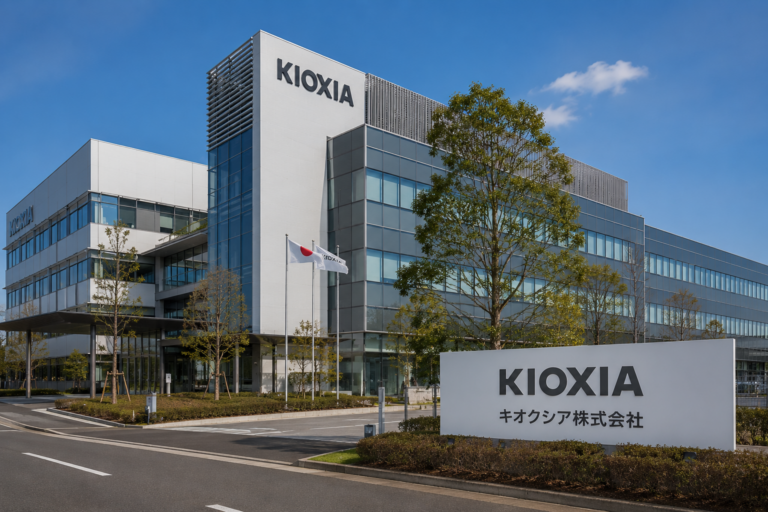
Kioxia Holdings stock has sold off sharply in the last few months as investors have sold off companies in the memory industry. It dropped to ¥13,500 on Monday, down by over 52% from its highest point this year, erasing billions of yen in value. This retreat may continue as jitters in the memory and AI industry accelerate.
Kioxia Holdings stock has dropped despite strong growth
Kioxia Holdings, a top SanDisk partner, is having the best year ever as its revenue and profitable growth accelerates amid the ongoing AI boom. Its products have seemn robust growth, a trend the management believes will continue in the foreseeable future.
The most recent results showed that revenue jumped by 415% YoY in the June quarter to ¥1.76 trillion. It had made ¥342 billion a year earlier. Notably, its net profit soared to ¥842 trillion, while its operating margin jumped to 75%.
This growth happened across its business, with SSD & storage and smart devices soaring by over 574% and 188%, respectively. The management expects that to grow, citing strong demand from its top clients. As a result, together with SanDisk, the company plans to invest $31 billion in Japan to boost its capacity in the coming years.
The next key catalyst for the stock will be the upcoming earnings report on October 30th. These results will provide more insights about its revenue and profitability growth.
Kioxia is caught in the AI bubble fears
The ongoing Kioxia stock retreat is mostly because of the fears of the AI bubble, which analysts believe will burst soon. Indeed, the AI Stock Bubble Index has jumped to the extreme zone of 74, and this trend may continue soon.
These fears explain why many companies in the memory industry have slumped. DRAM, the popular memory ETF, has dropped by 43% from its highest point this year, with most of its constituent companies, including Micron, SK Hynix, and Samsung falling by double digits from the all-time high.
Ray Dalio has warned that the AI bubble may burst soon since interest rates and bond yields have jumped this year. The ten-year yield jumped to a multi-year high of 5.3%, while the two-year rose to over 5%.
In a report released last week, Gartner warned that many AI companies will need to announce large impairments in the coming years.
Kioxia Holdings stock technical analysis
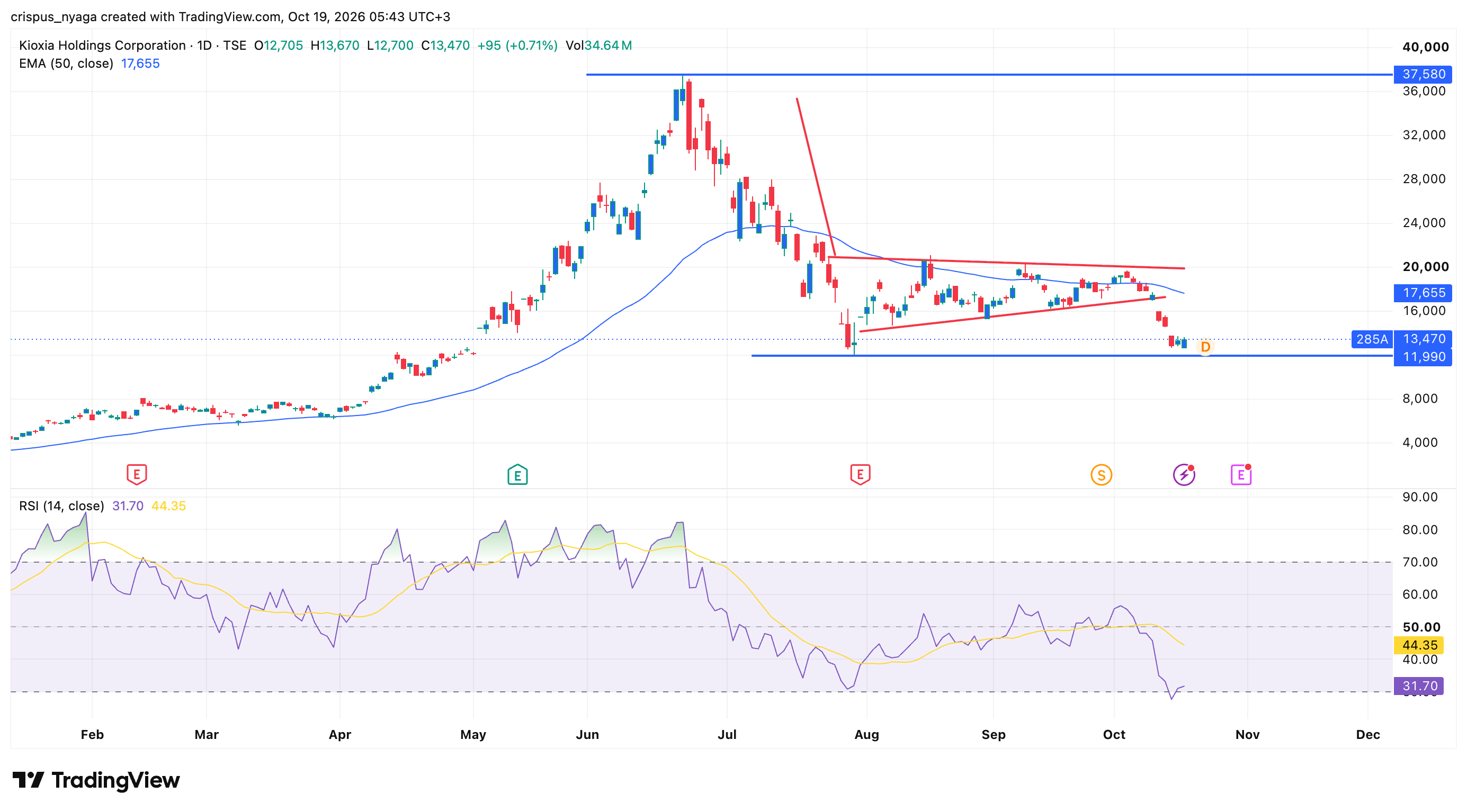
Kioxia stock chart | Source: TradingView
The daily chart shows that Kioxia shares have slumped in the past few months, moving from ¥37,580 in June to ¥13,455 today. It formed a bearish pennant pattern, which is made up of a vertical line and a symmetrical triangle. It has already moved below its lower side, confirming the bearish outlook.
The stock has slumped below the 50-day moving average and the Supertrend indicator. At the same time, the Relative Strength Index (RSI) and the MACD indicators have continued falling this month.
Despite its strong fundamentals, the stock will likely continue falling, potentially to ¥10,000. This view will be confirmed if it drops below the key support level of ¥11,990.
The post Kioxia stock at risk of falling to ¥10k as AI Bubble jitters escalate appeared first on Invezz
The Kospi Composite Index continued its strong sell-off last week as jitters surrounding the artificial intelligence (AI) escalated. It dropped to 5,463 points last week, down by nearly 40% from its highest point this year. Technicals suggest that this sell-off may continue as a death cross pattern nears.
Kospi Index slumps as AI jitters continue
South Korean stocks have lost momentum, with investors dumping popular names like Samsung Electronics and SK Hynix being in a steep sell-off. Samsung Electronics dropped by over 40% from its all-time high. Similarly, SK Hynix fell to 1.24 million won, down by over 57% from the highest point this year. These retreats have led to a wipeout worth billions of dollars.
SK Square, which owns a large stake in SK Hynix, has dropped to 784,000 won, down by 64% from its highest level this year. The retreat has also coincided with the sell-off in US memory companies, including popular names like Micron, SanDisk, and Western Digital.
The decline happened as investors remained concerned about the AI bubble. Data show that the AI Bubble Index has jumped to 76, and this rally may continue. As a result, some analysts believe that the bubble will start to burst soon. This includes popular names like Ray Dalio and Michael Burry.
The fears escalated last week after Gartner warned that many large AI companies will need to announce billions of dollars in impairments by 2030. The report pointed to neoclouds like CoreWeave and Nebius as being the most exposed.
Meanwhile, the AI industry has had some negative news recently. Firmus, an Australian company, pulled its IPO two weeks ago as investors balked at the valuation it was seeking.
In another report, media reports suggests that OpenAI’s revenue was $20 billion lower than initially expected. Anthropic’s third-quarter revenue was also weaker than expected.
Crude oil price surge and South Korean Central Bank decisions
Kospi Index is also falling because of the ongoing crisis in the Middle East that has pushed crude oil priceshigher. Brent and the West Texas Intermediate (WTI) jumped to $110 and $101, respectively. This surge will likely continue as Iran continues shooting ships attempting to cross the Strait of Hormuz.
The next key catalysts for the Kospi Index is the upcoming South Korean Central Bank interest rate decision. Economists expect the bank to leave interest rates unchanged at 3.0% as it observes the current inflation trends.
Kospi Index technical analysis
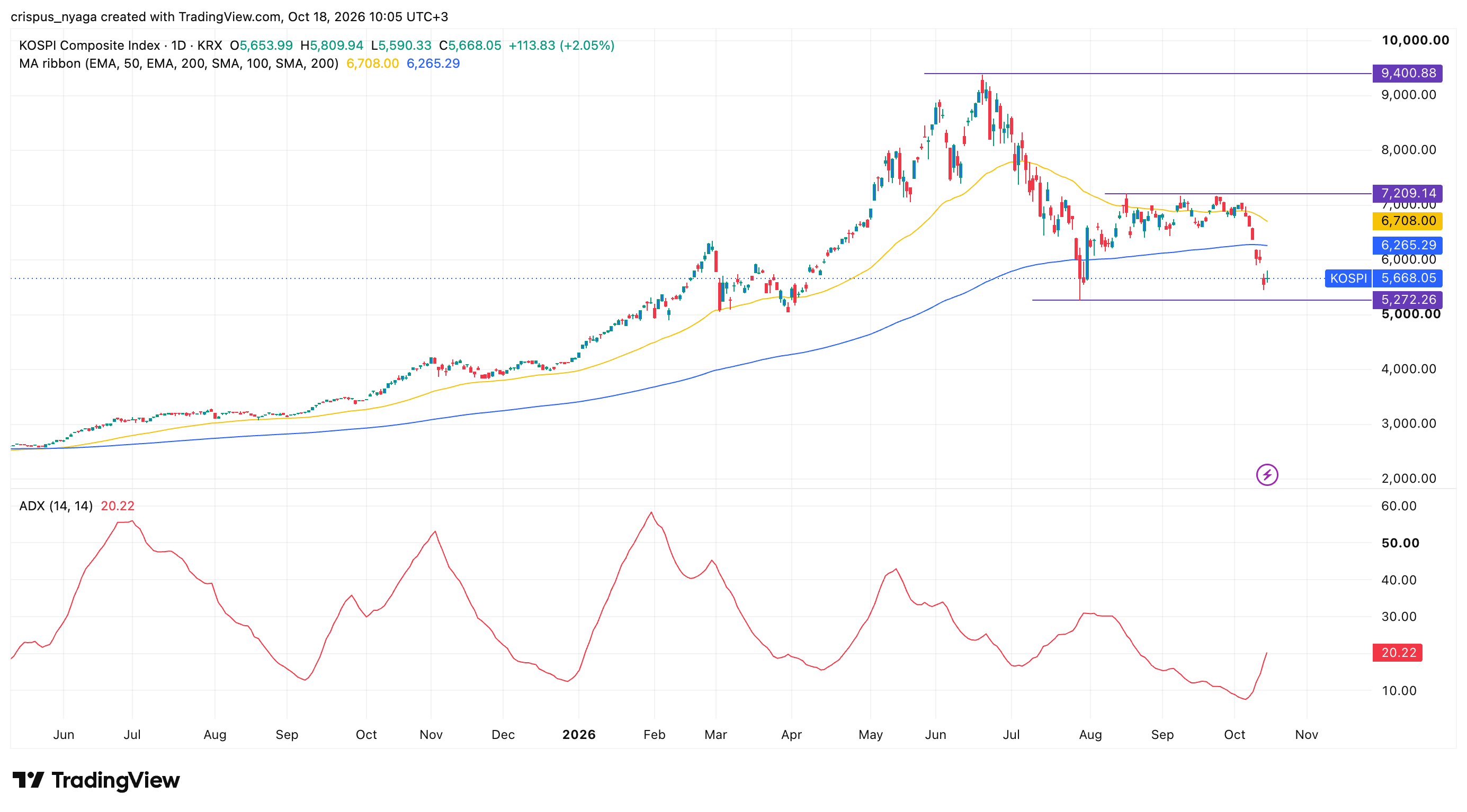
Kospi Index chart | Source: TradingView
The daily chart shows that the Kospi Index has slumped in the past few months. It has dropped from 9,400 points in June to the current 5,668 points.
The index resumed the downward trend after hitting the key resistance level of 7,209 in August, September, and October. It has now remained below the 50-day and 100-day moving averages, while the Average Directional Index (ADX) has risen.
Therefore, the index will likely remain under pressure in the near term. If this happens, the next level to watch will be at 5,272, its lowest level in July. A move below that level will point to more downside, potentially to 5,000.
The post Kospi Index outlook: Headwinds pile up as the selloff deepens, what next? appeared first on Invezz
Expensive diesel makes deliveries, farming, and construction harder to finance. For a company able to turn crude oil into fuel, though, a shortage can create a stronger selling margin. That difference explains why an energy headline can hurt household budgets while helping a refiner.
Suncor Energy (TSX: SU) gives Canadian investors exposure to that business. It produces oil, refines it, and sells fuel through Petro-Canada. The investment case is stronger when we separate what it earns from producing crude and what it earns from processing it.
Crude isn’t the finished product
A refinery buys or receives crude, processes it, and sells products such as diesel and gasoline. The useful margin depends on the difference between product prices and feedstock costs, after considering operating expenses.
More crude supply doesn’t automatically mean more diesel. The refinery has to have the right equipment, available capacity, and reliable operations. Transport costs can also prevent cheap crude from reaching a plant able to process it.
Current market coverage describes tight refined-product inventories and constraints on refinery capacity. The G7’s October energy statement also called for more refined-product production, particularly diesel. These pressures create an opportunity, but don’t establish that every refiner earns the same profit.
A simple example shows the difference. If fuel prices rise by $10 a barrel while crude input costs rise by $8, the additional gross spread is $2, before other costs. If both rise equally, the higher fuel price doesn’t create that same improvement.
Earnings evidence
Suncor reported second-quarter refinery crude throughput of 470,600 barrels a day, compared with 442,300 a year earlier. Its refining network’s stated capacity increased at the start of 2026, so the utilization percentage needs to be read alongside the actual barrels processed.
The company’s filings reported a refining and marketing gross margin of $61.50 a barrel on its specified inventory-cost basis, compared with $34.40 a year earlier. That’s about a 79% increase in that margin measure. It includes more than diesel, but it gives the fuel-market opportunity a concrete operating foundation.
At the group level, free funds flow reached $3.38 per share. This is Suncor’s adjusted cash measure after capital spending. The $0.60 quarterly dividend used about 18% of that amount, leaving substantial cash for other uses during a strong quarter.
For dividend investors, that comparison is more useful than assuming a shortage automatically guarantees the payout. Both upstream prices and downstream margins contributed to the result.
Earning income
At a recent close of $103.04, Suncor’s annualized $2.40 dividend yielded about 2.3%. A $10,000 budget bought 97 shares for $9,994.88, generating $232.80 annually at an unchanged payment.
COMPANYRECENT PRICENUMBER OF SHARESANNUAL DIVIDENDANNUAL TOTAL PAYOUTFREQUENCYTOTAL INVESTMENTSU$103.0497$2.40$232.80Quarterly$9,994.88
That’s useful income, but the stock’s appeal also depends on repurchases and business performance. Management increased planned monthly share repurchases to $500 million beginning in August. Buying back shares can increase each remaining owner’s share of future earnings, provided the price paid makes sense.
The October share price was about 8 times four times the latest $3.23 adjusted quarterly earnings. That looks inexpensive on a strong-quarter comparison. It isn’t a full-year forecast, and elevated refining margins can make a cyclical business look cheaper than it would under normal conditions.
My judgment is to treat Suncor as a measured energy holding, with the dividend supported by recent cash. The main risks are outages, expensive maintenance, lower oil prices, and shrinking refining margins. An integrated model helps spread those exposures, it doesn’t remove them. Eligible shares in a Tax-Free Savings Account (TFSA) can shelter Canadian investment income and gains. Fuel shortages still make the underlying earnings uneven.
Bottom line
The diesel squeeze helps explain Suncor’s strong refining results, but cash coverage and the purchase price decide whether the shares are attractive. Recent cash comfortably covered the dividend. At the quoted price, the opportunity includes income and repurchases, with enough restraint to avoid treating unusually strong fuel margins as permanent.
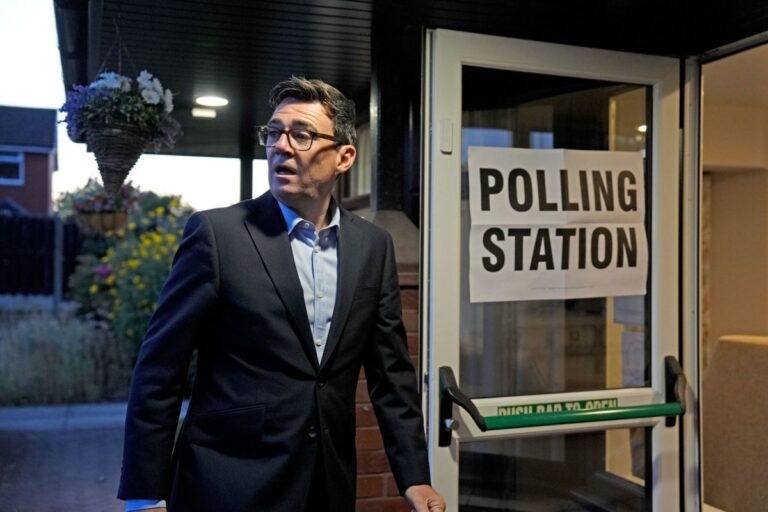
Prime Minister Andy Burnham casts his vote in the Greater Manchester mayoral by-election | (Alamy)
4 min read18 October
Electoral reform was one of the headline announcements in Andy Burnham’s party conference speech last month. However, not all Labour MPs are enthusiastic about shifting to a proportional voting system.
“In past years, you have voted twice to support electoral reform. I hear you, I agree with you, and today I am announcing a new national commission on electoral reform,” Burnham told Labour activists in his first conference speech as Prime Minister.
“We will contest the next election with a manifesto commitment to change the electoral system so that everyone’s vote counts and everyone’s voice is heard.”
Burnham has long supported replacing first-past-the-post (FPTP) with proportional representation (PR), and reforming the Westminster voting system is supported by a majority of Labour members. Around 100 Labour MPs backed a campaign for a national commission before Burnham committed to holding one in his speech in Liverpool.
Supporters of electoral reform say it would make Westminster elections fairer.
Earlier this year, over 50 academics wrote to the Labour government warning that FPTP risked producing distorted results on an unprecedented scale, with increasing numbers of candidates elected on low vote shares. “The collision of a multi-party electorate with a voting system designed for just two parties is creating new risks for Britain,” they said in a letter reported by PoliticsHome.
A policy of electoral reform could also help Burnham win support from the Greens and the Liberal Democrats.
However, since the PM’s announcement, it has emerged that Labour MPs, ministers included, are far from united on moving away from FPTP – the system under which Labour under Keir Starmer won its landslide majority in 2024.
PoliticsHome understands that Louise Haigh, Deputy PM and Burnham’s close ally, has concerns about shifting to PR.
Other Cabinet members have previously voiced reservations about the idea.
In 2022, Angela Rayner, now Secretary of State for Housing, Communities and Local Government, said she was a “first-past-the-post girl” who was “yet to be convinced by PR”, telling The News Agents podcast that it could allow extremist parties such as the British National Party (BNP) to win House of Commons seats.
John Healey, now Chancellor, campaigned against electoral reform when voters were asked to approve the alternative vote system in a 2011 referendum, describing it as “perverse”.
He wrote for The Independent: “Immediately after an election the parties would be scrambling to do coalition deals. They would feel free to jettison policies that had been firm pledges only a week earlier. This isn’t the new type of politics people have been calling for. They want politics that treats them with respect, not as fools.”
Ed Miliband, the Foreign Secretary, took the opposite position in that referendum.
Energy Secretary Miatta Fahnbulleh and Communities Minister Florence Eshalomi were both signatories to the Labour MP campaign for an electoral reform national commission this year.
Neal Lawson, director of the pressure group Compass and co-founder of the new Labour group Mainstream, believes some senior ministers will seek to prevent reform.
“Some people in the Cabinet who are very opposed to it, who are old-school tribal, adversarial Labour, and they will try and do whatever they can to try and kick PR into the long grass,” he told PoliticsHome.
Labour MPs who oppose PR argue it would weaken the party’s electoral position.
The question of how Labour would build a coalition government in a hung Parliament scenario has been complicated by Burnham’s refusal to work with the Green Party as long as its passed conference motion describing zionism as racism remains in place.
A Labour MP who supports getting rid of FPTP admitted that “the prospect of having to rely on Ed Davey, or even worse the Greens, to get stuff through almost makes me physically sick”.
Charlie Buckley, senior research associate at More In Common, said forming a workable majority “looks even more complicated” under PR than it does under FPTP.
“The Greens would go from a handful of MPs to a sizable bloc, while Restore Britain would arrive in Parliament in numbers, potentially giving these smaller parties a kingmaker role in the formation of coalitions,” he told PoliticsHome.
Henry Tufnell, the Labour MP for Mid and South Pembrokeshire, said his experience of PR in Wales has strengthened his opposition to changing to the voting system.
“I saw on the doorstep ahead of the Welsh elections how democratic accountability can be lost under proportional representation and the broken link between the electorate and the representative. We should think very carefully about introducing any legislation nationally on electoral reform,” he told PoliticsHome.
However, Lawson stressed that the balance of opinion within the Labour Party had shifted towards reforming the electoral system.
“You’ve got the person at the top who’s instinctively and intrinsically pro-proportional representation, and you’ve got the whole body of the membership, and now the trade unions, and a big chunk of the PLP (Parliamentary Labour Party).
“The overwhelming mood in the Labour Party is for PR.”
Phil Rosenthal, the creator of “Everybody Loves Raymond” and host of “Somebody Feed Phil,” sees the loss of classic American diners as a bigger problem than just losing a favorite local restaurant.
“I feel like diners are disappearing from America. Why? Because it’s hard to maintain any restaurant. And because it has a low price point, it’s hard to maintain for regular people owning a diner,” he said on an episode of his PBS show.
The loss, he noted, cuts deeper than it might seem.
“But with that loss of that center of the community where people rich and poor can come and sit and you can talk to your neighbors over a cup of coffee or plate of eggs, or a sandwich or burger. Maybe we lose the community. And maybe with that, we lose the country,” he said.
It’s a slow process, and now another local legend, Zoto’s Diner, will permanently close on Oct. 25 after 53 years in business.
Zoto’s Diner closing soon
Like many of the diners that have closed over the past few years, Zoto’s did not share a reason for shutting down.
“We hope all of our loyal customers will come in to see us as much as possible over these next couple of weeks. It is a very emotional time for us all and we will truly miss spending breakfast, lunch, and dinner with so many of you who feel more like family than customers,” the company posted in a Facebook message, which shared the Oct. 25 closing date.
Zoto’s has been family-owned and operated since 1973. The current owners, Steve Zoto and his wife Joanne, have not shared a reason as to why the restaurant is closing.
“In recent years, their daughter, Nikki, has served as the diner’s general manager,” according to WFMZ, a local news station.
Local and chain diners are closing
“Diners are disappearing across America. From the 1950s to the 2000s, the number in the U.S. dropped from roughly 6,000 to 2,500,” according to a 2025 Business Insider report that was referring to independent diners.
Many diners used to be 24/7, and that type of restaurant has been struggling as well.
The traditional 24/7 restaurants, many of which are diners, are experiencing upheaval nationwide. The number of restaurants offering 24-hour service in the U.S. fell 11% between January 2020 and January 2025, according to Yelp data released in 2025.
Diners, at least in the northeast, play an important role in the communities they serve.
My wife and I had coffee and tea at a now-closed Long Island diner, and the area’s many diners offered affordable meals and no judgment when a group of college kids shared waters and an order of fries.
That tradition, however, has been slowly disappearing. Here are a number of local diners which have closed over the past year.
Heart’s Coffee Shop closed after 47 years in California. The family-owned Lake Balboa diner served its final meals on Aug. 9, 2026. The owners had resisted raising menu prices for 13 years, and their daughter said rising costs forced the family to draw on savings, according to the Los Angeles Times.
Tasty Home Cookin’ closed after 36 years in Sarasota, Florida. The family-owned diner shut down in July 2026 after its owners struggled with rising operating costs and inflation, according to WWSB ABC7.
Dershey’s Cafe closed after nearly 30 years in Michigan. The St. Johns breakfast-and-lunch restaurant served its final customers in August 2026. Roger and Mary Dershem founded it in 1997, and their daughter continued running it after her father’s death in 2022, reported News 10 WILX.
Leni’s Cafe closed after nearly 50 years in New Orleans. The downtown breakfast-and-lunch institution closed May 29, 2026, as owners Pete and Deb Patselikos retired, according to New Orleans CityBusiness.
Kap’s Coffee Shop & Diner closed after nearly 60 years in Albuquerque. The Route 66 restaurant served its last customers on Oct. 11, 2026. The owners cited challenges along Central Avenue, reported the Albuquerque Journal.
Knapp’s Restaurant closed after serving Tacoma since 1938. The Proctor District diner closed in June 2026, just nine months after a new owner took over, according to The News Tribune.
New York has been hit hard by diner closures. And anyone who has seen “Seinfeld” has an idea of the place of the New York diner in the city as late as the late-1990s. How Jerry, Elaine, George, and Kramer used to meet (Monk’s Cafe on the show, Tom’s Diner in real life) was very similar to how my friends met in diners in New York in the 90s.
“The classic diner is under siege. Rents are rising, costs are ballooning, neighborhoods are gentrifying — and aging owners are ready to call it quits,” the New York Post reported.
More Restaurants:
Hooters closing more restaurants in bankruptcy comeback
These are the True Food Kitchen locations closing in Chapter 11
Oprah-backed chain closes 12 restaurants for good after filing Chapter 11
Nearly 200 have closed in the last decade, according to the New York tabloid.
“The few that remain are being forced to reinvent themselves — revamping their menus, acquiring pricey liquor licenses and bringing in posh kitchen crews for a city that’s getting ever more expensive — and ever more bougie,” added the Post.
Diners serve as almost a community center in some communities.
Shutterstock
Major diner chains are closing, too
Former Denny’s CEO Kelli A. Valade explained why the chain was struggling and closing restaurants in the diner brand’s first-quarter 2025 earnings call.
“Consumer sentiment remains negative as fear around tariffs and higher price of goods, combined with concerns about the job market resulted in consumers pulling back on spending. We are now operating in one of the most aggressive value-driven environments we’ve seen in years,” she explained.
Pricing is being held down, she noted, by the state of the economy.
“Guests are stretched, inflation pressures remain and every brand is fighting for share by pushing harder on price and promotion while trying to win with the guest experience,” she added.
Denny’s is one of a number of national diner chains to shrink.
Denny’s closed 150 restaurants in 2025. The chain continued closing underperforming locations in 2026, including restaurants operated by franchisee M15 Inc. in Minnesota and Wisconsin. The franchisee cited financial difficulties and said it could no longer meet payroll or buy supplies, according to TheStreet.
Huddle House has lost 64 locations since 2021. The Southern diner chain declined from 313 restaurants at the start of fiscal 2021 to 249 in May 2026, TheStreet reported.
Village Inn has shrunk from more than 220 restaurants to around 111. The breakfast-and-diner chain has lost locations over several years, including two Colorado restaurants that closed in January 2026, according to TheStreet.
Rosenthal restated the importance of diners on “Somebody Feed Phil.”
“So, I’m going to solve everything by having a diner. And if you become a regular, now you start seeing the same folks. And before you know it, you’re talking. And before you know it, maybe you can solve some of the problems of the town because you’re all like-minded. We’re way more like-minded than the news would have us think,” he said.
Related: Discount grocery chain closing all stores as bargain grocers struggle
A government deadline can sound like the end of a dispute. For Stelco (TSX: STLC) workers and investors following its U.S. owner, October 13 was more likely another step in a difficult argument over jobs, tariffs, and promises made during a takeover.
Ottawa demanded a plan explaining how Cleveland-Cliffs would honour employment commitments associated with its 2024 purchase of Stelco. Up to 500 Hamilton workers faced layoffs. The deadline is important, sure, but it doesn’t automatically reopen production lines or settle who is legally right.
Image source: Getty Images
A response isn’t a resolution
An October 9 letter defended the cuts by citing pressure from imports and a sharp decline in Canadian steel exports to the United States. Ottawa is examining obligations accepted when it approved a foreign acquisition. A weak market can explain why management wants to cut costs. It doesn’t, by itself, establish that a binding employment promise can be set aside.
The Investment Canada Act provides an enforcement process. Depending on the circumstances and legal findings, Ottawa can seek court orders concerning compliance and other remedies. The law includes divestiture among possible court remedies. That doesn’t make a forced sale today’s automatic outcome.
A negotiated plan could address staffing, production, or support. An unresolved disagreement could move toward enforcement. Either route still needs concrete terms. So investors shouldn’t price a political demand as if it were already a signed settlement.
The stock behind Stelco
Stelco is now part of Cleveland-Cliffs (NYSE: CLF), instead of an independent TSX investment. Buying the parent means owning a broader North American steel business, with U.S.-dollar share exposure and risks extending beyond Hamilton.
Cliffs reported second-quarter revenue of US$5.2 billion and operating cash flow of US$230 million. Its adjusted net loss was US$115 million. Sales and cash generation improved, but the company wasn’t yet earning an adjusted net profit.
Here’s the useful distinction. Operating cash flow represented about 4.4% of revenue. That cash still needed to cover investment spending and other obligations. A large revenue number doesn’t mean the same amount is available to workers, lenders, or shareholders.
For Canadians learning how to buy stocks, the parent-company distinction is important. The familiar Canadian plant name doesn’t turn CLF into a Canadian-listed security or remove currency exposure.
Considerations
The most useful development would be an agreement that explains the jobs and operating commitments while leaving a workable business. A legal confrontation introduces uncertainty about costs, production decisions, and management attention.
Even a settlement wouldn’t resolve the entire stock case. Cliffs depends on steel prices, customer demand, plant utilization, energy costs, and debt service. Tariffs can protect one market while damaging access to another. A shareholder owns those competing effects together.
My judgment is to wait for firmer operating evidence and the terms of any employment resolution before treating this as a bargain. A deadline alone provides too little information to justify a purchase.
Holding eligible shares in a Tax-Free Savings Account (TFSA) can shelter Canadian investment gains. The account cannot protect the business from a trade dispute or make an uncertain turnaround dependable.
Bottom line
Today’s deadline asks Stelco’s owner for accountability; it doesn’t guarantee an immediate rescue or a forced sale. Investors now need the substance of Ottawa’s response and a credible path from improving cash generation to lasting profits. For CLF, patience is more useful than buying the headline.
goeasy (TSX: GSY) was one of the top TSX stocks known for consistently paying and growing its dividend at a solid pace. However, its reputation as a leading dividend payer took a hit when the company suspended its dividend payouts in March 2026.
goeasy is Canada’s leading non-prime lender, offering leasing and lending products to subprime consumers.
Source: Getty Images
Why goeasy suspended its dividend
For years, goeasy rewarded its shareholders with regular dividend increases. In February 2020, it joined the S&P/TSX Canadian Dividend Aristocrats Index after growing its dividend at an impressive 42% compound annual growth rate (CAGR) over the previous five years.
The non-prime lender continued that trend in February 2025, announcing a 24.8% increase in its quarterly dividend from $1.17 to $1.46 per share. It was the 11th consecutive year that goeasy had raised its dividend, solidifying its reputation as a strong income stock.
However, things took a sharp turn in March 2026. goeasy’s share price plunged after the company reported significant loan losses and faced criticism from a short-seller. Amid financial pressure, goeasy’s management announced it would suspend its quarterly dividend.
The financial services company reported approximately $331 million in net charge-offs for Q4, largely due to troubled auto and powersports loans in its LendCare division, which it acquired in 2021. These losses pressured its financial performance and forced management to suspend dividend payments.
goeasy is now focused on strengthening its business and improving its financial position. The company is concentrating more on easyfinancial’s unsecured and home equity lending businesses while reducing auto and powersports lending through LendCare’s merchant network. It also intends to bring easyfinancial and LendCare under a unified operating model, improve efficiency, and strengthen LendCare’s leadership. These changes are expected to generate around $30 million in annual cost savings.
What lies ahead for goeasy’s dividend?
goeasy is currently focused on improving its liquidity and getting its credit performance back on track. As management is working to stabilize the business, the company’s dividend remains suspended. Given the challenges it faces, shareholders may have to wait some time before dividend payments resume.
For the third quarter, goeasy expects gross consumer loans to range between $4.8 billion and $5 billion, down from $5.4 billion in the same period last year. This decline in its loan portfolio, along with a lower overall yield on consumer loans, could put pressure on both revenue and earnings.
The company’s annualized loan yield is taking a hit from higher credit loss allowances affecting interest receivable, tighter lending through merchant partners, and a modest slowdown in loans issued directly to consumers.
goeasy’s profitability is likely to face further near-term challenges. Lower yields on consumer loans, continued credit losses, and higher borrowing costs could weigh on adjusted operating income and overall earnings.
Taken together, these factors suggest goeasy may need more time to recover before it can consider resuming its dividend. For now, the company’s priority appears to be strengthening its balance sheet, managing credit risk, and restoring the stability of its lending business. Until its financial performance improves, investors should not expect dividend payments to resume in the near future.
Warren Buffett was critical of a stock market that he said is increasingly driven by speculative trading, as opposed to investing for the long term.
“It’s tough to find values when everybody is preferring gambling,” Buffett told CNBC’s Becky Quick.
The chairman of Berkshire Hathaway had sharp words on the stock market earlier this year. In May, he likened it to “a church with a casino attached,” specifically calling out the surge in one-day options trading as “gambling.”
The stock market has rallied to all-time highs this year, climbing a wall of worry that included an energy shock from an ongoing war with Iran. Skeptics have said there’s too much speculation in stocks tied to the artificial intelligence build-out, with vehicles such as options and leveraged exchange-traded funds adding fuel to the fire. Equities have increasingly attracted retail traders en masse, who are buying shares of memory chipmaker Micron and recent initial public offering SpaceX.
The billionaire investor, 95, known for his stout adherence to value investing expressed his belief that the most meaningful investment opportunities are fewer and far between, requiring a patient and disciplined approach.
“There are times when opportunities are just thrown at you so fast you can’t, you know, it’s unbelievable,” the Berkshire chairman said. “And then there’s other times when you’re very, very lucky if you find one thing in a couple of years. And it should always be that the, the latter is what prevails.”
“But since humans love to gamble so much, there’s more money in, in actually cultivating gamblers than there are cultivating investors,” he said.
A Tax-Free Savings Account (TFSA) gives you a lot of flexibility, but that flexibility can also lead to mistakes. You can withdraw money whenever you want without paying tax, which sounds simple enough. The part Canadians sometimes forget is that you have to wait until the next calendar year to get that withdrawal amount added back to your contribution room limit.
Put the money back too soon without enough available room, and you could create an overcontribution problem. That is one reason I always recommend treating a TFSA as a place for long-term investing instead of constant trading and withdrawals. The longer you remain invested in fundamentally strong businesses, the more time their earnings, dividends, and share-price growth have to compound.
Here are two top Canadian stocks I think are worth holding patiently inside a TFSA.
Source: Getty Images
Brookfield Asset Management
If you want a TFSA holding that combines dividend income with exposure to global growth trends, Brookfield Asset Management (TSX: BAM) is definitely worth taking a closer look.
Headquartered in New York, BAM is a global alternative asset manager with more than US$1 trillion in assets under management across infrastructure, energy, private equity, real estate, and credit. Its stock trades around $66 per share with a market cap of $104.6 billion. It also offers a 4.4% annualized dividend yield at this market price.
BAM’s shares have had a mixed run recently. While it’s down about 21% over the last year, it remains up 5% over the last six months. That weakness makes the stock look undervalued compared with the momentum in Brookfield’s underlying business.
About that: In the second quarter, the asset manager raised a record US$77 billion and deployed US$21 billion. BAM’s fee-related earnings climbed 20% year-over-year (YoY) to US$808 million, while distributable earnings rose 15% YoY to US$707 million. More importantly, fee-bearing capital jumped 19% YoY.
Brookfield has also been building for future growth by completing its acquisition of Oaktree and expanding partnerships tied to artificial intelligence (AI) infrastructure, energy, and private markets.
For TFSA investors who want to keep strong businesses working over the long run, BAM stock’s growth initiatives and 4.4% yield make its recent stock weakness an attractive opportunity.
Canadian Tire
Canadian Tire (TSX: CTC.A) is a smart choice for investors who like the sound of owning an established Canadian business with improving earnings and a steady dividend.
The company owns and operates retailers (such as Mark’s and Party City Canada), gas stations, and commercial properties throughout the country. After gaining 14% in the last year, its shares now trade around $192 per share, giving it a market cap of about $10 billion. The stock also offers a 3.8% annualized dividend yield.
In the June quarter, Canadian Tire’s revenue rose 2.4% YoY, while income before income taxes increased 8.4% to $280 million.
At the same time, there were encouraging signs across its retail banners. For example, SportChek’s comparable sales jumped 8%, while Mark’s comparable sales increased 4.2%. Canadian Tire’s e-commerce sales also grew 14%, showing that its digital channels continue to gain traction.
The company continues to advance its True North strategy through more personalized Triangle credit card loyalty offers, stronger e-commerce capabilities, and refreshed store concepts. Overall, Canadian Tire’s earnings growth, dividend income, and loyalty strategy make it an attractive long-term TFSA hold.
A Tax-Free Savings Account (TFSA) is a powerful tool for long-term wealth creation, letting investors earn tax-free dividend income and capital gains on eligible investments, up to their available contribution room. However, investors should exercise caution, as losses realized on investments held within a TFSA permanently reduce investors’ contribution room.
Amid heightened market volatility driven by geopolitical tensions, rising bond yields, and persistent inflation, investors may benefit from adding quality dividend stocks to their portfolios. Companies with established business models, predictable cash flows, and a history of consistent dividend payments can provide a reliable income stream and help cushion portfolios against market uncertainty.
Against this backdrop, Enbridge (TSX: ENB) stands out as a potential TFSA holding. The energy infrastructure giant has rewarded shareholders with decades of uninterrupted dividend payments and a long track record of annual increases. Let’s examine its business outlook, growth opportunities, dividend history, and current yield to assess its appeal for long-term, income-focused TFSA investors.
Source: Getty Images
Enbridge’s business outlook
Enbridge operates more than 200 revenue-generating assets across North America, spanning energy infrastructure, utilities, and renewable energy. About 98% of its earnings come from regulated utility operations and long-term take-or-pay contracts, with 80% indexed to inflation. This resilient business model limits its exposure to commodity price fluctuations and economic uncertainty, supporting predictable earnings and dependable cash flows across market cycles. Reflecting its consistent execution, Enbridge has met or exceeded its financial guidance for 19 consecutive years.
This operational resilience has translated into compelling long-term shareholder returns. Enbridge has generated a total shareholder return of more than 855% over the past 20 years, equivalent to an annualized return of 11.9%. The company also has a long-standing dividend record, paying dividends since 1953 and increasing payouts for 31 consecutive years. With a forward dividend yield of approximately 5.9%, Enbridge offers income-seeking investors an attractive combination of recurring income and long-term wealth-creation potential.
Let’s now examine Enbridge’s growth prospects and the factors that could sustain its financial performance and dividend growth.
Enbridge’s growth prospects
Despite the growing transition towards renewable energy, oil and natural gas are expected to remain integral to the energy mix for years to come. Meanwhile, growing energy production and consumption across North America could drive sustained demand for Enbridge’s extensive infrastructure and services.
Capitalizing on these opportunities, Enbridge has identified approximately $50 billion in potential growth investments across its business segments through the end of this decade. The company plans to allocate roughly $10 billion to $11 billion annually toward these initiatives. Beyond organic expansion, strategic acquisitions and joint ventures could further strengthen its asset base and broaden its growth opportunities. Enbridge is also pursuing asset optimization and cost-efficiency measures, targeting $600 million to $900 million in savings by the end of 2027.
These investments, combined with operational efficiencies, could support continued financial growth. Management expects adjusted earnings per share and distributable cash flow per share to grow about 5% annually in the coming years. Amid these growth projections, the company, which has returned $38 billion to shareholders in the last five years, expects to return $40–$45 billion over the next five years through 2030.
Together, these growth initiatives and shareholder return commitments could strengthen Enbridge’s capacity to sustain dividend increases, reinforcing its appeal to long-term, income-seeking investors.
Investors’ takeaway
Enbridge’s share price has come under pressure in recent weeks amid regulatory and legal uncertainties surrounding its Line 5 pipeline and concerns about elevated interest rates, given the capital-intensive nature of its business. Consequently, the stock has declined approximately 18% from its recent highs, bringing its valuation to more attractive levels. It currently trades at forward 12-month price-to-sales and price-to-earnings multiples of 1.8 and 21.7, respectively.
Despite these near-term headwinds, Enbridge’s predictable cash flows, substantial growth pipeline, and long history of dividend increases underpin its long-term investment appeal for TFSA investors.