
Author

admin

Browsing

Canadian utility stocks are some of the best long-term investments on the market. They offer reliable business models that generate recurring revenue streams that, in turn, fund handsome dividends.

Part of that appeal stems from the sheer necessity of the service that they provide. That consistency persists across market cycles, making them ideal long-term holdings to consider.

That being said, several compelling utility stocks report earnings soon.

Here’s a look at what those Canadian utility stocks can offer before and after earnings.

Source: Getty Images

Fortis: The case for starting before earnings

Fortis (TSX: FTS) is the largest of the three utilities. The company offers electric and natural gas service to customers across Canada, the U.S. and the Caribbean. The company reports on the latest quarter on November 3.

In terms of growth, Fortis has an existing five-year capital plan that extends through 2030. Fortis expects the $28.8 billion plan to drive rate base growth and support its targeted annual dividend increases of 4% to 6% through the end of the decade.

The November update is expected to extend that capital plan through 2031.

Speaking of dividends, Fortis offers a yield of 3.3%. The company also has the second-longest streak of annual dividend increases in Canada, currently at 52 years.

That fact alone makes Fortis one of the top Canadian utility stocks to consider.

Emera and Canadian Utilities: More reasons to wait?

The other two utility stocks for investors to consider right now are Emera (TSX: EMA) and Canadian Utilities (TSX: CU). Both offer compelling cases for investors on their own, but recent events warrant considering them together.

That’s because earlier this month, Emera and Canadian Utilities announced plans to combine, with the merged company operating under the Emera name. The deal is not expected to be finalized until the second half of 2027.

Turning to dividends, both offer attractive payouts. Emera offers a yield of 4.4%, whereas Canadian Utilities offers 3.8%. Similarly, both stocks offer attractive dividend growth streaks.

Emera has provided 20 years of consecutive annual increases, whereas Canadian Utilities has the longest streak in Canada, currently at 54 years of increases.

Investors considering an investment in either company may be more inclined to wait until after the upcoming earnings dates when more clarity on the deal may be provided.

Should you buy these Canadian utility stocks before or after earnings?

Waiting until the companies announce earnings gives investors a chance to fully assess the investment. That’s especially true when there’s uncertainty around recent events, such as the Canadian Utilities and Emera tie-up.

And while waiting doesn’t guarantee a lower purchase price, it can help investors make more informed purchase decisions.

Similarly, an encouraging outlook from one stock could send shares higher before a patient buyer makes a move.

Across the three Canadian utility stocks, I would feel more comfortable investing in Fortis before the earnings announcement.

Both Emera and Canadian Utilities are great investment options too, but I’d prefer to wait and see what the November earnings updates reveal.


The big data centre buildout has taken a U-turn amidst growing concerns around hyperscalers’ binge borrowing. While there were many warning signs, Meta Platforms’ (NASDAQ: META) plans to create a new class of non-voting shares to fund artificial intelligence (AI) investments triggered a sell-off in AI stocks.

While AI investments are showing revenue and profits, the sheer amount of capital going into it and the depreciation that comes with it have worried capital markets. Meta’s five-year credit default swaps were trading at record highs on October 23, 2026, according to a Reuters article. This brings back flashes of the dot-com bubble and the 2008 Global Financial Crisis. Central banks in Asia have already hiked interest rates to curb inflation. If the US Fed increases interest rates by 25 or 50 basis points, the massive AI debt will trigger a huge interest cost.

Source: Getty Images

Beware of the big data centre buildout

A Gartner report warned that AI infrastructure investments are at risk of a US$4 trillion asset write-down through 2032. The concerns are valid. Unlike oil and gas pipelines, AI infrastructure depreciates rapidly. Those who have used graphics processing units (GPUs) know this. Considering the amount of capex announced for AI infrastructure through 2030, AI data centre owners would need US$8.5 trillion in revenue by 2030 to meet capex, financing costs, and a 12% return on invested capital (ROIC). Gartner does not see AI revenue crossing US$3.6 trillion by 2030.

The problem is the ticking time bomb of infrastructure upgrades. If AI data centres fail to generate sufficient revenue, raising new debt will be difficult, and outdated infrastructure won’t fetch desired revenue. Hence, when hyperscalers like Meta call for more capital, investors are giving it a second thought.

While one side of the coin raises concerns of an AI bubble burst, the other side of the coin states that AI is here to stay. What if the fears are a pullback before another rally? A good strategy is to invest in both sides of the coin.

Hammond Power Solutions is positioned for the big data centre buildout

If you believe that the AI data centre setback is temporary and another wave of investment is coming, Hammond Power Solutions (TSX:HPS) is a good stock. It builds transformers for electrification and electrical distribution networks. It has a strong order book as demand for AI-focused data centre transformers picked up in the U.S. and Mexico. The Canadian demand fell due to timing.

HPS’ stock price fell 37% between June 22 and September 1 when fears of cooling AI investment surfaced. It recovered 37% between September 2 and October 5 and fell again by 31% in October. The gap between the two dips is narrowing, showing growing investor apprehension. Even though order backlog has almost doubled year-over-year, investors have already priced in that order book. For HPS stock to grow further, AI investments have to pick up. Now is a good opportunity to buy the dip if you are bullish on the data centre buildout.

Constellation Software is positioned for the big data centre fallout

Being optimistic is one thing, but hedging your downside risk is another. As an investor, you have to look at all possibilities and diversify your money in investments that look promising.

Constellation Software (TSX: CSU) is well-positioned to benefit from the AI slowdown and offer contrarian growth. It is a software holdings company, with a portfolio of thousands of software across 100-plus verticals serving niche demands of mission-critical applications. Unlike AI data centre companies, it is not burning budget on AI migration. However, it isn’t ignoring AI either. Constellation’s operating companies are testing AI at their level. If AI investments stall or pull back, Constellation stock surges, as seen in its October rally of 16%.

Constellation continues to enjoy strong free cash flow growth from new acquisitions. Unlike Meta, Constellation has contained its balance sheet debt and is using free cash flow to make new acquisitions. Since the AI boom pulled down software stocks, it acquired stakes in some good software companies at a discount.

Investor takeaway

The contrarian stock price movement of HPS and CSU to AI investing makes them a perfect fit for a balanced portfolio.


Alain Tolhurst


2 min read3 hr

As Chancellor John Healey gears up for the biggest day of his political career next Wednesday, The Rundown speaks this week to one of the few people who knows what it’s like to prepare to deliver a Budget: Jeremy Hunt.

Hunt, who led the Treasury during the Rishi Sunak Conservative government, reflected on the final few days before standing up in the House of Commons to deliver a Budget.

The Conservative MP described that period as the “calm before the storm”, explaining that, by this point in the Budget process, “all the big decisions have been made” and what remains is working out how to land them with the media and the public.

“For me, that Sunday before a Budget was pretty sacrosanct, because that’s when I would sit in my chancellor’s study in No 11, which is a beautiful small room, and just in total quietness, crunch through my speech and work out exactly what I wanted to say” he told the podcast.

Asked what advice he would give to Healey as he prepares to deliver his first Budget, Hunt said “don’t underestimate your own power and your ability to do radical and bold measures”, stressing that the Treasury is “the most powerful ministry in Whitehall”.

“When I was health secretary, I would’ve died to be able to stand up for one moment in the year and set out my stall on the NHS and how I was going to make it great.

“You don’t have that; it’s only the Chancellor. So what I would really say is, don’t waste the moment,” said Hunt.

The Rundown is presented by Alain Tolhurst, and is produced and edited by Ewan Cameron for Podot

  • Click here to listen to the latest episode of The Rundown, or search for ‘PoliticsHome’ wherever you get your podcasts.


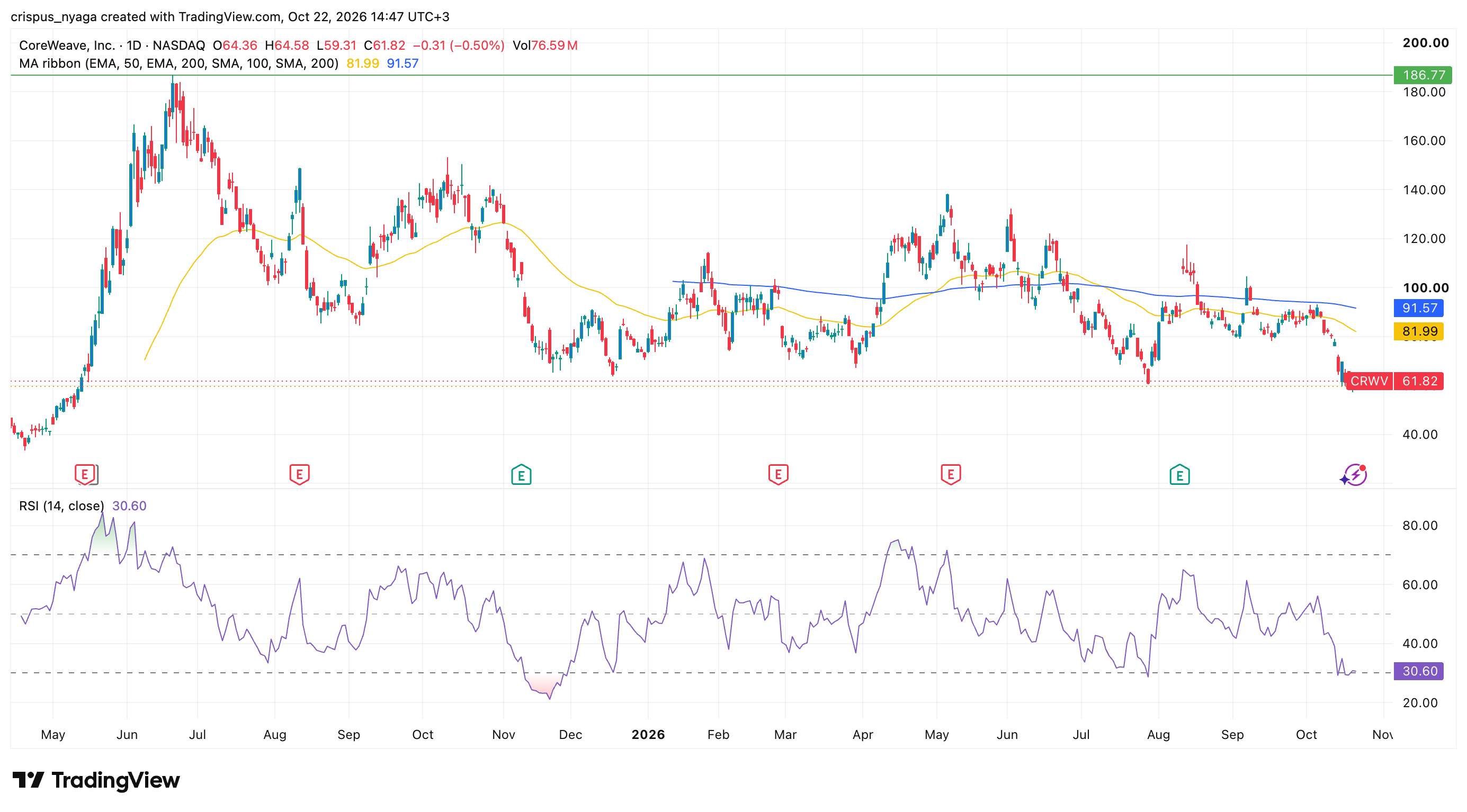
CoreWeave’s stock extended its sharp downward trend, while its bond yields surged this week as investors remained concerned about the neocloud industry. CRWV fell to $57, its lowest level since May 9 last year. The stock has slumped more than 67% from its peak this year, wiping out billions of dollars in market value. So, is this retreat a good buying opportunity?

CoreWeave stock is falling despite soaring demand

CoreWeave, a former Bitcoin mining company that has successfully pivoted towards the artificial intelligence industry, is doing well. It has become the biggest company in the neocloud industry, clinching deals with the biggest companies in the space like Anthropic, OpenAI, and Jane Street. 

The company is benefiting from the ongoing demand for computing power, which analysts believe has more room to go. In a statement today, Jensen Huang, Nvidia’s CEO, said that demand for neoclouds was off the charts, with capital being the only challenge. He said:

“If you look at the fundamentals, the demand for the neo clouds is off the charts. What is missing in the middle is the working capital to fuel that growth because there’s just so much demand across so many sectors of AI, capital is scarce.”

Just this week, the WSJ noted that Anthropic’s S1 document showed that its future infrastructure costs will top $600 billion. It is now negotiating additional computing deals that could see commitments rise by as much as $150 billion. In this case, it may negotiate with CoreWeave.

Strong revenue and backlog growth

The recent results showed that the company’s revenue backlog jumped to $104 billion at the end of the June quarter. This surge made it the biggest company in the neocloud industry. It is also fueling its strong revenue growth, with the quarterly figure rising to $2.57 billion from $1.2 billion in the same period last year. 

Wall Street analysts believe that CoreWeave has more room for growth, with the annual revenue expected to hit $12.87 billion, followed by $26.35 billion next year. If this trend continues, chances are that the company’s annual revenue will hit $50 billion in the foreseeable future. 

The challenge, however, is that the company’s financing costs are elevated. Its bond yields have continued to rise, with some long-term ones yielding 15%. Also, its total debt has jumped to nearly $30 billion. 

Also, some analysts believe that the company will need to announce huge impairments in the coming years. In a report released last week, Gartner said that AI data center owners will need to make a cumulative $8.5 trillion in revenue to cover the rising capital spending. It expects the total revenue to be no more than $3.6 trillion. The report added:

“Neoclouds will be among the most exposed to the imbalance between revenue and capital spending. Neoclouds must soon earn returns on AI-optimized IaaS and associated platforms to sustain operations.”

CoreWeave stock price technical analysis

CRWV stock chart | Source: TradingView

The daily chart shows that the CRWV stock has been in a strong sell-off this month and is now at the lowest level in months. The risk is that it has formed a head-and-shoulders pattern, which is a common bearish sign. 

CoreWeave remains below all moving averages, while the Relative Strength Index (RSI) has moved to the oversold level of 30. The combination of the H&S pattern and the moving averages suggests that the stock will continue falling in the near term. If this happens, it will drop to $35.

The post CoreWeave stock on edge as Jensen Huang touts strong neocloud demand appeared first on Invezz

The FTSE 100 Index has pulled back over the past few days, falling from this month’s high of 10,891 to its current level of 10,670. The retreat continued this week as top companies like Barclays released their earnings and crude oil prices jumped. This article looks at some of the top Footsie shares to watch next week, including HSBC, Lloyds, BP, and NatWest.

Lloyds Bank in focus as it releases its earnings

Lloyds, the biggest British bank by users, has been in a strong sell-off this year, a trend that continued this week after Barclays published its earnings and announced large layoffs. The stock has dropped from a high of 117.80p in August to the current 100p. 

Therefore, bulls hope that the company’s earnings will provide a bullish catalyst. Analysts expect the upcoming results to show that its net interest income rose to £3.8 billion, helped by higher interest rates. Its total income is expected to come in at £5.1 billion. 

The company will also provide more information about Accelerate 2030, the strategy it is working on through 2030. This strategy has several pillars, including cost efficiency, AI and digital transformation, and expansion in other areas like wealth management.

Technically, the stock has already dropped below the 50-day and 200-day moving averages, meaning that a death cross may happen. 

HSBC earnings to provide color on wealth management

HSBC stock has been in a strong sell-off in the past few months, moving from a high of 1,608p in June to the current 1,350p. Like Lloyds, the company will publish its financial results on Monday.

The most important aspects to watch will be its costs, which have remained at an elevated level despite the cost-cutting measures. Costs have also risen because of China’s capital requirements. 

Most notably, the results will provide more color on its wealth management business, which has supported its earnings in the past few quarters. In its last earnings report, the company said that the international wealth and premier banking business made $2.61 billion in the first half of the year, up from $2.13 billion in the same period last year. Its Hong Kong business made $5.13 billion, while UK made $3.32 billion. 

NatWest in focus as earnings loom

NatWest stock has also been in a strong sell-off in the past few months, moving from a high of 726p to 626p. The company will also publish its earnings report on Friday, which is expected to show that its net interest income rose to £3.6 billion in the third quarter, with its total income rising £4.6 billion. Analysts also expect the profit to come in at £1.61 billion. 

Like the other banks, NatWest stock has been in a strong sell-off and is also about to form a death cross pattern. 

BP in focus as oil prices rise and earnings loom

BP is another top FTSE 100 stock to watch next week. Its stock has jumped to a record high of 624p, driven by the ongoing oil price surge. Brent has already jumped to 114p, and the upward trend may continue towards the midterm elections. As such, the stock will  likely continue rising as investors predict more profits in the future. The company’s earnings are also expected to provide hints on its performance.

In addition to these four, other top FTSE 100 companies to watch will be Unilever, GlaxoSmithKline, Standard Chartered, and Haleon.

The post Top FTSE 100 Index shares to watch next week: HSBC, Lloyds, BP, NatWest appeared first on Invezz

If you’re retired and looking to generate reliable passive income from your TFSA, Choice Properties REIT (TSX: CHP.UN) is easily one of the top Canadian stocks to consider.

Choice currently offers an annual yield of roughly 5.2% and pays its distribution monthly, making it especially appealing if you’re looking to supplement your retirement income.

However, while an attractive yield and monthly payments are certainly useful, what makes Choice such a high-quality investment is the business behind those payments.

After all, when you’re relying on your investments to help cover your expenses, you want to own businesses that can consistently generate cash, even when the economy weakens.

And with Choice owning a massive portfolio of properties across Canada, including grocery stores, pharmacies and industrial buildings, that’s exactly why it’s worth considering for your TFSA.

Source: Getty Images

A highly defensive Canadian real estate stock

One of the biggest reasons Choice is such a reliable income investment is its relationship with Loblaw, its largest tenant.

Plus, both Choice and Loblaw are controlled by George Weston, which benefits from both businesses doing well and has a long-term interest in keeping their relationship strong and mutually beneficial.

In fact, Loblaw accounts for roughly 57% of Choice’s rental revenue. That gives Choice significant exposure to grocery stores and pharmacies, where demand tends to remain resilient regardless of how the economy is performing.

Because even when Canadians cut back on spending, they still need to buy food and fill prescriptions. That helps support its tenants’ businesses and their ability to keep paying rent.

Furthermore, Choice’s grocery-anchored properties can also be attractive locations for other retailers, which benefit from having those essential stores bring customers to the area.

That demand helps explain why Choice’s portfolio was 97.7% occupied at the end of the second quarter.

Plus, its existing leases also give it opportunities to keep growing its rental income. For example, Choice recently renewed 50 leases with Loblaw, extending them by an average of five years, with rents averaging 8.8% above the expiring rates.

That shows exactly how those properties continue generating income for years while allowing Choice to collect more rent from assets it already owns.

Why Choice Properties is an ideal TFSA stock for retirees

That consistent rental income is what allows Choice to pay its monthly distribution while continuing to invest in its properties.

In fact, through the first half of 2026, Choice paid out roughly 84% of its adjusted funds from operations, a measure that accounts for the cost of maintaining and leasing its properties.

The ratio was closer to 90% in the second quarter, with management pointing to the timing of spending on maintenance and tenant improvements. So, although the distribution remains covered, keeping that payout manageable is important.

Choice also maintains investment-grade credit ratings, which help support its access to financing as it refinances debt and invests in growth, another reason you can have confidence owning the stock for the long haul.

Furthermore, holding Choice in a TFSA allows you to collect that monthly income tax-free and withdraw it whenever you need it. Those withdrawals also won’t increase the income used to calculate federal benefits such as Old Age Security.

That can make a meaningful difference in retirement, allowing you to supplement your income without creating an additional tax bill or reducing those benefits.

And while Choice’s distribution growth has been modest recently, it announced its fourth consecutive annual increase earlier this year.

Plus, with opportunities to raise rents, expand existing retail properties and develop additional industrial space, Choice can continue growing the cash flow its portfolio generates, helping support further distribution increases over the long haul.

The app that delivers dinner is about to deliver a holiday sweater, too.

Kohl’s is rolling out nationwide same-day delivery through Uber Technologies’ (UBER) Uber Eats in November, adding a third delivery partner to a holiday plan built around making gift shopping faster, clearer, and easier on the wallet.

The retailer announced the move on Oct. 21, alongside a slate of other convenience upgrades ahead of Thanksgiving.

Shoppers can already order same-day delivery from Kohl’s and Sephora at Kohl’s through DoorDash and Instacart, which is run by Maplebear. Uber Eats joins them next month, putting Kohl’s inside one more app that millions of people already have on their phones.

Read more: Kevin O’Leary calls this ‘the best side hustle there is’ for turning $0 into $10,000 in 30 days

Kohl’s wins as delivery apps bring in new crowd

Kohl’s says the partnerships are paying off in a big way. About 80% of same-day delivery customers through those partners are new to Kohl’s, Chief Customer Officer Arianne Parisi said.

For a department store competing for every holiday dollar, that is a sizable pool of first-time shoppers arriving without a single marketing push in the store itself.

Parisi laid out the company’s thinking at its Oct. 21 holiday presentation, and the order of priorities says a lot about this season. “We’re thinking first and foremost, value. Next, experience. Third, gifting and then finally, convenience,” Parisi said, according to Women’s Wear Daily. 

In a news release, she said customers are being “very intentional about making every dollar and every moment count this season,” which is why Kohl’s wants to be “the easiest choice for families.”

The campaign tying it all together is called The North Kohl’s, which leans into cozy, style, home, and gifting themes. It features actress Ellie Kemper as “Kohl’s Mom,” according to Modern Retail.

Kohl’s stores will be closed on Thanksgiving and Christmas Day, as they have been in past years.

Shoppers can order Kohl’s through Uber Eats app this holiday season.

Sundry Photography / Getty Images

Kohl’s holiday offerings: price tiers, gift sets, stocking stuffers

Value is the main selling point. Kohl’s is putting clear $5, $10, $15, and $20 pricing tiers across departments, with stocking stuffers starting at $4.99. Nearly half the assortment in the in-store Holiday Gift Shop is new, and the majority of items cost less than $15. 

Modern Retail reported that the retailer is also marking items more clearly as “X percent off,” both in stores and online, to help value-focused shoppers see the savings at a glance.

Gift sets are getting a bigger spotlight, too. Sephora at Kohl’s is offering more than 400 festive gift sets, along with more than 2,000 prestige beauty items under $30, according to the company’s news release.

More Retail:

  • Home Depot is making a big bet on cautious consumers
  • Another state just banned a controversial retail pricing practice
  • JPMorgan just flagged a slow-build food crisis

In toys, Kohl’s is stocking more than 1,000 LEGO sets, plus dedicated in-store Toy Towers filled with gifts under $10.

For shoppers who would rather skip the trip, there are more ways to buy. This is the first holiday season Kohl’s customers can use Klarna’s buy now, pay later option in stores and online. 

Buy now, pay later has become a mainstream holiday tool.

An Experian survey last year found that 43% of consumers had used or planned to use BNPL for holiday expenses, more than double the share from a similar survey two years earlier.

A holiday run that starts on the couch

Kohls.com and the Kohl’s app now have an AI-powered shopping assistant and digital gift guides. Free in-store pickup is available with most orders ready in two hours through Christmas Eve, and free in-store returns run through Jan. 31, 2027, on purchases made from Oct. 4 through Dec. 30.

Put it all together, and the pitch is simple. Kohl’s wants the gift run to feel less like a chore, with prices that are easy to read, gift sets that are easy to grab, and delivery that can show up the same day.

For families trying to stretch every dollar without a last-minute store dash, the real hook is that Kohl’s will be a tap away on the same app that handles dinner.

Related: Read more:

Insider Brief

  • Reliable Robotics raised another $115M, bringing its Series D to $275M and lifting the autonomous-aircraft developer’s valuation above $1B.
  • The company is developing the Reliable Autonomy System for gate-to-gate automated flight and is seeking FAA certification on the Cessna 208B Grand Caravan, while also holding contracts with multiple branches of the U.S. military.
  • Reliable recently completed autonomous taxi, takeoff and landing operations at Albuquerque International Sunport under an FAA pilot program, with a remote pilot more than 700 miles away and an onboard safety pilot supervising the flights.

Reliable Robotics has raised another $115 million in new capital, bringing its Series D round to $275 million and pushing the autonomous aircraft developer’s valuation above $1 billion.

According to the company, Nimble Partners led the financing as a returning investor, with new backing from Gideon Capital, RockCreek, Geek Ventures, Gold Hill Capital and Sparkwave Capital, among others. Island Green Partners also participated again. The new capital includes a $25 million term loan from Silicon Valley Bank. The funding will be used to expand Reliable’s aircraft fleet and production facilities and grow its engineering team.

Reliable Robotics previously announced $160 million for the Series D but said it expanded the round after receiving additional investor demand. The company has now raised more than $380 million in equity capital overall.

The Mountain View, Calif.-based company is developing the Reliable Autonomy System, or RAS, for automated aircraft operations. Reliable said the system is designed to address aviation risks including loss of control and controlled flight into terrain while working with existing aircraft and aviation infrastructure.

The company is seeking Federal Aviation Administration certification for RAS on the Cessna 208B Grand Caravan. According to Reliable, the system is designed to automate an aircraft from gate to gate, including taxiing, takeoff, en-route flight management and landing.

Reliable said its certification work includes an FAA-accepted certification plan, means of compliance and closed issue papers for continuous autopilot engagement. The company described RAS as the first FAA-certifiable system intended to support full gate-to-gate automated aircraft operations.

Commercial and Military Use

RAS is being developed for both commercial and military applications. Reliable has contracts with multiple branches of the U.S. military and has completed several military airworthiness review processes with the U.S. Air Force, the company said.

Reliable was also selected for the FAA’s Advanced Air Mobility Integration Pilot Program. The company said that participation will allow it to conduct pre-certification operations in the National Airspace System while delivering cargo to smaller and rural communities in New Mexico and Colorado.

Reliable Robotics completed its first autonomous flights at Albuquerque International Sunport under the program this week. Its automated Cessna 208B Grand Caravan performed taxi, takeoff and landing operations while supervised by a remote pilot more than 700 miles away in Mountain View, Calif., along with an onboard safety pilot., according to the Albuquerque International Sunport.

The autonomous flight system uses high-integrity navigation, full-authority flight controls and four-dimensional flight planning. Reliable said it is designed to operate within existing U.S. aviation infrastructure without requiring changes to the National Airspace System for commercial use.

Expanding Operations

Alongside the financing, Reliable announced new offices in Seattle and San Diego, adding to locations in Mountain View and San Martin, Calif., and Albuquerque, N.M. The Seattle operation will include a center focused on the company’s radar program. Reliable said it recently expanded its workforce to more than 250 employees and plans to recruit across engineering roles at its locations.

Brookfield Renewable Partners (TSX: BEP.UN) is among the best Canadian dividend stocks in 2026. Over the past decade, it has returned 204% to shareholders, including dividend reinvestment.

Despite these inflation-beating returns, it trades 36% below its all-time high and offers a 5.6% yield right now.

Image source: Getty Images

What Brookfield Renewable does and why income investors care

Brookfield Renewable owns power plants, which include hydro dams, wind farms, solar projects, and a fast-growing battery business. It also owns Westinghouse, which CEO Connor Teskey said services over 60% of the world’s operating nuclear reactors.

Brookfield is an electricity landlord: customers sign long contracts to buy the power, and Brookfield collects the rent.

CFO Patrick Taylor said about 90% of its cash flow is contracted for more than 12 years. Roughly 70% of the cash flow is inflation-linked, and 95% of the debt is fixed-rate with a 14-year term.

A steady, widening cash flow base has allowed the company to raise dividend distributions for 15 consecutive years.

Over the long term, Brookfield aims to grow annual distributions by 5–9%. It also aims to grow funds from operations (FFO) per unit by 10% or more.

Why surging power demand is a tailwind for the stock

Teskey emphasized that electricity demand is running well ahead of supply for three reasons.

  • Cars and factories are going electric.
  • Advanced economies are rebuilding their industrial base.
  • And artificial intelligence (AI) data centres are power-intensive.

In just a few years, Teskey said, energy went from something everyone took for granted to the biggest bottleneck for the world’s most important companies.

Brookfield has been building for this moment. Managing Director Amanda Laszutko said it developed less than 1 GW (gigawatt) a year in 2021. In the last 12 months, it developed eight gigawatts and expects to develop 11 gigawatts a year starting in 2028.

Three years ago, the company had almost no battery storage. Today, its batteries can output up to 5 GW at once, enough to power more than three million homes.

Management also raised its deployment target to over US$11 billion across the next five years, up from US$10 billion.

Taylor said Brookfield raised US$1 billion by selling assets over the past 12 months. Over the last five years, it sold assets worth US$4 billion at an internal rate of return of 18%, above its 15% target.

The company can raise about US$2 billion at a cost near 8% and redeploy it at 15% or more, which should drive per-unit FFO growth higher.  

Is BEP stock undervalued?

Teskey said Brookfield has underperformed the broader markets in recent years due to elevated interest rates. However, the company has successfully showcased an ability to pass higher financing costs on to customers through its contracts.

Teskey stated:

It does feel like we’re in an unnatural position right now with an incorrect market read on the impact of interest rates.

Analysts forecast FFO per share to grow from US$2.01 in 2025 to US$3.13 in 2030. With a 70% payout ratio, the annual dividend should rise to US$2.20 per share in 2030, up from US$1.57 per share in 2026.

If BEP stock trades at 14 times forward FFO, it could surge 54% over the next 40 months. Adjusted for dividends, cumulative returns could exceed 70%.

It’s been quite a while since Telus (TSX: T) reduced its payout, and things haven’t gotten a lot better over the past year, with the shares collapsing another 44%. Indeed, I never thought that the former telecom titan and dividend darling would have a realistic shot at plunging to the single digits.

But with the name going for $11 and change with so much negative momentum behind it, it might not be all too long before shares of T dive into the single digits while the yield looks to swell once again.

Today, the shares yield a nice 6.3%, but, of course, there are 6%-yielders on the TSX Index that don’t entail trying to catch a falling knife. Personally, I think Telus stock continues to be an incredibly uncertain name and one that could prove risky to bottom-fish for.

While I do think that the shares are starting to get ridiculously oversold, I can’t say that I’m all too enthused by the road ahead. Now, shares are quite cheap, going for 15.7 times forward price-to-earnings (P/E).

Source: Getty Images

Shares look cheap, but there’s still quite a bit of debt

But let’s be real, that’s not exactly a “steal” of a deal for a stock that’s shed close to 66% from its peak. While the company has made progress in improving the cash flow situation, the debt load remains a bit of a concern with the 224% debt-to-equity ratio.

With rising fears of increasing interest rates, perhaps it’s no mystery why investors would rather hit the sell button on the stock with the intent of asking questions later. While I do think that Telus is starting to look tempting for deep-value investors looking for an outsized payout, I wouldn’t rush into the stock here.

Catching a falling knife is just too hard and too painful!

For those keen on adding to their position, I’d much rather be an incremental buyer, perhaps buying in quarters over the span of a year.

That way, investors will take the timing out of the equation and won’t be discouraged if their attempt to bottom-fish doesn’t go well over the near term. Even with a dollar-cost averaging (DCA) strategy in place, there’s really no way to mitigate all the risks with a name that could stay untimely for another year or maybe even a bit more.

Why Telus is worth holding

As for whether Telus is still worth holding, I think it is. The stock looks to be fairly valued, maybe even mildly undervalued, with expectations that are so low that it might not take much to put an end to the multi-year bear market.

Perhaps the biggest reason to stay the course, even if you’re underwater, is the solid dividend. While I can’t say for sure how much rate-hike risk is baked in, I do think that management deserves the benefit of the doubt as they look to shore up cash to reduce that debt.

It’s a hefty amount of debt, but more than manageable. The main wild card, in my view, is the sovereign AI data centre growth pathway, which might be the growth driver that makes Telus a dividend darling again or maybe, if AI doesn’t keep booming, it’ll prolong the road to recovery. Either way, it’ll be an interesting ride as we head into year’s end.