
Author

admin

Browsing

The researchers also employed a special technique to streamline this process so a mobile robot can continually update uncertain memory entries in real time. 

When compared to baseline methods, UQ-DAAAM boosted the robot’s confidence and improved the accuracy of its answers to questions about objects, their locations, and when it saw them. 

“Contrary to ChatGPT, when we think about physical AI, it is not enough to simply put a disclaimer cautioning that sometimes the robot might be wrong. Allowing a robot to know what it doesn’t know is going to be essential for this technology to be deployed safely and have a positive impact on society,” says Luca Carlone, an associate professor in MIT’s Department of Aeronautics and Astronautics (AeroAstro), principal investigator in the Laboratory for Information and Decision Systems (LIDS), director of the MIT SPARK Laboratory, and the senior author of the paper presenting UQ-DAAAM.

He is joined on the paper by co-lead authors and MIT graduate students Harry Zhang and Nicolas Gorlo. The research will be presented at the Conference on Neural Information Processing Systems. 

Amending memory

This new method builds on the researchers’ prior work, DAAAM, a robot memory system that uses a vision-language model (VLM) to richly describe objects in scenes a robot captures with its onboard cameras. These descriptions are stored as detailed captions in a 3D map-based representation of the robot’s environment that it can call upon later to answer questions. 

But the robot sometimes sees objects only partially or from far away, or its camera might capture blurry or poorly lit images. In these cases, DAAAM might describe these objects incorrectly, such as by mistaking a gray chimney for a squirrel perched on a rooftop.

“With no way to correct itself, this wrong memory would persist as the robot proceeds in its environment, which could impact downstream applications,” Zhang says.

UQ-DAAAM integrates uncertainty quantification into the DAAAM framework. It allows the robot to measure its confidence in the accuracy of object descriptions and fix incorrect captions as it travels through an environment.

While on the move, the robot constantly collects and stores images of the world around it. Many of these images show the same objects captured from different angles. UQ-DAAAM uses these additional viewpoints to identify and correct unreliable descriptions.

First, it calculates the VLM’s confidence level in the words it generated to describe a potentially mislabeled object. Then, it measures consistency by comparing this description to captions of images that describe the same object from different vantage points.

“We fuse both sources of uncertainty into a single number that captures how certain the VLM is in its overall understanding of the object,” Carlone explains.

If that number exceeds a certain threshold, the uncertainty is too high, and UQ-DAAAM will refine the caption by using additional images of the object.

It does this using a heuristic, or simple rule, that determines which additional viewpoints will reduce the robot’s uncertainty about the object. For instance, it might choose an image captured a few frames later that clearly shows smoke emanating from the chimney. 

The researchers mathematically proved that this heuristic can identify the best frames to select without rerunning the VLM, dramatically reducing the amount of computation. 

“The key challenge Nico and Harry had to overcome is how to combine VLMs with uncertainty quantification into something that is running in a fraction of a second on a robot that is moving,” Carlone says.

Remembering with confidence

Once it has identified additional captions that will reduce its uncertainty about the object, the system uses an LLM to fuse them into a single object description. To boost accuracy, the LLM puts more weight on new captions and those with less ambiguity.

This refinement step is able to resolve ambiguities for about 92 percent of the objects in the robot’s environment, while only requiring two additional captions per object. It increased the accuracy of object descriptions by 5 percent compared to the state of the art.

UQ-DAAAM also provided more accurate answers to questions about the objects it observed, where it saw them, and when it last encountered them than baseline methods.

“Performing this uncertainty quantification procedure across the entire map the robot generates allows it to improve its understanding of what it has observed,” Gorlo says.

Next, the researchers want to use UQ-DAAAM to guide different types of robots, like mobile robotic manipulators, and apply their uncertainty quantification techniques to other domains. 

In addition, they are studying the use of UQ-DAAAM to identify areas of high uncertainty the robot could revisit to improve its understanding of the environment. They are also exploring uncertainty quantification in systems that predict the future state of a robot’s environment.

This research is supported, in part, by the U.S. Army Research Laboratory and the U.S. Office of Naval Research. Carlone is currently on sabbatical as an Amazon Scholar; this article describes work performed at MIT and is not associated with Amazon.

Gold price extended its recovery on Thursday as investors digested the outcome of the US midterm elections and what it could mean for inflation. The metal climbed to $4,143, its highest level since October 22 and 7.18% above its lowest point this month. The rally could continue ahead of the US nonfarm payrolls (NFP) data.

Gold price jumps as crude oil sinks

Gold extended a rally that started on Monday when it dropped to the multi-month low of $3,875. This rally gained steam as crude oil dropped, with Brent moving to $93 and the West Texas Intermediate (WTI) moving to $86.80.

The price action is mostly because investors believe that Trump has no easy way out of his disastrous Iran war that cost him the Senate and the House of Representatives.

One suggestion is that Trump may rule out launching new strikes against Iran since that move will lead to a prolonged war with no way out. The risk, however, is that, sensing his desperation, Iranians may launch the first strikes. 

Trump may also decide to restart his negotiations with Iran. However, Iran has maintained that the starting point will be its seven-point demands, which includes the end of the blockade, sanctions relief, reparations, and the return of its held $13 billon. 

The falling oil prices are bullish for gold because they point to lower inflation in the future. This explains why US bond yields are falling, with the ten-year dropping to 4.83% and the five-year falling to 4.6%. 

Gold tends to perform well when bond yields are in a sustained downtrend, because it is a non-yielding asset and the opportunity cost of holding it falls. When yields rise, investors often rotate into Treasuries to earn a steady return.

US nonfarm payrolls data

The next important catalyst for gold will be the US nonfarm payroll (NFP) data that comes out on Friday. Economists expect the report to show that the economy added 67k jobs last month, a modest increase from the 29k it added a month earlier. 

Recently, however, the official jobs report has missed the estimates by far. For example, last month, the September NFP report came in at 29k, much lower than the expected 89,000. 

A strong jobs report may push the Federal Reserve to hike interest rates in the upcoming meeting in December. On the other hand, if the jobs report comes out lower than expected, the Fed may decide to pause its rates.

XAU price technical analysis

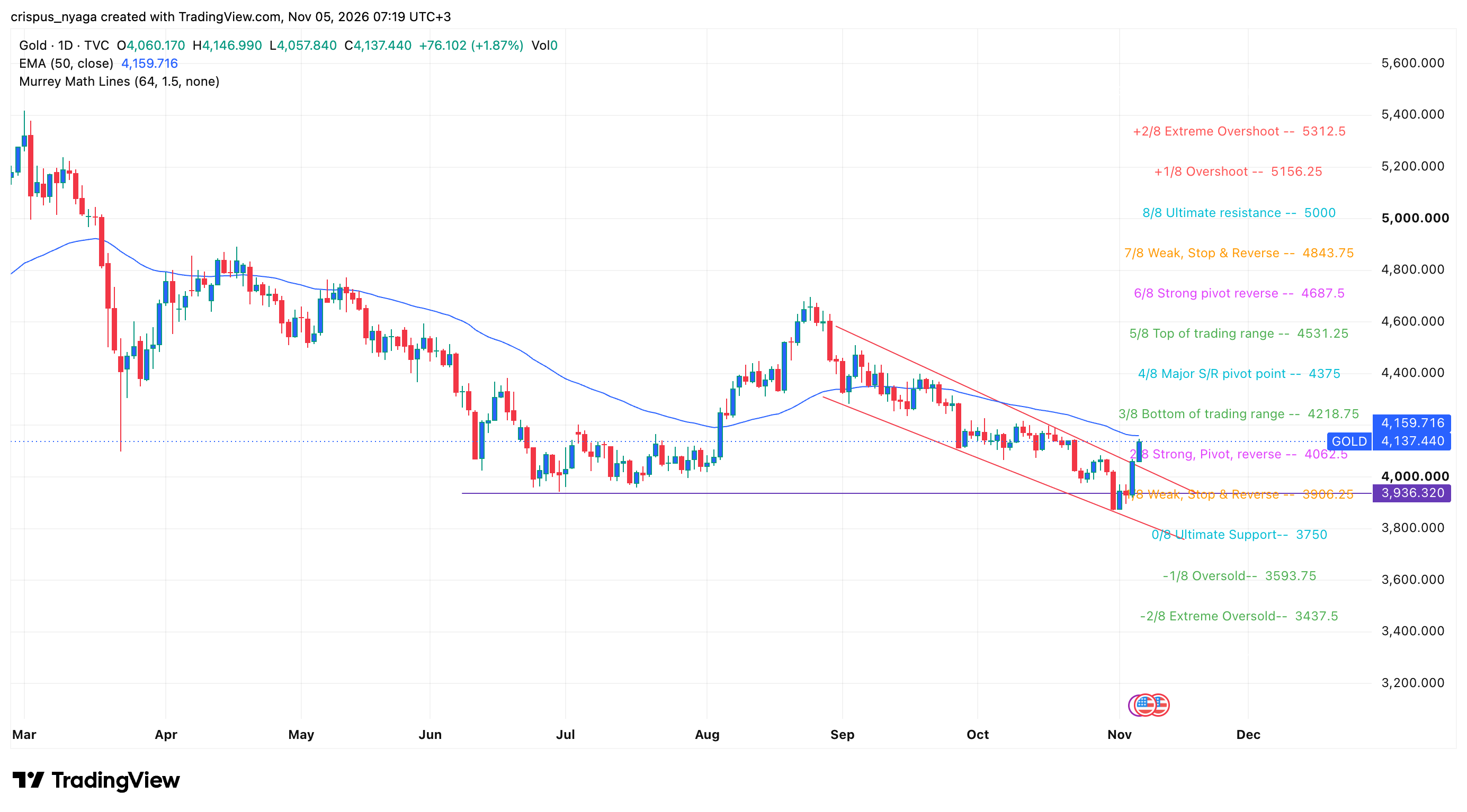
Gold price chart | Source: TradingView

The daily chart shows that gold has staged a strong recovery in the past few days. It has now moved above the important level of $3,936, its lowest level in June. 

Gold has also jumped above the Strong, Pivot, Reverse level of the Murrey Math Lines tool, confirming the bullish breakout. It has also spiked above the upper side of the descending channel.

Gold is now attempting to jump above the 50-day moving average. If this happens, the rally may continue, pushing it to the Major S/R pivot point of the Murrey Math Lines tool at $4,375. 

The post Gold price forecast: Can the rally last as oil slides before US nonfarm payrolls? appeared first on Invezz

A toll road doesn’t stop collecting tolls because interest rates rise. The owner can still feel the squeeze when its debt comes due. That’s the tension for infrastructure investors after the Bank of Canada lifted its policy rate to 2.5% on October 28. The appeal is essential assets producing dependable cash, with enough growth left after financing costs to keep the investor’s payment moving higher.

Source: Getty Images

Rising rates have two sides

Infrastructure often earns through long contracts, regulated prices, or charges linked to inflation. Those arrangements can help revenue rise as costs increase. Borrowing creates a separate exposure. Fixed-rate debt can delay the impact of higher rates, while refinancing or new projects eventually bring the market’s current cost of money into the business.

I’d judge a payout using growth per share or unit, because a bigger collection of assets doesn’t automatically improve each owner’s income. Issuing more units to fund acquisitions spreads future earnings across more investors. The best version of infrastructure investing produces cash growth that stays ahead of the extra financing and ownership claims needed to create it.

Brookfield is growing per-unit earnings

Brookfield Infrastructure Partners (TSX: BIP.UN) owns utilities, transport, midstream, and data infrastructure. That gives it several ways to earn from assets people and businesses keep using. Data capacity is one growth avenue, while established networks and transport assets provide cash from activities that already exist. I like that combination more than a payout dependent entirely on a future construction boom.

Second-quarter funds from operations (FFO) reached US$0.89 per unit, up 10% year over year. FFO is an adjusted operating-earnings measure commonly used for infrastructure. The company reported a 66% payout ratio in its supplemental materials. That leaves room for other commitments, with the growth showing the expanding asset base is reaching the earnings attached to each unit.

The quarterly distribution is US$0.455, up 6% from a year earlier, or US$1.82 annualized. A Canadian purchase needs a currency conversion before calculating its yield. At $1.3978 per U.S. dollar, the November 2 Bank of Canada rate, that annual payment is approximately $2.544 per unit. Against the recent $53.24 close, the yield is about 4.8%.

Turn the yield into income

A $10,000 budget buys 187 whole units before fees. The table converts the U.S.-dollar distribution at that same exchange rate, with future Canadian payments changing as the dollar moves.

COMPANYRECENT PRICENUMBER OF SHARESANNUAL DIVIDENDANNUAL TOTAL PAYOUTFREQUENCYTOTAL INVESTMENTBIP.UN$53.24187$2.5440$475.73Quarterly$9,955.88

That’s an average of about $39.64 a month, paid quarterly. The underlying annual distribution would be US$340.34 for the holding. I’d focus on its ability to grow that payment in its declared currency, while leaving some flexibility in a Canadian household budget. Exchange rates can improve or reduce the converted amount even when Brookfield leaves the distribution unchanged.

Financing still gets a vote

New projects and acquisitions can support growth, but higher borrowing costs raise the return they need to earn. Asset sales help recycle capital, although they also remove the cash those assets used to generate. I’d want replacement investments to add more than the company gives up. Strong operating growth helps with that task, while an expensive acquisition could undo part of the benefit.

I’d buy gradually for long-term dividend income, keeping the holding modest if the account already has substantial property and utility exposure. These investments share sensitivity to financing conditions. The next increase has to be earned through operating growth and sensible investment, which is why I wouldn’t assume the recent payout increase repeats automatically.

Bottom line

Brookfield Infrastructure has the operating growth and payout cushion to make continued increases plausible. I’d keep adding in stages, with expectations centred on rising per-unit cash generation. Higher rates make disciplined financing more valuable, giving well-chosen projects and useful existing assets a chance to earn their place in tomorrow’s income stream.


Alan White


5 min read03 November

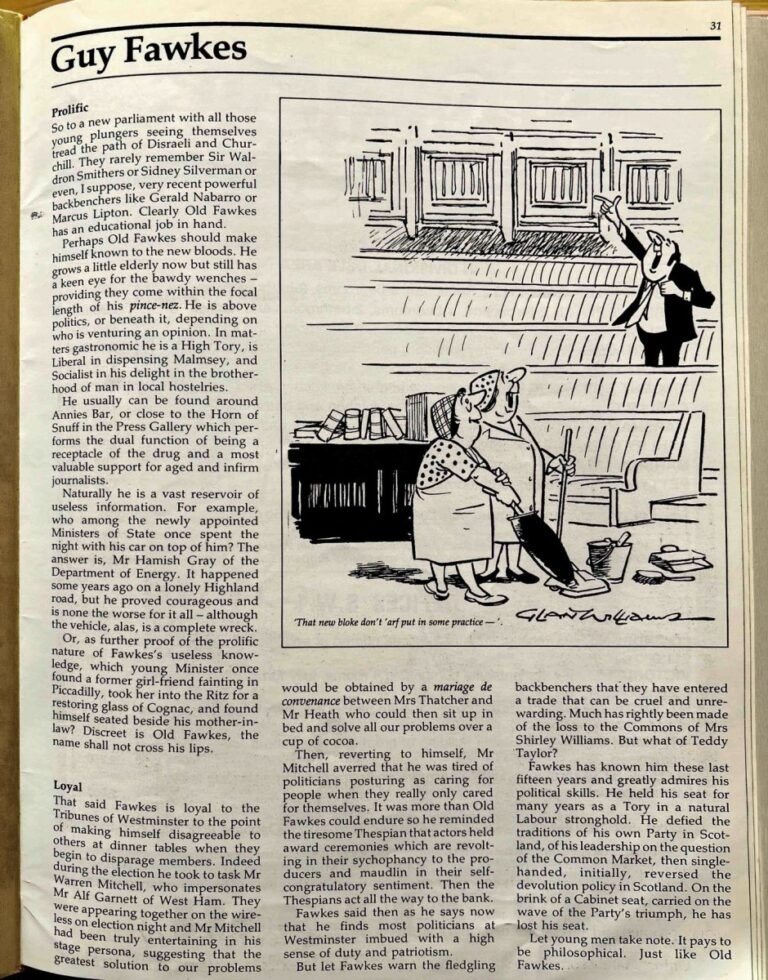
Gossip has always been a key element of parliamentary life. Alan White looks through the archives at how the early magazine covered it

Any historian worth their salt knows that if you really want to understand British political history, you can’t simply research the words spoken in the Chamber or the documents that track the evolution of policy. Politics is an activity undertaken by people, and by people who gossip a lot.

Long before the popular right-wing blog of the same name, a different Guido Fawkes was supplying parliamentarians with their weekly quota of tittle-tattle. This Guido made his debut in the first issue of The House as its diarist, and there is no more joyous a way to step inside the Parliament of 50 years ago than to read his old columns.

After the 1979 election, Guido dedicated a few lines of his diary to describe himself to the new intake: “He is above politics, or beneath it, depending on who is venturing an opinion. In matters gastronomic he is a High Tory, is Liberal in dispensing Malmsey, and Socialist in his delight in the brotherhood of man in local hostelries. He usually can be found around Annie’s Bar, or close to the Horn of Snuff in the Press Gallery, which performs the dual function of being a receptacle of the drug and a most valuable support for aged and infirm journalists.”

Fawkes was fond of his fellow scribes, though like all good hacks was wont to take great pleasure in their screw-ups and keen to offer sympathies to editors: “The correction which appears in the current edition of that valuable little reference book, Dod’s Parliamentary Companion, is something of a collectors’ item. It reads ‘Reference to Lord Gibson on page 122. For National Front read National Trust.’”

And for all his mirth-making, he did not hold the politicians around him in low regard either. He describes being on TV with Warren Mitchell, who when out of character (House readers of a certain vintage will remember his comic creation, the West Ham fan Alf Garnett) proceeded to moan about how they only care for themselves. “It was more than Old Fawkes could endure, so he reminded the tiresome thespian that actors hold award ceremonies which are revolting in their sycophancy.”

Indeed, he was always quick to give kudos to moments of wit from the parliamentarians. One of his favourite stories (so good he actually ended up telling it twice, perhaps due to a slow gossip week) involved shadow Scotland secretary Teddy Taylor at a televised hustings, where the subject under discussion was censorship. Taylor was being heckled by a noisy group on this issue, while another individual in the crowd was shouting at him regarding his position on Rhodesia.

Fawkes described how he asked the censorship group whether they’d be happy for him to tell the man to be quiet. They assented. “‘Now you shut up’, said Master Teddy to the heckler, ‘and, as for the rest of you, you are in favour of censorship now and we’re only haggling about what we intend banning.’”

His happy place was clearly in the friction between the media and those they cover; he recorded with much joy how William Rees-Mogg’s Times had printed an attendance record of Members (time is something of a flat circle, you might conclude), prompting “the enterprising rascals in the Scottish National Party” to do the same thing to the press gallery “with dire results”.

The faltering workings of the Palace also provided a rich seam of material. In 1977, the lift to the press gallery broke down, which prompted a booze shortage, and a heart-rending ballad from Fawkes:

I know not whether unions be right
Or whether they tell a lie
I only know the liftmen stay out
And the gallery is very high
And 107 steps lead to the top
Where the bar has run quite dry
And every seat along its walls
Is lined with folk in pain
And Fawkes the Scribe looks in the Bar
Where men their brothers maim

He was even more horrified by the “new space age digital clocks which now loom over the Commons Chamber… What next! Will the Serjeant’s rapier be replaced by a laser-beam lamp?”

Fawkes’ bond with his readers clearly developed over the years, to the point where he was even sharing his romantic misfortunes. On one occasion, he was asked to conduct a beautiful Swedish woman around the House, a “task close to the aged villain’s heart”. She asked to be introduced to an MP and Fawkes, keen to avoid such “dashing plungers as Master Andrew Faults, Master Hugh Dykes, or worst of all the Foreign Secretary”, alighted on David James MP.

“Disaster. The unassuming Tory stood up and addressed her in faultless Swedish. She began to enquire about his Scandinavian experiences and soon he was, modestly, explaining that he had sailed around Cape Horn in a windjammer from a Finnish port with a Swedish crew… And yes, he knew Stockholm for he had been smuggled into the port when he ‘scaped from a prisoner of war camp.”

So, the question is: who was he? Well, The House can reveal, exclusively, that Guy Fawkes was in fact the pen name of the left-wing journalist Hugh Macpherson, who was the political editor of Tribune and, somewhat unexpectedly (a shame we don’t see more of this these days: look what the culture wars have taken from us), also wrote regularly for The Spectator.

Macpherson plied his trade in the days when writers’ bylines were unlikely to be preserved forever by the internet, but we do find mention of him in a Tribune piece about how the Labour left would frequently meet in the Gay Hussar, Soho, where he once castigated Mo Mowlam with such enthusiasm over Tony Blair’s policies that she “put her napkin over her head”. A proper hack, it feels safe to say. 

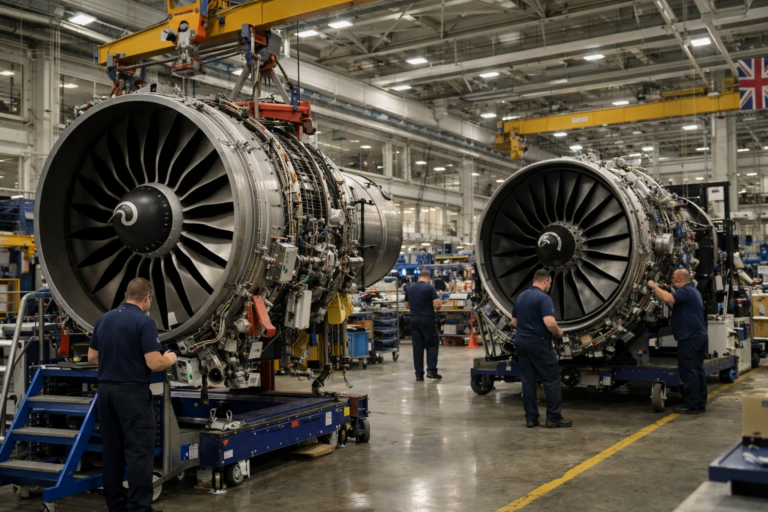
Rolls-Royce’s share price has held steady over the past few weeks, moving up from a year-to-date low of 1,159p to the current 1,264p. Still, it remains well below its year-to-date high of 1,586p. Despite the weakness, Morningstar analysts believe the stock will rebound by about 20% to 1,520p.

Morningstar analysts expect Rolls-Royce stock to rebound

In a recent post, Ollie Smith, a Morningstar analyst, said that he believes that the company’s fair value is at 1,520p. If the stock moves to this level, it will be a 20% jump from where it is today.

The analyst believes that the company will continue to see strong demand for its products in the coming years. Most notably, he sees the company benefiting from the ongoing rearmament by European governments and the supercycle in the civil aviation industry. He added:

“Investors will have to wait for Rolls-Royce’s next trading update on Nov. 12 to find out if there is a material change to that picture, and whether the company thinks 2027 will give 2025’s incredible defense stock gains a run for their money.”

Next week’s earnings to provide color on its business

Rolls-Royce stock dropped after its top competitors published its financial results. GE Aerospace and Safran released earnings, which showed that their businesses were doing well, but facing challenges. 

Safran’s main issue was that the aftermarket business was struggling as airlines reduced their flights amid the rising jet fuel prices. GE Aerospace, on the other hand, released results that beat analysts’ estimates. However, the company’s forward guidance for the fourth quarter was moderately lower than expected. It also noted that costs remained a major challenge. On the positive side, these stocks have started to pare back their losses in the past few days. 

Looking forward, the next important catalyst for Rolls-Royce shares will be the upcoming earnings report, which will provide more information about its financial results.

The most recent earnings report showed that its underlying profit rose by 46% in the first half of the year to £2.5 billion. Most notably, despite the challenges in the aviation industry, the company raised its full-year estimate. 

The company’s free cash flow rose to £2 billion, helped by the higher underlying profit. Rolls-Royce expects that its full-year underlying profit will be between £4.7 billion and £4.9 billion. 

Rolls-Royce share price technical analysis

Rolls-Royce

RR stock chart | Source: TradingView

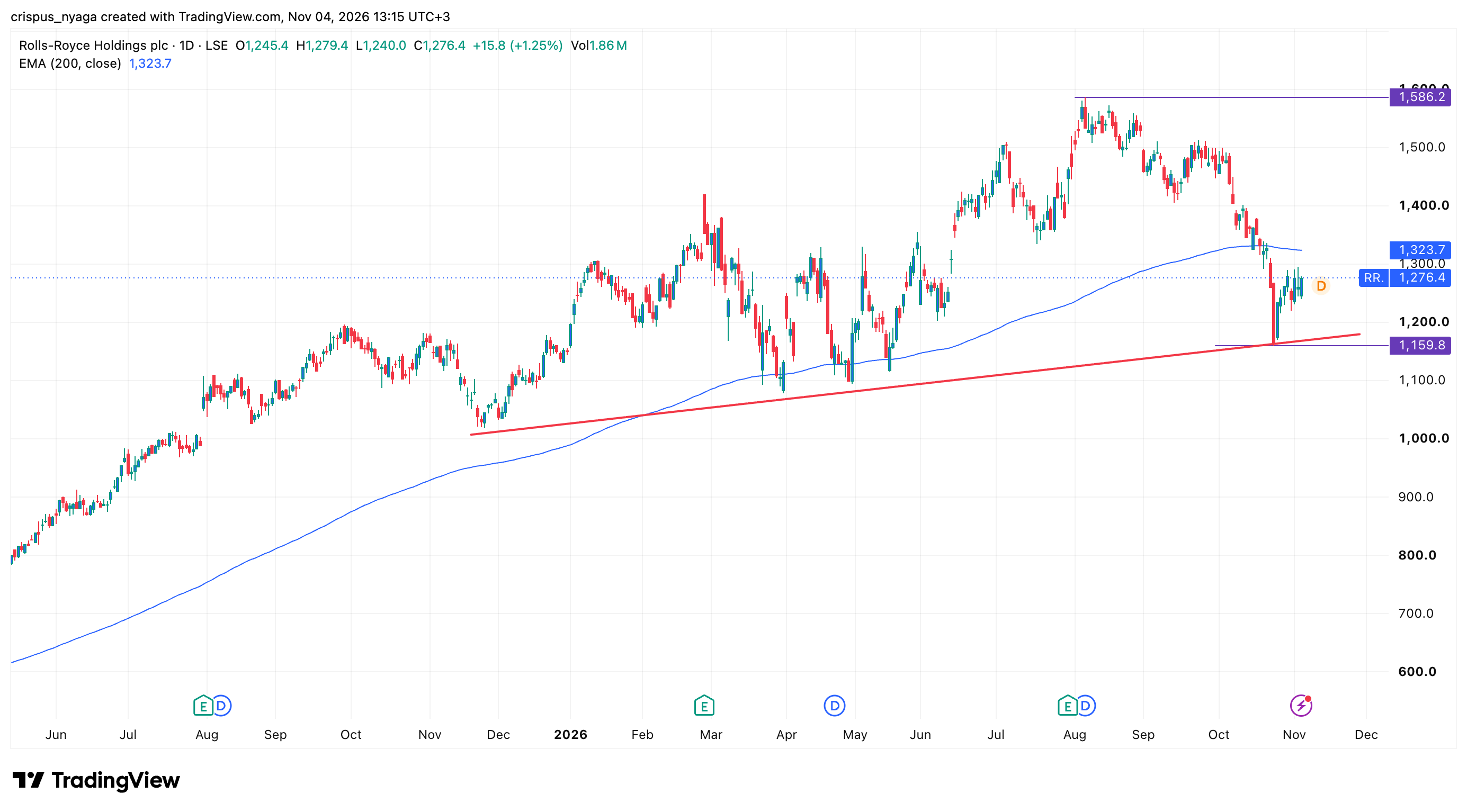
The daily chart shows that the RR stock price crashed to 1,159p late October as GE and Safran published their results. It then bounced back to the current 1,275p as investors bought the dip in industrial names. 

The rebound happened because its lowest level coincided with the ascending trendline that links the lowest levels since November last year. 

The challenge, however, is that the stock remains capped below the 200-day moving average and is forming a bearish flag pattern. Therefore, the stock will likely remain on edge in the near term and possibly rebound if the US-Iran war ends.

READ MORE: Rolls-Royce stock is falling fast this month: Is a rebound possible?

The post Morningstar analyst sees Rolls-Royce stock jumping to 1,520p: will it? appeared first on Invezz

Duolingo stock is rising today, November 4, as investors react to an earnings report showing that revenue growth accelerated last quarter. DUOL climbed to $147, up 15% from its lowest point this week. So, will these gains hold, or is this a dead-cat bounce?

Duolingo’s business continued growing despite AI disruption

DUOL stock has been in a steep downtrend over the past few months as investors weighed the potential disruption from artificial intelligence (AI) tools. It also fell after the company shifted its focus away from profitability and toward user and revenue growth.

There are signs that Duolingo’s business is doing well. Its earnings report showed that its daily active users soared to 64.9 million, up by 29% from a year earlier. The number of paid subscribers also continued rising, reaching 13.1 million, up by 14% from a year earlier. 

Duolingo’s revenue rose by 14% to $309 million, with its bookings hitting 316 million. The company made a net income of $27.2 million, giving it a net profit margin of 8.8%. Its revenue and user growth was partly due to its partnerships, including with games like Brawl Stars and Eggy Party.

Duolingo stock also jumped as the company published its share repurchase data. It repurchased shares worth about $6.4 million as part of its $400 million program announced in February.

The management expects the company’s growth to continue in the fourth quarter. It expects that its revenue will be $382 million, much higher than the $321 million that analysts were expecting. Even the most optimistic analyst expected the revenue to hit $331 million.

For the year, the company expects revenue to be $1.29 billion, much higher than the expected $1.22 billion. The same is true with the adjusted EBITDA, which is expected to jump to $84 million and $323 million.

Analysts are relatively bullish about Duolingo shares. Evercore’s Mark Mahaney reiterated his outperform rating, while Goldman Sachs’ Eric Sheridan hiked his target from $114 to $135. Morgan Stanley’s Nathan Feather hiked the target of $140. The other highly optimistic analysts are from DA Davidson and Wedbush.

Duolingo stock price analysis

DUOL stock chart | Source: TradingView

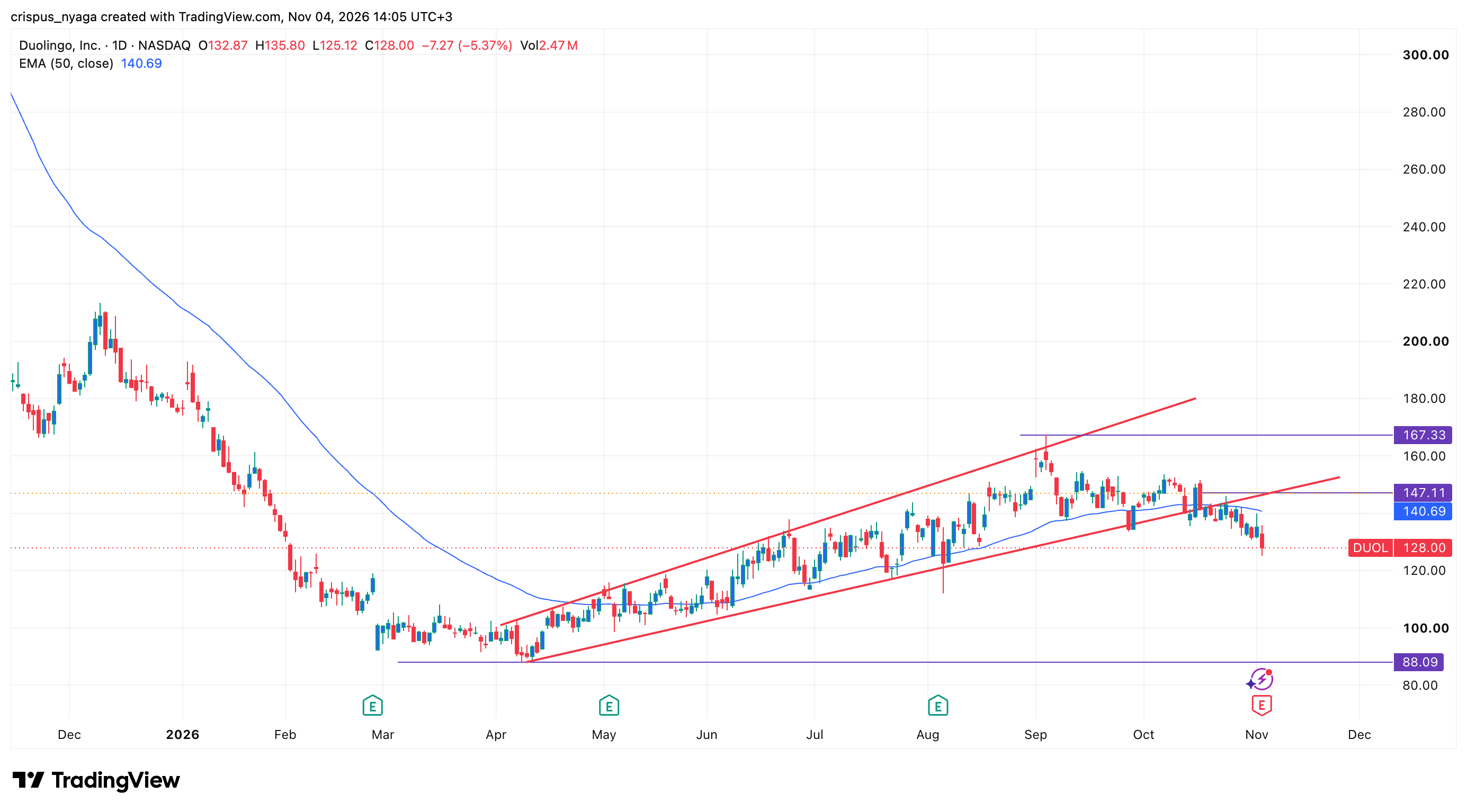
The daily chart shows that the Duolingo stock has been in a downward trend in the past few weeks. It dropped from $167 in September to a low of $128 before its earnings report on Tuesday.

Before the retreat, the stock was forming a megaphone pattern. This pattern normally leads to more upside over time. Therefore, the most likely scenario is where the stock continues rising, potentially to the key resistance level of $167. 

The post Duolingo stock is soaring after its earnings: will these gains hold? appeared first on Invezz

Fortis (TSX: FTS) has long been viewed as one of the best long-term investments to consider. And now, there’s one more reason for that belief to continue. Fortis announced a 4% dividend increase this week during its latest quarterly update.

This means that Fortis extends its dividend increase to 53 consecutive years, the second-longest of any stock in Canada. The company also extended that growth guidance through 2031.

That means a higher payout today and a longer outlook for further increases. But does this make Fortis worth adding to an income portfolio?

Source: Getty Images

53 consecutive years of increases

The latest increase has Fortis bumping the quarterly dividend to $0.67 per share. The first payment at that new rate will be December 1, with an ex-dividend date of November 17.

The new rate calls for an annual dividend of $2.66, and management calls for additional annual bumps of 4% to 6% through 2031.

The benefit for existing shareholders is additional income without buying more. Investors who opt to reinvest those payments can build their portfolio further and allow future increases to buy additional shares.

Additionally, the guidance on future increases helps set expectations. Investors with longer-term timelines may feel more comfortable knowing that additional increases are being planned for.

What supports further dividend growth through 2031?

Fortis operates regulated electric and gas utilities in Canada, the U.S. and the Caribbean. Fortis invests in infrastructure needed to deliver energy, with regulators determining the rates they can charge and the returns they are allowed to earn.

This means that Fortis generates a recurring and stable revenue stream that leaves room for growth investment and for that quarterly dividend.

Fortis’s new five-year capital plan totals $32.2 billion. That’s an increase of $3.4 billion from the previous plan. The company expects the investments to support compound annual rate-base growth of 7.5% through 2031.

That includes spending on transmission projects at ITC and infrastructure at FortisBC.

The rate base is the value of Fortis’ utility assets on which regulators allow a return. Its growth gives Fortis a path to higher earnings, but rate-base growth doesn’t automatically translate into the same growth in earnings per share.

In the most recent quarter, Fortis reported adjusted earnings of $0.92 per share, up from the $0.87 per share reported in the same period last year.

Is Fortis worth buying for income?

As of the time of writing, Fortis offers a yield of 3.1%. That’s not the highest yield on the market, but it can provide investors looking to build an income stream a great starting point.

The fact that Fortis has over half a century of annual increases to that dividend behind it makes it an even more appealing investment. That’s because a rising payout can help offset higher expenses in future years, while also rewarding patience.

In short, Fortis provides a necessary service, generates reliable income and continues to record annual upticks to its dividend.

In my opinion, Fortis is a great long-term option to hold in a well-diversified portfolio.

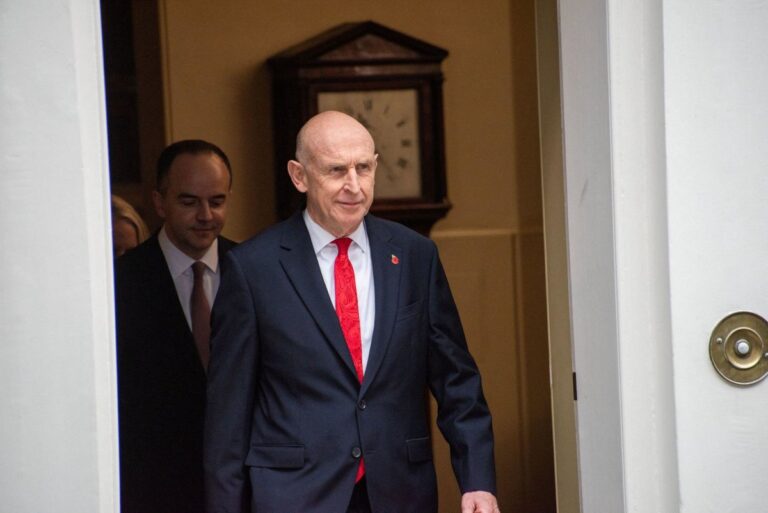
The Chancellor John Healey walks out 11 Downing Street on Budget Day. | (Alamy)


Harriet Symonds


4 min read03 November

John Healey has pledged that former miners will receive their remaining pension funds following a Labour MP backlash on the eve of last week’s Budget.

On Tuesday, the Chancellor told MPs that ex-miners would receive “every penny” of the pension fund and said work is happening to ensure that happens “in weeks, not months”. 

“Every penny of the pension fund surplus will go to miners,” he told the House of Commons.

“I know the job’s not done. I will go on to ensure the full transfer of the guarantors fund. I want a way to resolve this in weeks, not months.

“That work is underway. That work will be done jointly by DESNZ (Department for
Energy Security & Net Zero) and the Treasury,” the Chancellor said. 

In his Budget speech last Wednesday, Healey pledged the “full transfer of the Guarantor’s Fund”, believed to be worth £1.2bn, and promised to end the “standstill arrangement”, ensuring the pensions continue to rise for former miners.

The night before, a group of Labour MPs representing former mining seats expressed fury after being told that the government planned to renege on its pledge to transfer what remains of the Mineworkers’ Pension Scheme (MPS).

As reported by PoliticsHome last week, the MPs made urgent representations to No 10, the Treasury and the whips in an attempt to persuade the government to rethink.

Normanton and Hemsworth MP John Trickett told PoliticsHome on the night: “We owe a moral duty to the miners and the government must show that it has listened, understands and will act in this matter. Nothing less will do.”

Another Labour MP, Kate Osbourne, told PoliticsHome: “I will continue to push for us to deliver in full on our promise to end this injustice and ensure former miners and their widows receive the pensions they deserve.”

Former chancellor Rachel Reeves ended a 30-year-old arrangement in her first Budget in 2024 by transferring the first part of the fund (£1.5bn) to former miners. 

On Tuesday, sources close to Reeves told PoliticsHome the issue was very important to her and that, as chancellor, she met with many people directly impacted by it.

The latest statement from Healey on Tuesday was in response to Scottish Labour MP Imogen Walker, who asked for an updated timeline for the return of the pension fund.

“There is more to do and time is pressing,” she said, adding: “They deserve every penny of their pensions”.

PoliticsHome understands the Chancellor informed MPs at a meeting of the Parliamentary Labour Party on Monday night that he is working with trustees of the MPS to ensure ex-miners receive what is owed within a matter of weeks. 

Last week, the Coalfield Group of Labour MPs wrote to Healey demanding the immediate release of the £1.2bn fund.

Signed by MPs including Luke Akehurst, Rachel Taylor and group chair Grahame Morris, the letter urges Healey and Prime Minister Andy Burnham to “prove to miners and their families that this Labour government is on their side”.

“Since 1994, the government has taken more than £4.4bn from the MPS in return for a guarantee that has never cost the public purse a penny,” the MPs write.

“We understand the fiscal pressure of the Treasury, however, in light of the facts, we cannot see a justification for withholding the money that belongs to scheme members alone.”

On Monday, Reform UK urged the government to pay the remaining pension fund before Christmas and promised that ex-miners would be paid what is owed within the first 100 days of a Nigel Farage-led government. 

“Enough is enough. Miners and their families have waited too long. Tragically, 18 ex-miners die every day without the fair resolution of this matter they deserve,” Robert Jenrick and Lee Anderson said in a joint statement.


Insider Brief

  • France’s Bleu Robotics has raised €5 million in pre-seed funding to develop AI software designed for teaching humanoid robots new factory tasks with fewer demonstrations and reducing deployment time.
  • Contrarian Ventures and OVNI Capital co-led the round, with participation from Kvanted, WEPA and Charlie Songhurst, alongside angel investor Lukas M. Ziegler.
  • Bleu said its software can teach tasks from as few as 10 demonstrations, works across different humanoid platforms and is already being deployed with automotive manufacturers and WEPA.

France’s Bleu Robotics has raised €5 million in pre-seed funding to develop AI software designed to teach humanoid robots new factory tasks with fewer demonstrations and shorten the time required to put them to work.

Contrarian Ventures and OVNI Capital co-led the round, with participation from Kvanted, WEPA and technology investor Charlie Songhurst, according to a joint LinkedIn announcement with angel investor Lukas M. Ziegler.

The Paris-based startup is developing software for industrial humanoid robots that learns from demonstrations performed by human operators. Rather than training a robot on large datasets for each task, Bleu said its system identifies the intended goal and constraints behind an operator’s demonstration and uses that information to reproduce the task.

Bleu is working to make a full humanoid deployment process take less than one hour. The company noted a robot can learn a new industrial task from as few as 10 demonstrations, with operators teaching it directly at the workstation without writing code. This will let manufacturers adapt robots as production needs change, reducing the training and integration work required for each new task.

Training Robots on the Factory Floor

Bleu said its software is designed to work across different humanoid platforms and allow robots to be retrained as production requirements change or when they are moved to another location.

The company also claimed its approach can deliver more than 99% accuracy for production tasks and use up to 100 times less data than alternative approaches. Those performance figures were presented in the funding announcement and were not accompanied by testing methodology or benchmark details.

Bleu said its first deployments are already underway with major automotive manufacturers and WEPA, a European hygiene-paper producer. The announcement did not identify the automotive companies.

The company was founded by Benoît Berkoukchi, Jean-Baptiste Mouret and Serena Ivaldi. Berkoukchi previously managed assembly-line teams at Renault, while Mouret and Ivaldi are research directors at France’s INRIA research institute, according to the announcement.

Since late August, gold spot prices have dived by nearly 16%, while silver has plunged roughly 30%. A technology sector-led selloff has triggered selling across metals of late, while persistent inflation and expectations of prolonged high interest rates added pressure. Copper miners have been dragged lower, too, even as some producers benefit from stronger copper prices. But metal prices aren’t the only force pressuring mining shares.

In this article, I’ll look at what’s dragging down gold, silver, and copper miners and discuss two Canadian mining stocks worth watching.

Source: Getty Images

Why Canadian mining stocks keep sliding

It’s important to understand that gold’s safe-haven reputation offers little protection when investors sell assets to raise cash. During a market selloff, investors may sell profitable positions to cover losses elsewhere or reduce their overall exposure to risk. This is one of the key reasons why gold stocks can come under pressure even when concerns about the broader economy remain elevated.

In addition, share prices of metals and mining companies reflect not only metal prices but also production costs, operating performance, and expectations for future profits. When gold and silver prices decline, investors may start anticipating weaker margins, even if the companies recently reported strong earnings. This combination of falling commodity prices and cautious market sentiment can put additional pressure on TSX-listed mining stocks.

Silver and copper face additional worries about industrial demand, deepening the pressure on mining shares. But still, recent declines don’t necessarily mean every miner’s business has deteriorated.

Now, let me quickly highlight two top TSX mining stocks that I think are worth keeping on your radar despite the recent weakness in the mining sector.

Pan American Silver stock

Pan American Silver (TSX: PAAS) deserves a closer look amid the selloff. Based in Vancouver, it produces silver and gold across the Americas. Its shares currently trade at $52.99 apiece, with a $22 billion market cap and a 1.9% annualized dividend yield. This mining stock has slipped 26% year to date.

Nevertheless, its financial growth trend remains strong as Pan American’s revenue rose about 38% year-over-year (YoY) in the second quarter, helped by stronger realized metal prices. Silver production rose 27% YoY, backed mainly by La Colorada and Juanicipio. As a result, the mining firm’s adjusted earnings nearly doubled to US$308 million, while attributable free cash flow climbed 47%.

Pan American’s long-term outlook also benefits from its substantial mineral reserves. In September, the company reported 511.1 million ounces of silver and 6.3 million ounces of gold in proven and probable reserves, having replaced more silver reserves than it mined.

With La Colorada Skarn and a US$146 million initial development phase at Timmins moving forward, its cash generation and growth opportunities could make the recent share-price weakness worth a closer look.

Capstone Copper stock

Capstone Copper (TSX: CS) shares have also slid despite strong earnings. Operating in the United States, Mexico and Chile, it ended October 2026 at $11 per share with an $8.4 billion market cap. Notably, its shares have lost 20% so far in 2026.

In the third quarter, the copper producer’s revenue surged 19% YoY as its realized copper price rose to US$6.61 per pound from US$4.49. As a result, Capstone’s adjusted net profit for the quarter almost doubled to US$93.8 million. But its copper production fell 18% YoY to 45,218 tonnes after maintenance disruptions, lower ore grades and weaker cathode output.

On the brighter side, its Mantoverde expansion offers growth potential, targeting about 20,000 tonnes of additional annual copper output as operations ramp up toward sustained higher throughput in early 2027. Also, its planned Cozamin sale could strengthen the balance sheet further.

For investors willing to weather short-term volatility in metals prices, this mining stock’s growth plans offer many reasons to keep watching.